

11 Label-Free Super-Resolution Microscopy by Nonlinear …
281
its measurement is challenging. Nonlinear PA signal is even weaker but carries the
potential for achieving enhanced resolution in microscopy [50] as well as improved
feedback for noninvasive focusing through scattering media.
To increase the SNR in PA detection, and extract nonlinear PA signals, a modulation and lock-in detection scheme is used as feedback for adaptive focusing through
scattering media [51]. Lock-in detection of PA signals, excited by optical pulses,
requires several signal processing preparation steps in order to extract the modulation envelope. Figure 11.14 depicts the analog detection scheme that converts a
modulated pulse train to a step-modulated signal. This step signal, containing the
amplitude of the original PA signal, is fed into a lock-in amplifier. The demodulated
PA amplitude is transferred to the computer to feed the optimization algorithm.
The photo-modulation is performed using an AOM (AA optoelectronic, MTS110)
driven by an arbitrary function generator, as in the NPMR experiments, and nonlinear
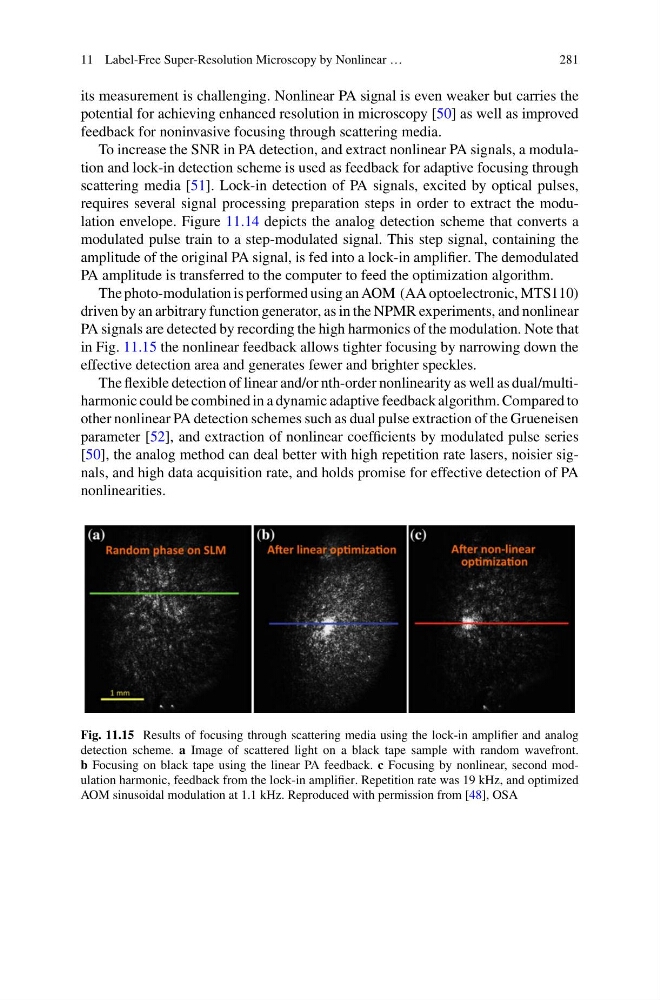
PA signals are detected by recording the high harmonics of the modulation. Note that
in Fig. 11.15 the nonlinear feedback allows tighter focusing by narrowing down the
effective detection area and generates fewer and brighter speckles.
The flexible detection of linear and/or nth-order nonlinearity as well as dual/multiharmonic could be combined in a dynamic adaptive feedback algorithm. Compared to
other nonlinear PA detection schemes such as dual pulse extraction of the Grueneisen
parameter [52], and extraction of nonlinear coefficients by modulated pulse series
[50], the analog method can deal better with high repetition rate lasers, noisier signals, and high data acquisition rate, and holds promise for effective detection of PA
nonlinearities.
Fig. 11.15 Results of focusing through scattering media using the lock-in amplifier and analog
detection scheme. a Image of scattered light on a black tape sample with random wavefront.
b Focusing on black tape using the linear PA feedback. c Focusing by nonlinear, second modulation harmonic, feedback from the lock-in amplifier. Repetition rate was 19 kHz, and optimized
AOM sinusoidal modulation at 1.1 kHz. Reproduced with permission from [48], OSA
281
its measurement is challenging. Nonlinear PA signal is even weaker but carries the
potential for achieving enhanced resolution in microscopy [50] as well as improved
feedback for noninvasive focusing through scattering media.
To increase the SNR in PA detection, and extract nonlinear PA signals, a modulation and lock-in detection scheme is used as feedback for adaptive focusing through
scattering media [51]. Lock-in detection of PA signals, excited by optical pulses,
requires several signal processing preparation steps in order to extract the modulation envelope. Figure 11.14 depicts the analog detection scheme that converts a
modulated pulse train to a step-modulated signal. This step signal, containing the
amplitude of the original PA signal, is fed into a lock-in amplifier. The demodulated
PA amplitude is transferred to the computer to feed the optimization algorithm.
The photo-modulation is performed using an AOM (AA optoelectronic, MTS110)
driven by an arbitrary function generator, as in the NPMR experiments, and nonlinear
PA signals are detected by recording the high harmonics of the modulation. Note that
in Fig. 11.15 the nonlinear feedback allows tighter focusing by narrowing down the
effective detection area and generates fewer and brighter speckles.
The flexible detection of linear and/or nth-order nonlinearity as well as dual/multiharmonic could be combined in a dynamic adaptive feedback algorithm. Compared to
other nonlinear PA detection schemes such as dual pulse extraction of the Grueneisen
parameter [52], and extraction of nonlinear coefficients by modulated pulse series
[50], the analog method can deal better with high repetition rate lasers, noisier signals, and high data acquisition rate, and holds promise for effective detection of PA
nonlinearities.
Fig. 11.15 Results of focusing through scattering media using the lock-in amplifier and analog
detection scheme. a Image of scattered light on a black tape sample with random wavefront.
b Focusing on black tape using the linear PA feedback. c Focusing by nonlinear, second modulation harmonic, feedback from the lock-in amplifier. Repetition rate was 19 kHz, and optimized
AOM sinusoidal modulation at 1.1 kHz. Reproduced with permission from [48], OSA