

11 Label-Free Super-Resolution Microscopy by Nonlinear …
271
timescale, electronic energy is transferred to lattice via electron–phonon coupling,
and the volume of the thermally-induced phase transition expands. Cooling processes follow, and the reverse transition into the insulator state occurs in hundreds
of picoseconds.
These photo-thermal properties can be used to realize SR. By fine-tuning the
pump-laser fluence to be slightly above the phase transition threshold, only the intense
center of the pump beam will induce the phase transition, invoking the narrowing of
the PSF via NPMR.
The experiments were performed on a patterned granular film of VO 2 (~100 nm
thick), on a silicon substrate. The samples comprised ~150 nm wide lines of polycrystalline nanoparticles, in which the phase transition may occur at somewhat different temperatures or laser fluences depending on nanoparticle size [33]. The samples
were scanned at varying pump fluences to characterize the onset of the photo-induced
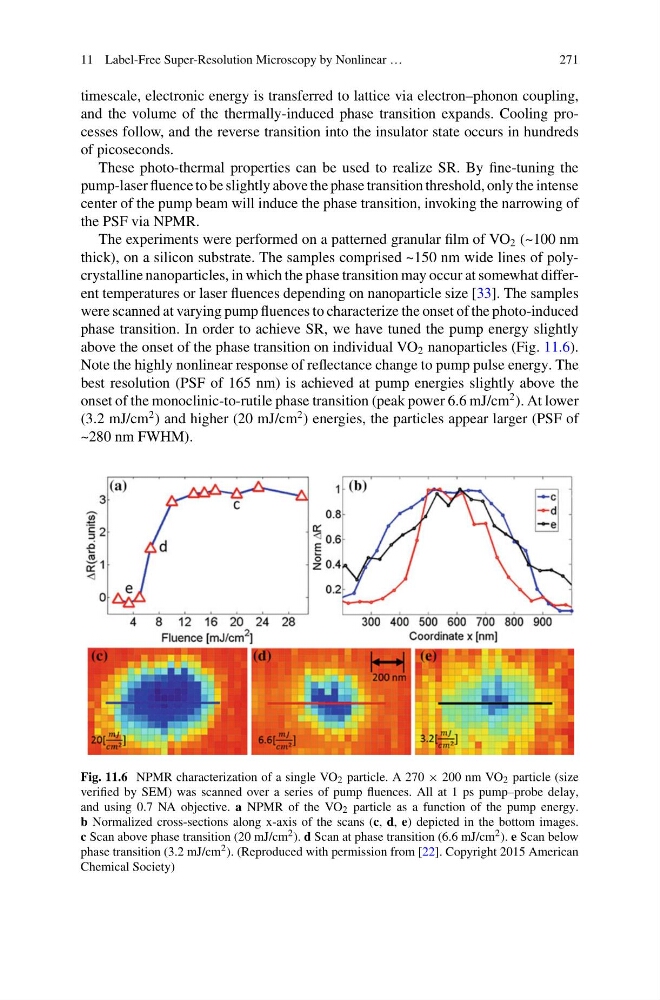
phase transition. In order to achieve SR, we have tuned the pump energy slightly
above the onset of the phase transition on individual VO 2 nanoparticles (Fig. 11.6).
Note the highly nonlinear response of reflectance change to pump pulse energy. The
best resolution (PSF of 165 nm) is achieved at pump energies slightly above the
onset of the monoclinic-to-rutile phase transition (peak power 6.6 mJ/cm
2 ). At lower
(3.2 mJ/cm
2 ) and higher (20 mJ/cm
2 ) energies, the particles appear larger (PSF of
~280 nm FWHM).
Fig. 11.6 NPMR characterization of a single VO 2 particle. A 270 × 200 nm VO 2 particle (size
verified by SEM) was scanned over a series of pump fluences. All at 1 ps pump–probe delay,
and using 0.7 NA objective. a NPMR of the VO 2 particle as a function of the pump energy.
b Normalized cross-sections along x-axis of the scans (c, d, e) depicted in the bottom images.
c Scan above phase transition (20 mJ/cm 2 ). d Scan at phase transition (6.6 mJ/cm 2 ). e Scan below
phase transition (3.2 mJ/cm 2 ). (Reproduced with permission from [22]. Copyright 2015 American
Chemical Society)
271
timescale, electronic energy is transferred to lattice via electron–phonon coupling,
and the volume of the thermally-induced phase transition expands. Cooling processes follow, and the reverse transition into the insulator state occurs in hundreds
of picoseconds.
These photo-thermal properties can be used to realize SR. By fine-tuning the
pump-laser fluence to be slightly above the phase transition threshold, only the intense
center of the pump beam will induce the phase transition, invoking the narrowing of
the PSF via NPMR.
The experiments were performed on a patterned granular film of VO 2 (~100 nm
thick), on a silicon substrate. The samples comprised ~150 nm wide lines of polycrystalline nanoparticles, in which the phase transition may occur at somewhat different temperatures or laser fluences depending on nanoparticle size [33]. The samples
were scanned at varying pump fluences to characterize the onset of the photo-induced
phase transition. In order to achieve SR, we have tuned the pump energy slightly
above the onset of the phase transition on individual VO 2 nanoparticles (Fig. 11.6).
Note the highly nonlinear response of reflectance change to pump pulse energy. The
best resolution (PSF of 165 nm) is achieved at pump energies slightly above the
onset of the monoclinic-to-rutile phase transition (peak power 6.6 mJ/cm
2 ). At lower
(3.2 mJ/cm
2 ) and higher (20 mJ/cm
2 ) energies, the particles appear larger (PSF of
~280 nm FWHM).
Fig. 11.6 NPMR characterization of a single VO 2 particle. A 270 × 200 nm VO 2 particle (size
verified by SEM) was scanned over a series of pump fluences. All at 1 ps pump–probe delay,
and using 0.7 NA objective. a NPMR of the VO 2 particle as a function of the pump energy.
b Normalized cross-sections along x-axis of the scans (c, d, e) depicted in the bottom images.
c Scan above phase transition (20 mJ/cm 2 ). d Scan at phase transition (6.6 mJ/cm 2 ). e Scan below
phase transition (3.2 mJ/cm 2 ). (Reproduced with permission from [22]. Copyright 2015 American
Chemical Society)