

270
O. Tzang et al.
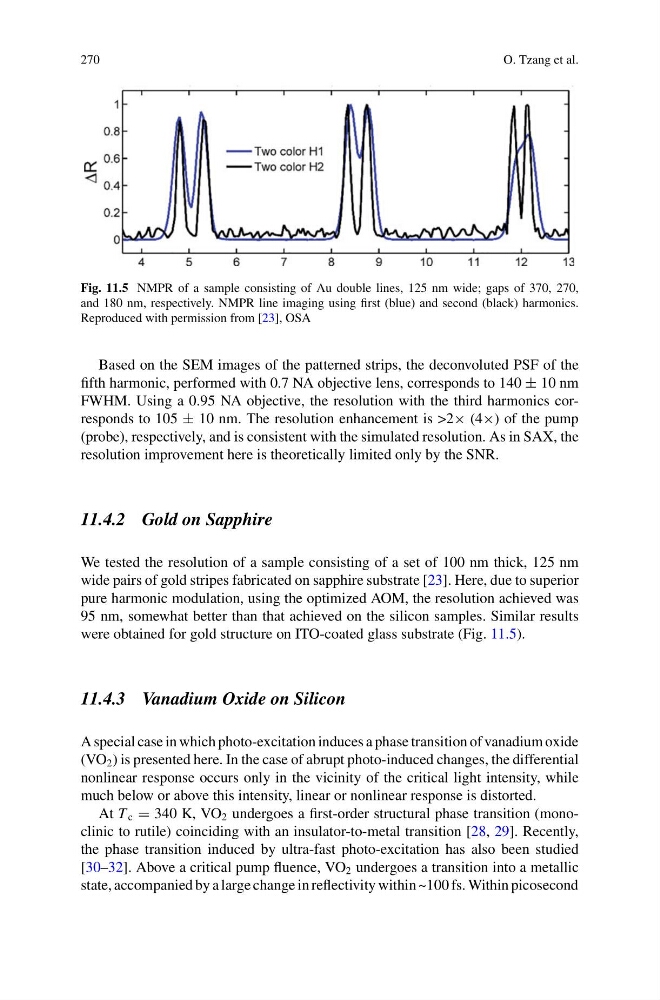
Fig. 11.5 NMPR of a sample consisting of Au double lines, 125 nm wide; gaps of 370, 270,
and 180 nm, respectively. NMPR line imaging using first (blue) and second (black) harmonics.
Reproduced with permission from [23], OSA
Based on the SEM images of the patterned strips, the deconvoluted PSF of the
fifth harmonic, performed with 0.7 NA objective lens, corresponds to 140 ± 10 nm
FWHM. Using a 0.95 NA objective, the resolution with the third harmonics corresponds to 105 ± 10 nm. The resolution enhancement is >2× (4×) of the pump
(probe), respectively, and is consistent with the simulated resolution. As in SAX, the
resolution improvement here is theoretically limited only by the SNR.
11.4.2 Gold on Sapphire
We tested the resolution of a sample consisting of a set of 100 nm thick, 125 nm
wide pairs of gold stripes fabricated on sapphire substrate [23]. Here, due to superior
pure harmonic modulation, using the optimized AOM, the resolution achieved was
95 nm, somewhat better than that achieved on the silicon samples. Similar results
were obtained for gold structure on ITO-coated glass substrate (Fig. 11.5).
11.4.3 Vanadium Oxide on Silicon
A special case in which photo-excitation induces a phase transition of vanadium oxide
(VO 2 ) is presented here. In the case of abrupt photo-induced changes, the differential
nonlinear response occurs only in the vicinity of the critical light intensity, while
much below or above this intensity, linear or nonlinear response is distorted.
At T c = 340 K, VO 2 undergoes a first-order structural phase transition (monoclinic to rutile) coinciding with an insulator-to-metal transition [28, 29]. Recently,
the phase transition induced by ultra-fast photo-excitation has also been studied
[30–32]. Above a critical pump fluence, VO 2 undergoes a transition into a metallic
state, accompanied by a large change in reflectivity within ~100 fs. Within picosecond
O. Tzang et al.
Fig. 11.5 NMPR of a sample consisting of Au double lines, 125 nm wide; gaps of 370, 270,
and 180 nm, respectively. NMPR line imaging using first (blue) and second (black) harmonics.
Reproduced with permission from [23], OSA
Based on the SEM images of the patterned strips, the deconvoluted PSF of the
fifth harmonic, performed with 0.7 NA objective lens, corresponds to 140 ± 10 nm
FWHM. Using a 0.95 NA objective, the resolution with the third harmonics corresponds to 105 ± 10 nm. The resolution enhancement is >2× (4×) of the pump
(probe), respectively, and is consistent with the simulated resolution. As in SAX, the
resolution improvement here is theoretically limited only by the SNR.
11.4.2 Gold on Sapphire
We tested the resolution of a sample consisting of a set of 100 nm thick, 125 nm
wide pairs of gold stripes fabricated on sapphire substrate [23]. Here, due to superior
pure harmonic modulation, using the optimized AOM, the resolution achieved was
95 nm, somewhat better than that achieved on the silicon samples. Similar results
were obtained for gold structure on ITO-coated glass substrate (Fig. 11.5).
11.4.3 Vanadium Oxide on Silicon
A special case in which photo-excitation induces a phase transition of vanadium oxide
(VO 2 ) is presented here. In the case of abrupt photo-induced changes, the differential
nonlinear response occurs only in the vicinity of the critical light intensity, while
much below or above this intensity, linear or nonlinear response is distorted.
At T c = 340 K, VO 2 undergoes a first-order structural phase transition (monoclinic to rutile) coinciding with an insulator-to-metal transition [28, 29]. Recently,
the phase transition induced by ultra-fast photo-excitation has also been studied
[30–32]. Above a critical pump fluence, VO 2 undergoes a transition into a metallic
state, accompanied by a large change in reflectivity within ~100 fs. Within picosecond