

248
T. C. Jagadale and S.-W. Chu
Nevertheless, it is important to realise that the donut hole is produced by
interference of light waves, and thus cannot reduce below the diffraction limit.
By increasing the intensity of STED beam, the saturation of stimulated emission enables further localisation of spontaneous emission, as shown in Fig. 10.2c,
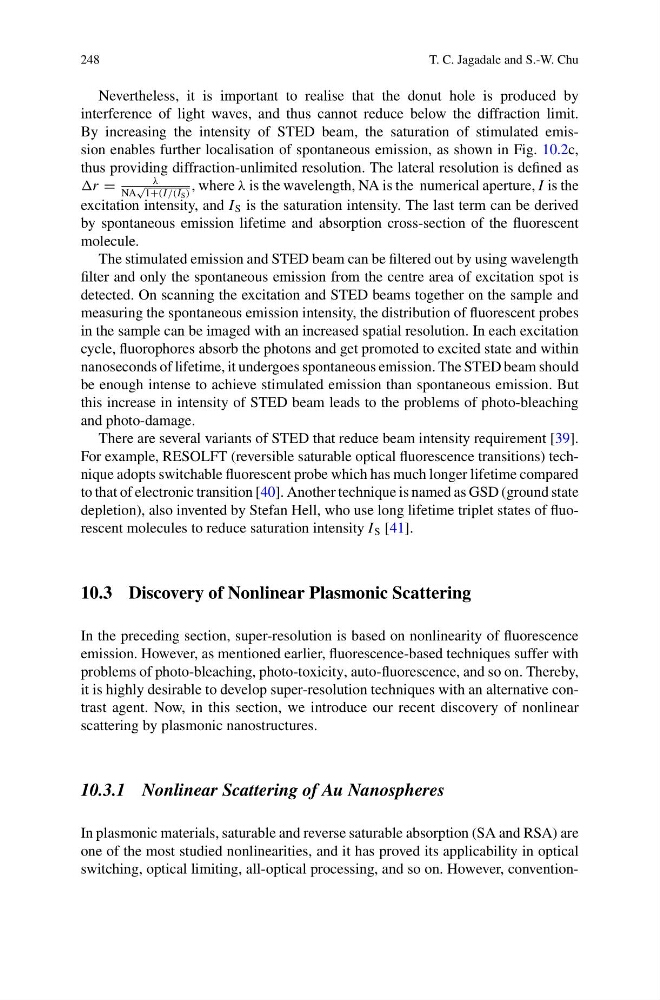
thus providing diffraction-unlimited resolution. The lateral resolution is defined as
r =
λ
NA
√
1+(I /(I S)
, where λ is the wavelength, NA is the numerical aperture, I is the
excitation intensity, and I S is the saturation intensity. The last term can be derived
by spontaneous emission lifetime and absorption cross-section of the fluorescent
molecule.
The stimulated emission and STED beam can be filtered out by using wavelength
filter and only the spontaneous emission from the centre area of excitation spot is
detected. On scanning the excitation and STED beams together on the sample and
measuring the spontaneous emission intensity, the distribution of fluorescent probes
in the sample can be imaged with an increased spatial resolution. In each excitation
cycle, fluorophores absorb the photons and get promoted to excited state and within
nanoseconds of lifetime, it undergoes spontaneous emission. The STED beam should
be enough intense to achieve stimulated emission than spontaneous emission. But
this increase in intensity of STED beam leads to the problems of photo-bleaching
and photo-damage.
There are several variants of STED that reduce beam intensity requirement [39].
For example, RESOLFT (reversible saturable optical fluorescence transitions) technique adopts switchable fluorescent probe which has much longer lifetime compared
to that of electronic transition [40]. Another technique is named as GSD (ground state
depletion), also invented by Stefan Hell, who use long lifetime triplet states of fluorescent molecules to reduce saturation intensity I S [41].
10.3 Discovery of Nonlinear Plasmonic Scattering
In the preceding section, super-resolution is based on nonlinearity of fluorescence
emission. However, as mentioned earlier, fluorescence-based techniques suffer with
problems of photo-bleaching, photo-toxicity, auto-fluorescence, and so on. Thereby,
it is highly desirable to develop super-resolution techniques with an alternative contrast agent. Now, in this section, we introduce our recent discovery of nonlinear
scattering by plasmonic nanostructures.
10.3.1 Nonlinear Scattering of Au Nanospheres
In plasmonic materials, saturable and reverse saturable absorption (SA and RSA) are
one of the most studied nonlinearities, and it has proved its applicability in optical
switching, optical limiting, all-optical processing, and so on. However, convention-
T. C. Jagadale and S.-W. Chu
Nevertheless, it is important to realise that the donut hole is produced by
interference of light waves, and thus cannot reduce below the diffraction limit.
By increasing the intensity of STED beam, the saturation of stimulated emission enables further localisation of spontaneous emission, as shown in Fig. 10.2c,
thus providing diffraction-unlimited resolution. The lateral resolution is defined as
r =
λ
NA
√
1+(I /(I S)
, where λ is the wavelength, NA is the numerical aperture, I is the
excitation intensity, and I S is the saturation intensity. The last term can be derived
by spontaneous emission lifetime and absorption cross-section of the fluorescent
molecule.
The stimulated emission and STED beam can be filtered out by using wavelength
filter and only the spontaneous emission from the centre area of excitation spot is
detected. On scanning the excitation and STED beams together on the sample and
measuring the spontaneous emission intensity, the distribution of fluorescent probes
in the sample can be imaged with an increased spatial resolution. In each excitation
cycle, fluorophores absorb the photons and get promoted to excited state and within
nanoseconds of lifetime, it undergoes spontaneous emission. The STED beam should
be enough intense to achieve stimulated emission than spontaneous emission. But
this increase in intensity of STED beam leads to the problems of photo-bleaching
and photo-damage.
There are several variants of STED that reduce beam intensity requirement [39].
For example, RESOLFT (reversible saturable optical fluorescence transitions) technique adopts switchable fluorescent probe which has much longer lifetime compared
to that of electronic transition [40]. Another technique is named as GSD (ground state
depletion), also invented by Stefan Hell, who use long lifetime triplet states of fluorescent molecules to reduce saturation intensity I S [41].
10.3 Discovery of Nonlinear Plasmonic Scattering
In the preceding section, super-resolution is based on nonlinearity of fluorescence
emission. However, as mentioned earlier, fluorescence-based techniques suffer with
problems of photo-bleaching, photo-toxicity, auto-fluorescence, and so on. Thereby,
it is highly desirable to develop super-resolution techniques with an alternative contrast agent. Now, in this section, we introduce our recent discovery of nonlinear
scattering by plasmonic nanostructures.
10.3.1 Nonlinear Scattering of Au Nanospheres
In plasmonic materials, saturable and reverse saturable absorption (SA and RSA) are
one of the most studied nonlinearities, and it has proved its applicability in optical
switching, optical limiting, all-optical processing, and so on. However, convention-