

234
H. Pinhas et al.
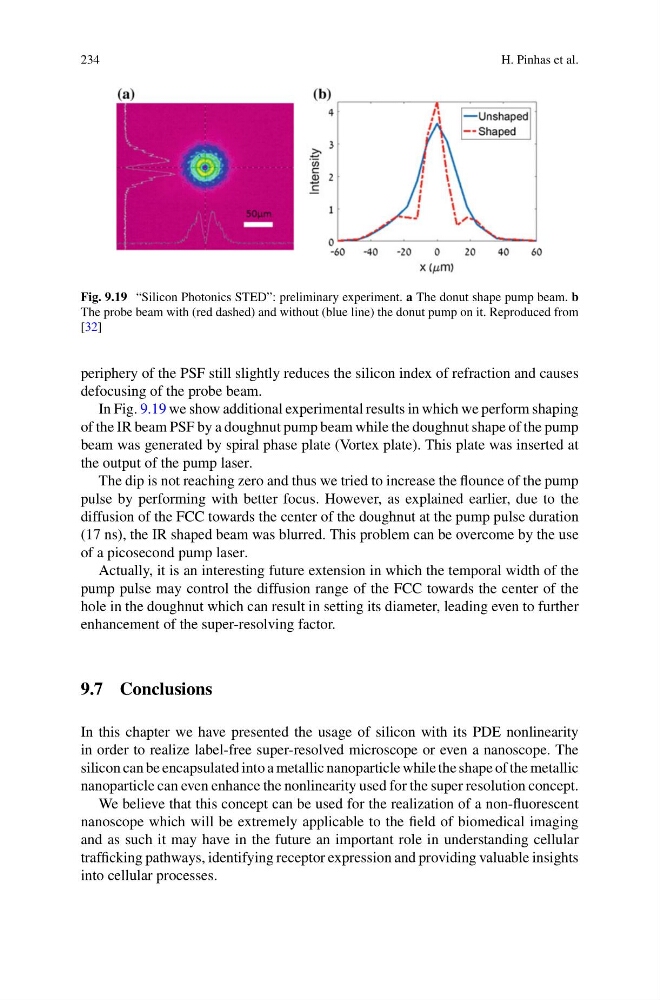
Fig. 9.19 “Silicon Photonics STED”: preliminary experiment. a The donut shape pump beam. b
The probe beam with (red dashed) and without (blue line) the donut pump on it. Reproduced from
[32]
periphery of the PSF still slightly reduces the silicon index of refraction and causes
defocusing of the probe beam.
In Fig. 9.19 we show additional experimental results in which we perform shaping
of the IR beam PSF by a doughnut pump beam while the doughnut shape of the pump
beam was generated by spiral phase plate (Vortex plate). This plate was inserted at
the output of the pump laser.
The dip is not reaching zero and thus we tried to increase the flounce of the pump
pulse by performing with better focus. However, as explained earlier, due to the
diffusion of the FCC towards the center of the doughnut at the pump pulse duration
(17 ns), the IR shaped beam was blurred. This problem can be overcome by the use
of a picosecond pump laser.
Actually, it is an interesting future extension in which the temporal width of the
pump pulse may control the diffusion range of the FCC towards the center of the
hole in the doughnut which can result in setting its diameter, leading even to further
enhancement of the super-resolving factor.
9.7 Conclusions
In this chapter we have presented the usage of silicon with its PDE nonlinearity
in order to realize label-free super-resolved microscope or even a nanoscope. The
silicon can be encapsulated into a metallic nanoparticle while the shape of the metallic
nanoparticle can even enhance the nonlinearity used for the super resolution concept.
We believe that this concept can be used for the realization of a non-fluorescent
nanoscope which will be extremely applicable to the field of biomedical imaging
and as such it may have in the future an important role in understanding cellular
trafficking pathways, identifying receptor expression and providing valuable insights
into cellular processes.
H. Pinhas et al.
Fig. 9.19 “Silicon Photonics STED”: preliminary experiment. a The donut shape pump beam. b
The probe beam with (red dashed) and without (blue line) the donut pump on it. Reproduced from
[32]
periphery of the PSF still slightly reduces the silicon index of refraction and causes
defocusing of the probe beam.
In Fig. 9.19 we show additional experimental results in which we perform shaping
of the IR beam PSF by a doughnut pump beam while the doughnut shape of the pump
beam was generated by spiral phase plate (Vortex plate). This plate was inserted at
the output of the pump laser.
The dip is not reaching zero and thus we tried to increase the flounce of the pump
pulse by performing with better focus. However, as explained earlier, due to the
diffusion of the FCC towards the center of the doughnut at the pump pulse duration
(17 ns), the IR shaped beam was blurred. This problem can be overcome by the use
of a picosecond pump laser.
Actually, it is an interesting future extension in which the temporal width of the
pump pulse may control the diffusion range of the FCC towards the center of the
hole in the doughnut which can result in setting its diameter, leading even to further
enhancement of the super-resolving factor.
9.7 Conclusions
In this chapter we have presented the usage of silicon with its PDE nonlinearity
in order to realize label-free super-resolved microscope or even a nanoscope. The
silicon can be encapsulated into a metallic nanoparticle while the shape of the metallic
nanoparticle can even enhance the nonlinearity used for the super resolution concept.
We believe that this concept can be used for the realization of a non-fluorescent
nanoscope which will be extremely applicable to the field of biomedical imaging
and as such it may have in the future an important role in understanding cellular
trafficking pathways, identifying receptor expression and providing valuable insights
into cellular processes.