

9 Usage of Silicon for Label-Free Super-Resolved Imaging
221
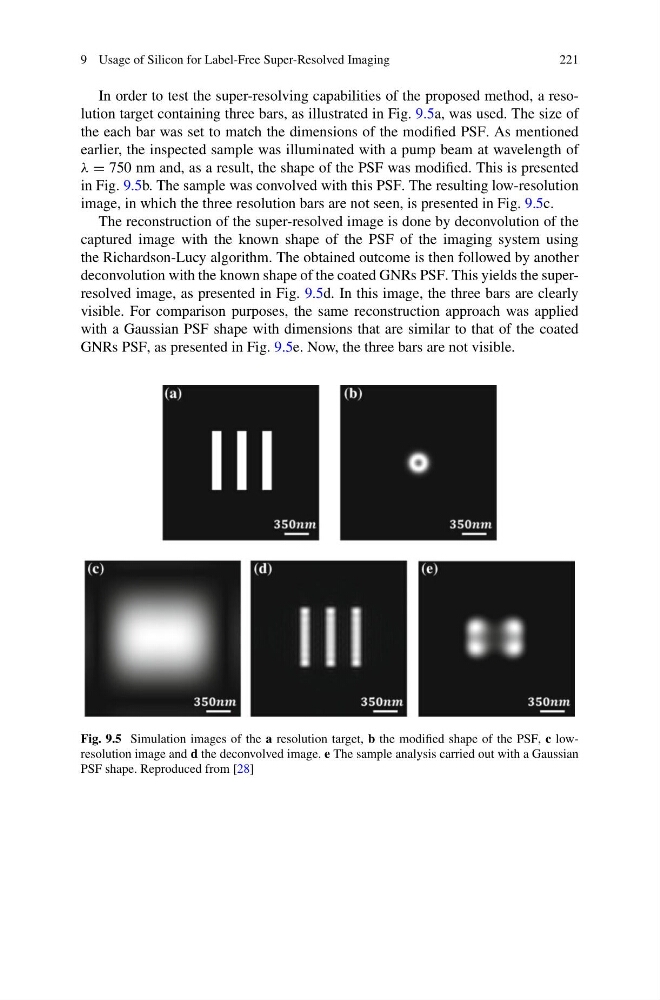
In order to test the super-resolving capabilities of the proposed method, a resolution target containing three bars, as illustrated in Fig. 9.5a, was used. The size of
the each bar was set to match the dimensions of the modified PSF. As mentioned
earlier, the inspected sample was illuminated with a pump beam at wavelength of
λ = 750 nm and, as a result, the shape of the PSF was modified. This is presented
in Fig. 9.5b. The sample was convolved with this PSF. The resulting low-resolution
image, in which the three resolution bars are not seen, is presented in Fig. 9.5c.
The reconstruction of the super-resolved image is done by deconvolution of the
captured image with the known shape of the PSF of the imaging system using
the Richardson-Lucy algorithm. The obtained outcome is then followed by another
deconvolution with the known shape of the coated GNRs PSF. This yields the superresolved image, as presented in Fig. 9.5d. In this image, the three bars are clearly
visible. For comparison purposes, the same reconstruction approach was applied
with a Gaussian PSF shape with dimensions that are similar to that of the coated
GNRs PSF, as presented in Fig. 9.5e. Now, the three bars are not visible.
Fig. 9.5 Simulation images of the a resolution target, b the modified shape of the PSF, c lowresolution image and d the deconvolved image. e The sample analysis carried out with a Gaussian
PSF shape. Reproduced from [28]
221
In order to test the super-resolving capabilities of the proposed method, a resolution target containing three bars, as illustrated in Fig. 9.5a, was used. The size of
the each bar was set to match the dimensions of the modified PSF. As mentioned
earlier, the inspected sample was illuminated with a pump beam at wavelength of
λ = 750 nm and, as a result, the shape of the PSF was modified. This is presented
in Fig. 9.5b. The sample was convolved with this PSF. The resulting low-resolution
image, in which the three resolution bars are not seen, is presented in Fig. 9.5c.
The reconstruction of the super-resolved image is done by deconvolution of the
captured image with the known shape of the PSF of the imaging system using
the Richardson-Lucy algorithm. The obtained outcome is then followed by another
deconvolution with the known shape of the coated GNRs PSF. This yields the superresolved image, as presented in Fig. 9.5d. In this image, the three bars are clearly
visible. For comparison purposes, the same reconstruction approach was applied
with a Gaussian PSF shape with dimensions that are similar to that of the coated
GNRs PSF, as presented in Fig. 9.5e. Now, the three bars are not visible.
Fig. 9.5 Simulation images of the a resolution target, b the modified shape of the PSF, c lowresolution image and d the deconvolved image. e The sample analysis carried out with a Gaussian
PSF shape. Reproduced from [28]