

9 Usage of Silicon for Label-Free Super-Resolved Imaging
219
used to calculate the change in the refractive index at each local point, in the nanostructure mesh, caused due to the PDE in the silicon coating.
In our simulations, we performed the testing at different intensities of the pump
to examine how different spatial locations along the Gaussian pump beam affect
the optical coefficients and thereafter the illumination PSF. All the simulations were
performed for various aspect ratios (A.R) and effective radii (R eff ) of the nanoparticle.
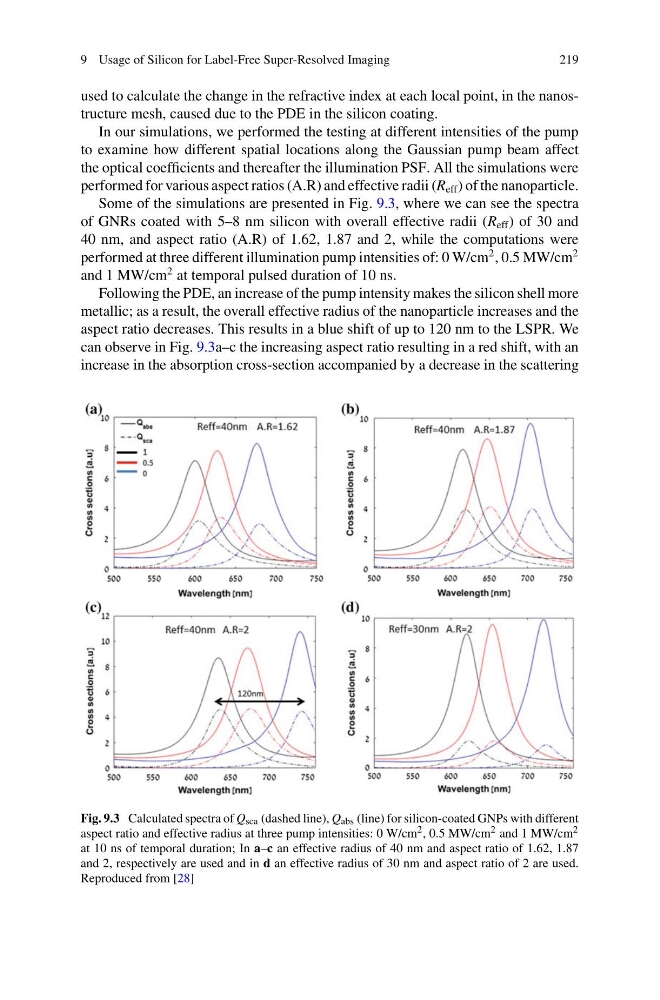
Some of the simulations are presented in Fig. 9.3, where we can see the spectra
of GNRs coated with 5–8 nm silicon with overall effective radii (R eff ) of 30 and
40 nm, and aspect ratio (A.R) of 1.62, 1.87 and 2, while the computations were
performed at three different illumination pump intensities of: 0 W/cm
2 , 0.5 MW/cm
2
and 1 MW/cm
2 at temporal pulsed duration of 10 ns.
Following the PDE, an increase of the pump intensity makes the silicon shell more
metallic; as a result, the overall effective radius of the nanoparticle increases and the
aspect ratio decreases. This results in a blue shift of up to 120 nm to the LSPR. We
can observe in Fig. 9.3a–c the increasing aspect ratio resulting in a red shift, with an
increase in the absorption cross-section accompanied by a decrease in the scattering
Fig. 9.3 Calculated spectra of Q sca (dashed line), Q abs (line) for silicon-coated GNPs with different
aspect ratio and effective radius at three pump intensities: 0 W/cm 2 , 0.5 MW/cm 2 and 1 MW/cm 2
at 10 ns of temporal duration; In a–c an effective radius of 40 nm and aspect ratio of 1.62, 1.87
and 2, respectively are used and in d an effective radius of 30 nm and aspect ratio of 2 are used.
Reproduced from [28]
219
used to calculate the change in the refractive index at each local point, in the nanostructure mesh, caused due to the PDE in the silicon coating.
In our simulations, we performed the testing at different intensities of the pump
to examine how different spatial locations along the Gaussian pump beam affect
the optical coefficients and thereafter the illumination PSF. All the simulations were
performed for various aspect ratios (A.R) and effective radii (R eff ) of the nanoparticle.
Some of the simulations are presented in Fig. 9.3, where we can see the spectra
of GNRs coated with 5–8 nm silicon with overall effective radii (R eff ) of 30 and
40 nm, and aspect ratio (A.R) of 1.62, 1.87 and 2, while the computations were
performed at three different illumination pump intensities of: 0 W/cm
2 , 0.5 MW/cm
2
and 1 MW/cm
2 at temporal pulsed duration of 10 ns.
Following the PDE, an increase of the pump intensity makes the silicon shell more
metallic; as a result, the overall effective radius of the nanoparticle increases and the
aspect ratio decreases. This results in a blue shift of up to 120 nm to the LSPR. We
can observe in Fig. 9.3a–c the increasing aspect ratio resulting in a red shift, with an
increase in the absorption cross-section accompanied by a decrease in the scattering
Fig. 9.3 Calculated spectra of Q sca (dashed line), Q abs (line) for silicon-coated GNPs with different
aspect ratio and effective radius at three pump intensities: 0 W/cm 2 , 0.5 MW/cm 2 and 1 MW/cm 2
at 10 ns of temporal duration; In a–c an effective radius of 40 nm and aspect ratio of 1.62, 1.87
and 2, respectively are used and in d an effective radius of 30 nm and aspect ratio of 2 are used.
Reproduced from [28]