

9 Usage of Silicon for Label-Free Super-Resolved Imaging
217
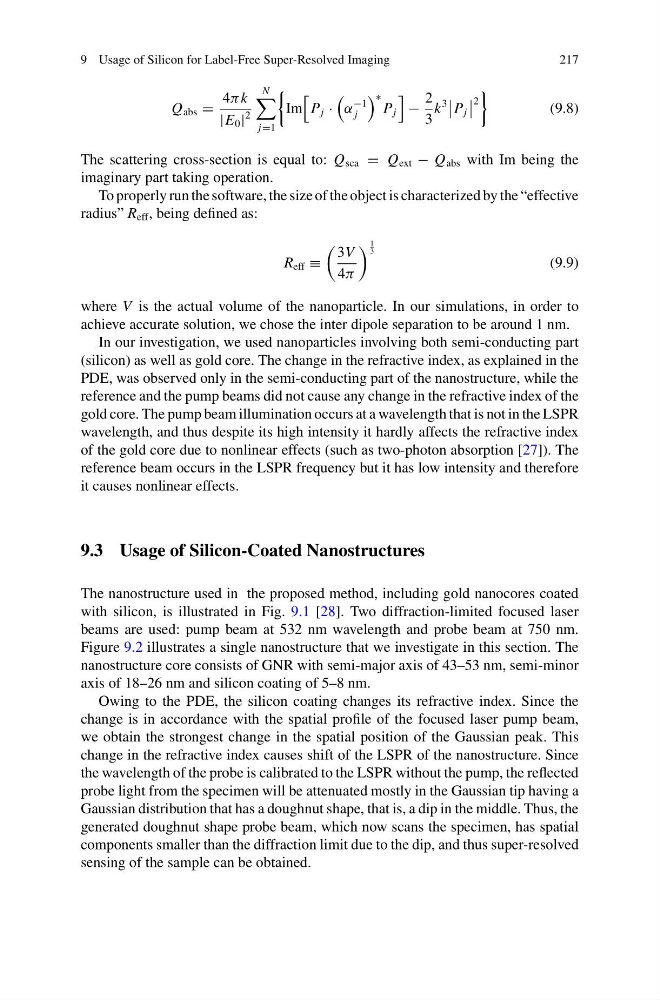
Q abs =
4π k
|E 0 |
2
N
j=1
Im
P j ·
α
−1
j
∗
P j
−
2
3
k
3
P j
2
(9.8)
The scattering cross-section is equal to: Q sca = Q ext − Q abs with Im being the
imaginary part taking operation.
To properly run the software, the size of the object is characterized by the “effective
radius” R eff , being defined as:
R eff ≡
3V
4π
1
3
(9.9)
where V is the actual volume of the nanoparticle. In our simulations, in order to
achieve accurate solution, we chose the inter dipole separation to be around 1 nm.
In our investigation, we used nanoparticles involving both semi-conducting part
(silicon) as well as gold core. The change in the refractive index, as explained in the
PDE, was observed only in the semi-conducting part of the nanostructure, while the
reference and the pump beams did not cause any change in the refractive index of the
gold core. The pump beam illumination occurs at a wavelength that is not in the LSPR
wavelength, and thus despite its high intensity it hardly affects the refractive index
of the gold core due to nonlinear effects (such as two-photon absorption [27]). The
reference beam occurs in the LSPR frequency but it has low intensity and therefore
it causes nonlinear effects.
9.3 Usage of Silicon-Coated Nanostructures
The nanostructure used in the proposed method, including gold nanocores coated
with silicon, is illustrated in Fig. 9.1 [28]. Two diffraction-limited focused laser
beams are used: pump beam at 532 nm wavelength and probe beam at 750 nm.
Figure 9.2 illustrates a single nanostructure that we investigate in this section. The
nanostructure core consists of GNR with semi-major axis of 43–53 nm, semi-minor
axis of 18–26 nm and silicon coating of 5–8 nm.
Owing to the PDE, the silicon coating changes its refractive index. Since the
change is in accordance with the spatial profile of the focused laser pump beam,
we obtain the strongest change in the spatial position of the Gaussian peak. This
change in the refractive index causes shift of the LSPR of the nanostructure. Since
the wavelength of the probe is calibrated to the LSPR without the pump, the reflected
probe light from the specimen will be attenuated mostly in the Gaussian tip having a
Gaussian distribution that has a doughnut shape, that is, a dip in the middle. Thus, the
generated doughnut shape probe beam, which now scans the specimen, has spatial
components smaller than the diffraction limit due to the dip, and thus super-resolved
sensing of the sample can be obtained.
217
Q abs =
4π k
|E 0 |
2
N
j=1
Im
P j ·
α
−1
j
∗
P j
−
2
3
k
3
P j
2
(9.8)
The scattering cross-section is equal to: Q sca = Q ext − Q abs with Im being the
imaginary part taking operation.
To properly run the software, the size of the object is characterized by the “effective
radius” R eff , being defined as:
R eff ≡
3V
4π
1
3
(9.9)
where V is the actual volume of the nanoparticle. In our simulations, in order to
achieve accurate solution, we chose the inter dipole separation to be around 1 nm.
In our investigation, we used nanoparticles involving both semi-conducting part
(silicon) as well as gold core. The change in the refractive index, as explained in the
PDE, was observed only in the semi-conducting part of the nanostructure, while the
reference and the pump beams did not cause any change in the refractive index of the
gold core. The pump beam illumination occurs at a wavelength that is not in the LSPR
wavelength, and thus despite its high intensity it hardly affects the refractive index
of the gold core due to nonlinear effects (such as two-photon absorption [27]). The
reference beam occurs in the LSPR frequency but it has low intensity and therefore
it causes nonlinear effects.
9.3 Usage of Silicon-Coated Nanostructures
The nanostructure used in the proposed method, including gold nanocores coated
with silicon, is illustrated in Fig. 9.1 [28]. Two diffraction-limited focused laser
beams are used: pump beam at 532 nm wavelength and probe beam at 750 nm.
Figure 9.2 illustrates a single nanostructure that we investigate in this section. The
nanostructure core consists of GNR with semi-major axis of 43–53 nm, semi-minor
axis of 18–26 nm and silicon coating of 5–8 nm.
Owing to the PDE, the silicon coating changes its refractive index. Since the
change is in accordance with the spatial profile of the focused laser pump beam,
we obtain the strongest change in the spatial position of the Gaussian peak. This
change in the refractive index causes shift of the LSPR of the nanostructure. Since
the wavelength of the probe is calibrated to the LSPR without the pump, the reflected
probe light from the specimen will be attenuated mostly in the Gaussian tip having a
Gaussian distribution that has a doughnut shape, that is, a dip in the middle. Thus, the
generated doughnut shape probe beam, which now scans the specimen, has spatial
components smaller than the diffraction limit due to the dip, and thus super-resolved
sensing of the sample can be obtained.