

216
H. Pinhas et al.
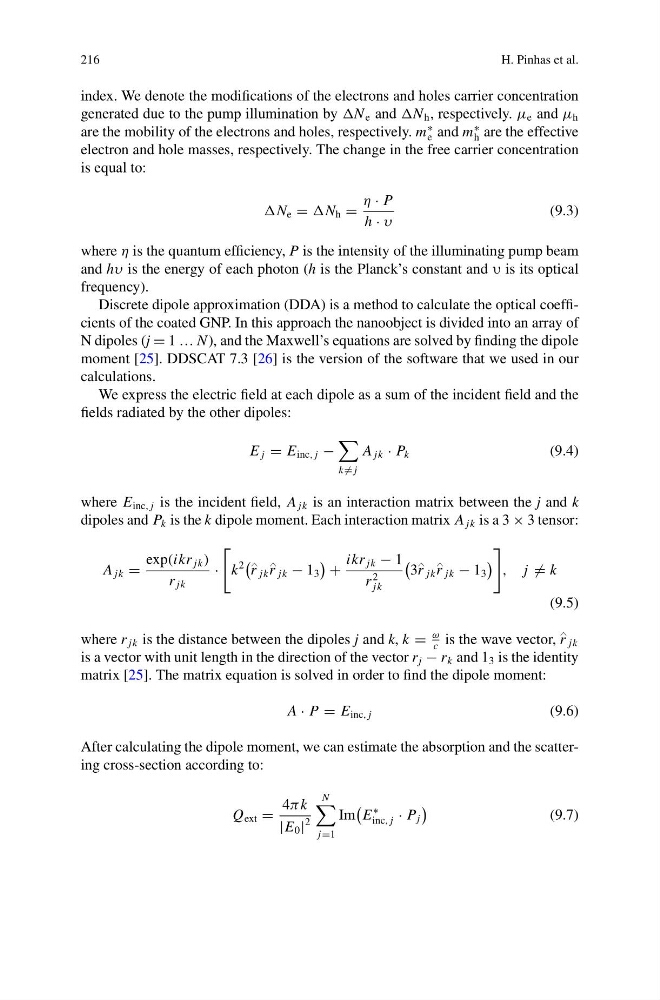
index. We denote the modifications of the electrons and holes carrier concentration
generated due to the pump illumination by N e and N h , respectively. μ e and μ h
are the mobility of the electrons and holes, respectively. m
∗
e and m
∗
h are the effective
electron and hole masses, respectively. The change in the free carrier concentration
is equal to:
N e = N h =
η · P
h · υ
(9.3)
where η is the quantum efficiency, P is the intensity of the illuminating pump beam
and hυ is the energy of each photon (h is the Planck’s constant and υ is its optical
frequency).
Discrete dipole approximation (DDA) is a method to calculate the optical coefficients of the coated GNP. In this approach the nanoobject is divided into an array of
N dipoles (j = 1 … N), and the Maxwell’s equations are solved by finding the dipole
moment [25]. DDSCAT 7.3 [26] is the version of the software that we used in our
calculations.
We express the electric field at each dipole as a sum of the incident field and the
fields radiated by the other dipoles:
E j = E inc, j −
k = j
A jk · P k
(9.4)
where E inc, j is the incident field, A jk is an interaction matrix between the j and k
dipoles and P k is the k dipole moment. Each interaction matrix A jk is a 3 × 3 tensor:
A jk =
exp(ikr jk )
r jk
·
k
2
r
jk r
jk − 1 3
+
ikr jk − 1
r
2
jk
3r
jk r
jk − 1 3
, j = k
(9.5)
where r jk is the distance between the dipoles j and k, k =
ω
c
is the wave vector, r
jk
is a vector with unit length in the direction of the vector r j − r k and 1 3 is the identity
matrix [25]. The matrix equation is solved in order to find the dipole moment:
A · P = E inc, j
(9.6)
After calculating the dipole moment, we can estimate the absorption and the scattering cross-section according to:
Q ext =
4π k
|E 0 |
2
N
j=1
Im
E
∗
inc, j · P j
(9.7)
H. Pinhas et al.
index. We denote the modifications of the electrons and holes carrier concentration
generated due to the pump illumination by N e and N h , respectively. μ e and μ h
are the mobility of the electrons and holes, respectively. m
∗
e and m
∗
h are the effective
electron and hole masses, respectively. The change in the free carrier concentration
is equal to:
N e = N h =
η · P
h · υ
(9.3)
where η is the quantum efficiency, P is the intensity of the illuminating pump beam
and hυ is the energy of each photon (h is the Planck’s constant and υ is its optical
frequency).
Discrete dipole approximation (DDA) is a method to calculate the optical coefficients of the coated GNP. In this approach the nanoobject is divided into an array of
N dipoles (j = 1 … N), and the Maxwell’s equations are solved by finding the dipole
moment [25]. DDSCAT 7.3 [26] is the version of the software that we used in our
calculations.
We express the electric field at each dipole as a sum of the incident field and the
fields radiated by the other dipoles:
E j = E inc, j −
k = j
A jk · P k
(9.4)
where E inc, j is the incident field, A jk is an interaction matrix between the j and k
dipoles and P k is the k dipole moment. Each interaction matrix A jk is a 3 × 3 tensor:
A jk =
exp(ikr jk )
r jk
·
k
2
r
jk r
jk − 1 3
+
ikr jk − 1
r
2
jk
3r
jk r
jk − 1 3
, j = k
(9.5)
where r jk is the distance between the dipoles j and k, k =
ω
c
is the wave vector, r
jk
is a vector with unit length in the direction of the vector r j − r k and 1 3 is the identity
matrix [25]. The matrix equation is solved in order to find the dipole moment:
A · P = E inc, j
(9.6)
After calculating the dipole moment, we can estimate the absorption and the scattering cross-section according to:
Q ext =
4π k
|E 0 |
2
N
j=1
Im
E
∗
inc, j · P j
(9.7)