

6 Absorption-Based Far-Field Label-Free Super-Resolution …
159
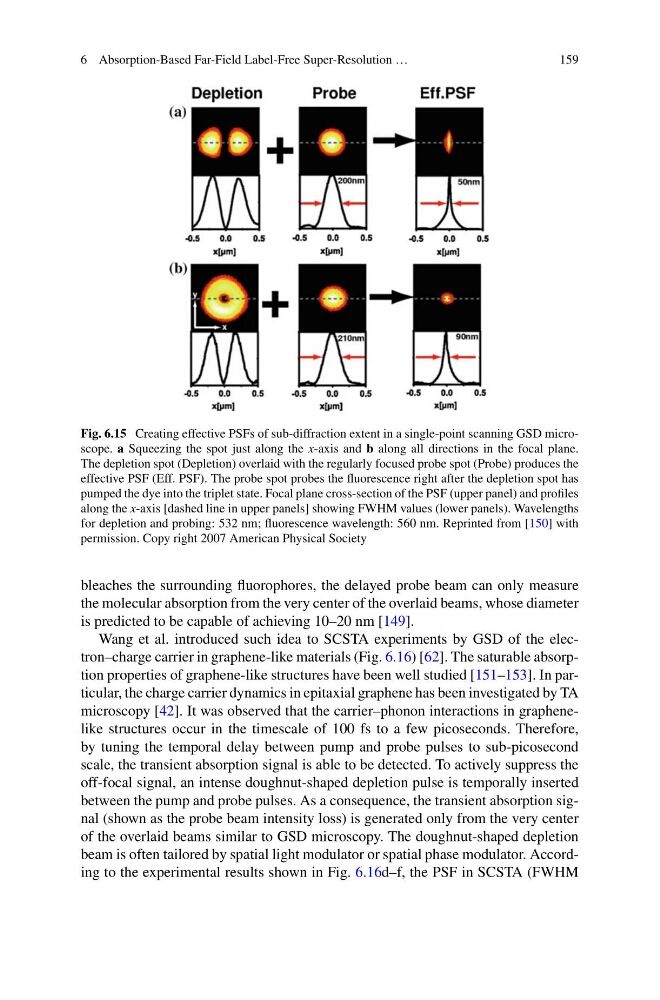
Fig. 6.15 Creating effective PSFs of sub-diffraction extent in a single-point scanning GSD microscope. a Squeezing the spot just along the x-axis and b along all directions in the focal plane.
The depletion spot (Depletion) overlaid with the regularly focused probe spot (Probe) produces the
effective PSF (Eff. PSF). The probe spot probes the fluorescence right after the depletion spot has
pumped the dye into the triplet state. Focal plane cross-section of the PSF (upper panel) and profiles
along the x-axis [dashed line in upper panels] showing FWHM values (lower panels). Wavelengths
for depletion and probing: 532 nm; fluorescence wavelength: 560 nm. Reprinted from [150] with
permission. Copy right 2007 American Physical Society
bleaches the surrounding fluorophores, the delayed probe beam can only measure
the molecular absorption from the very center of the overlaid beams, whose diameter
is predicted to be capable of achieving 10–20 nm [149].
Wang et al. introduced such idea to SCSTA experiments by GSD of the electron–charge carrier in graphene-like materials (Fig. 6.16) [62]. The saturable absorption properties of graphene-like structures have been well studied [151–153]. In particular, the charge carrier dynamics in epitaxial graphene has been investigated by TA
microscopy [42]. It was observed that the carrier–phonon interactions in graphenelike structures occur in the timescale of 100 fs to a few picoseconds. Therefore,
by tuning the temporal delay between pump and probe pulses to sub-picosecond
scale, the transient absorption signal is able to be detected. To actively suppress the
off-focal signal, an intense doughnut-shaped depletion pulse is temporally inserted
between the pump and probe pulses. As a consequence, the transient absorption signal (shown as the probe beam intensity loss) is generated only from the very center
of the overlaid beams similar to GSD microscopy. The doughnut-shaped depletion
beam is often tailored by spatial light modulator or spatial phase modulator. According to the experimental results shown in Fig. 6.16d–f, the PSF in SCSTA (FWHM
159
Fig. 6.15 Creating effective PSFs of sub-diffraction extent in a single-point scanning GSD microscope. a Squeezing the spot just along the x-axis and b along all directions in the focal plane.
The depletion spot (Depletion) overlaid with the regularly focused probe spot (Probe) produces the
effective PSF (Eff. PSF). The probe spot probes the fluorescence right after the depletion spot has
pumped the dye into the triplet state. Focal plane cross-section of the PSF (upper panel) and profiles
along the x-axis [dashed line in upper panels] showing FWHM values (lower panels). Wavelengths
for depletion and probing: 532 nm; fluorescence wavelength: 560 nm. Reprinted from [150] with
permission. Copy right 2007 American Physical Society
bleaches the surrounding fluorophores, the delayed probe beam can only measure
the molecular absorption from the very center of the overlaid beams, whose diameter
is predicted to be capable of achieving 10–20 nm [149].
Wang et al. introduced such idea to SCSTA experiments by GSD of the electron–charge carrier in graphene-like materials (Fig. 6.16) [62]. The saturable absorption properties of graphene-like structures have been well studied [151–153]. In particular, the charge carrier dynamics in epitaxial graphene has been investigated by TA
microscopy [42]. It was observed that the carrier–phonon interactions in graphenelike structures occur in the timescale of 100 fs to a few picoseconds. Therefore,
by tuning the temporal delay between pump and probe pulses to sub-picosecond
scale, the transient absorption signal is able to be detected. To actively suppress the
off-focal signal, an intense doughnut-shaped depletion pulse is temporally inserted
between the pump and probe pulses. As a consequence, the transient absorption signal (shown as the probe beam intensity loss) is generated only from the very center
of the overlaid beams similar to GSD microscopy. The doughnut-shaped depletion
beam is often tailored by spatial light modulator or spatial phase modulator. According to the experimental results shown in Fig. 6.16d–f, the PSF in SCSTA (FWHM