

158
C. Li and J.-X. Cheng
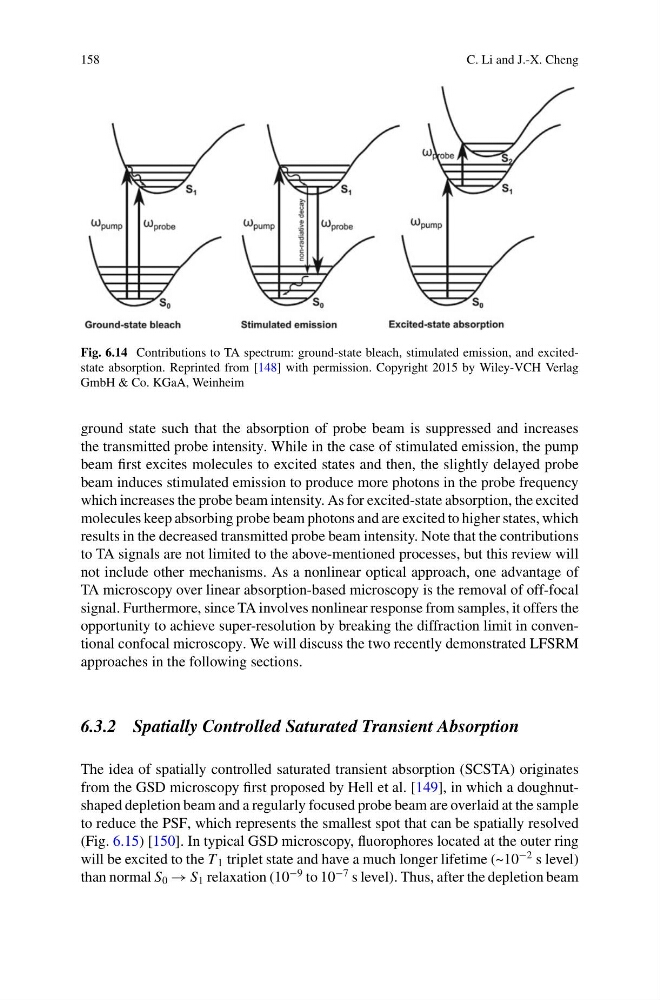
Fig. 6.14 Contributions to TA spectrum: ground-state bleach, stimulated emission, and excitedstate absorption. Reprinted from [148] with permission. Copyright 2015 by Wiley-VCH Verlag
GmbH & Co. KGaA, Weinheim
ground state such that the absorption of probe beam is suppressed and increases
the transmitted probe intensity. While in the case of stimulated emission, the pump
beam first excites molecules to excited states and then, the slightly delayed probe
beam induces stimulated emission to produce more photons in the probe frequency
which increases the probe beam intensity. As for excited-state absorption, the excited
molecules keep absorbing probe beam photons and are excited to higher states, which
results in the decreased transmitted probe beam intensity. Note that the contributions
to TA signals are not limited to the above-mentioned processes, but this review will
not include other mechanisms. As a nonlinear optical approach, one advantage of
TA microscopy over linear absorption-based microscopy is the removal of off-focal
signal. Furthermore, since TA involves nonlinear response from samples, it offers the
opportunity to achieve super-resolution by breaking the diffraction limit in conventional confocal microscopy. We will discuss the two recently demonstrated LFSRM
approaches in the following sections.
6.3.2 Spatially Controlled Saturated Transient Absorption
The idea of spatially controlled saturated transient absorption (SCSTA) originates
from the GSD microscopy first proposed by Hell et al. [149], in which a doughnutshaped depletion beam and a regularly focused probe beam are overlaid at the sample
to reduce the PSF, which represents the smallest spot that can be spatially resolved
(Fig. 6.15) [150]. In typical GSD microscopy, fluorophores located at the outer ring
will be excited to the T 1 triplet state and have a much longer lifetime (~10
−2 s level)
than normal S 0 → S 1 relaxation (10
−9 to 10
−7 s level). Thus, after the depletion beam
C. Li and J.-X. Cheng
Fig. 6.14 Contributions to TA spectrum: ground-state bleach, stimulated emission, and excitedstate absorption. Reprinted from [148] with permission. Copyright 2015 by Wiley-VCH Verlag
GmbH & Co. KGaA, Weinheim
ground state such that the absorption of probe beam is suppressed and increases
the transmitted probe intensity. While in the case of stimulated emission, the pump
beam first excites molecules to excited states and then, the slightly delayed probe
beam induces stimulated emission to produce more photons in the probe frequency
which increases the probe beam intensity. As for excited-state absorption, the excited
molecules keep absorbing probe beam photons and are excited to higher states, which
results in the decreased transmitted probe beam intensity. Note that the contributions
to TA signals are not limited to the above-mentioned processes, but this review will
not include other mechanisms. As a nonlinear optical approach, one advantage of
TA microscopy over linear absorption-based microscopy is the removal of off-focal
signal. Furthermore, since TA involves nonlinear response from samples, it offers the
opportunity to achieve super-resolution by breaking the diffraction limit in conventional confocal microscopy. We will discuss the two recently demonstrated LFSRM
approaches in the following sections.
6.3.2 Spatially Controlled Saturated Transient Absorption
The idea of spatially controlled saturated transient absorption (SCSTA) originates
from the GSD microscopy first proposed by Hell et al. [149], in which a doughnutshaped depletion beam and a regularly focused probe beam are overlaid at the sample
to reduce the PSF, which represents the smallest spot that can be spatially resolved
(Fig. 6.15) [150]. In typical GSD microscopy, fluorophores located at the outer ring
will be excited to the T 1 triplet state and have a much longer lifetime (~10
−2 s level)
than normal S 0 → S 1 relaxation (10
−9 to 10
−7 s level). Thus, after the depletion beam