

6 Absorption-Based Far-Field Label-Free Super-Resolution …
157
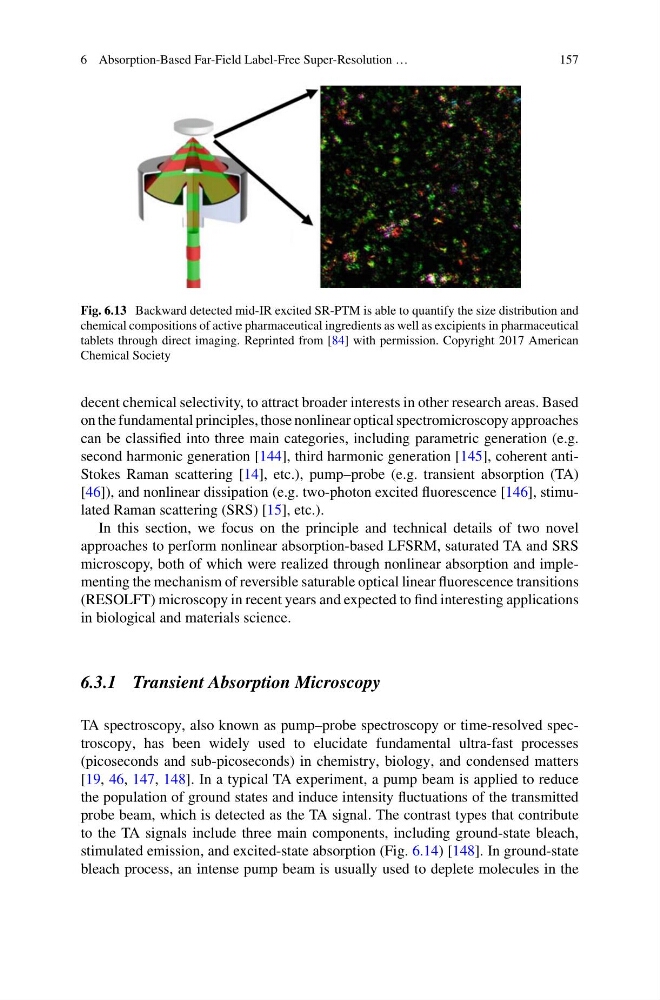
Fig. 6.13 Backward detected mid-IR excited SR-PTM is able to quantify the size distribution and
chemical compositions of active pharmaceutical ingredients as well as excipients in pharmaceutical
tablets through direct imaging. Reprinted from [84] with permission. Copyright 2017 American
Chemical Society
decent chemical selectivity, to attract broader interests in other research areas. Based
on the fundamental principles, those nonlinear optical spectromicroscopy approaches
can be classified into three main categories, including parametric generation (e.g.
second harmonic generation [144], third harmonic generation [145], coherent antiStokes Raman scattering [14], etc.), pump–probe (e.g. transient absorption (TA)
[46]), and nonlinear dissipation (e.g. two-photon excited fluorescence [146], stimulated Raman scattering (SRS) [15], etc.).
In this section, we focus on the principle and technical details of two novel
approaches to perform nonlinear absorption-based LFSRM, saturated TA and SRS
microscopy, both of which were realized through nonlinear absorption and implementing the mechanism of reversible saturable optical linear fluorescence transitions
(RESOLFT) microscopy in recent years and expected to find interesting applications
in biological and materials science.
6.3.1 Transient Absorption Microscopy
TA spectroscopy, also known as pump–probe spectroscopy or time-resolved spectroscopy, has been widely used to elucidate fundamental ultra-fast processes
(picoseconds and sub-picoseconds) in chemistry, biology, and condensed matters
[19, 46, 147, 148]. In a typical TA experiment, a pump beam is applied to reduce
the population of ground states and induce intensity fluctuations of the transmitted
probe beam, which is detected as the TA signal. The contrast types that contribute
to the TA signals include three main components, including ground-state bleach,
stimulated emission, and excited-state absorption (Fig. 6.14) [148]. In ground-state
bleach process, an intense pump beam is usually used to deplete molecules in the
157
Fig. 6.13 Backward detected mid-IR excited SR-PTM is able to quantify the size distribution and
chemical compositions of active pharmaceutical ingredients as well as excipients in pharmaceutical
tablets through direct imaging. Reprinted from [84] with permission. Copyright 2017 American
Chemical Society
decent chemical selectivity, to attract broader interests in other research areas. Based
on the fundamental principles, those nonlinear optical spectromicroscopy approaches
can be classified into three main categories, including parametric generation (e.g.
second harmonic generation [144], third harmonic generation [145], coherent antiStokes Raman scattering [14], etc.), pump–probe (e.g. transient absorption (TA)
[46]), and nonlinear dissipation (e.g. two-photon excited fluorescence [146], stimulated Raman scattering (SRS) [15], etc.).
In this section, we focus on the principle and technical details of two novel
approaches to perform nonlinear absorption-based LFSRM, saturated TA and SRS
microscopy, both of which were realized through nonlinear absorption and implementing the mechanism of reversible saturable optical linear fluorescence transitions
(RESOLFT) microscopy in recent years and expected to find interesting applications
in biological and materials science.
6.3.1 Transient Absorption Microscopy
TA spectroscopy, also known as pump–probe spectroscopy or time-resolved spectroscopy, has been widely used to elucidate fundamental ultra-fast processes
(picoseconds and sub-picoseconds) in chemistry, biology, and condensed matters
[19, 46, 147, 148]. In a typical TA experiment, a pump beam is applied to reduce
the population of ground states and induce intensity fluctuations of the transmitted
probe beam, which is detected as the TA signal. The contrast types that contribute
to the TA signals include three main components, including ground-state bleach,
stimulated emission, and excited-state absorption (Fig. 6.14) [148]. In ground-state
bleach process, an intense pump beam is usually used to deplete molecules in the