

132
N. Rahbany et al.
5.4.3 Scattering Through Disordered Media
It has been recently proposed that scattering media can be used to couple the information contained in the near-field wave vectors to the observable far-field with conventional optics [49]. The multiple elastic scattering that light experiences in such
a medium exhibits time-reversal symmetry, a property that has been used in optics
to achieve image transmission through opaque materials [50] or perfect absorption
[51], among other phenomena.
Near-field scanning optical microscope combined with digital holography can
be applied to probe the optical properties of such strongly scattering media using
aperture tips. The nanosized tips act as point-like sources and are used to excite the
input modes of strongly scattering media. The transmitted far-field signal is measured holographically and, as shown before, the complex field can be reconstructed
at any point in space between the camera and the output of the scattering media.
This allows us to accurately describe the amplitude and phase of the propagating
electromagnetic field and compare its behavior through different scattering media.
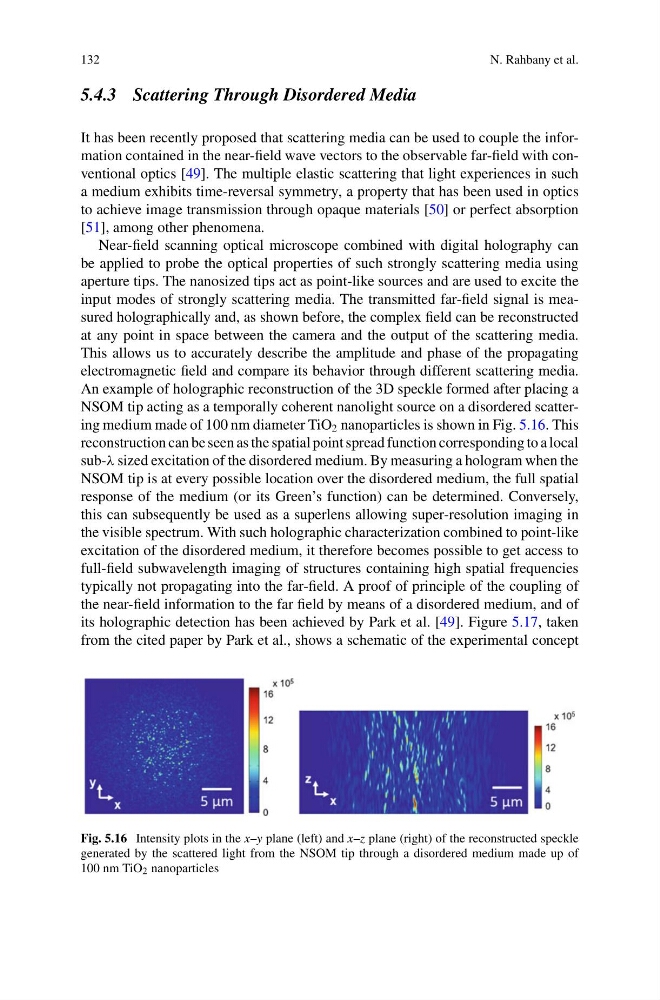
An example of holographic reconstruction of the 3D speckle formed after placing a
NSOM tip acting as a temporally coherent nanolight source on a disordered scattering medium made of 100 nm diameter TiO 2 nanoparticles is shown in Fig. 5.16. This
reconstruction can be seen as the spatial point spread function corresponding to a local
sub-λ sized excitation of the disordered medium. By measuring a hologram when the
NSOM tip is at every possible location over the disordered medium, the full spatial
response of the medium (or its Green’s function) can be determined. Conversely,
this can subsequently be used as a superlens allowing super-resolution imaging in
the visible spectrum. With such holographic characterization combined to point-like
excitation of the disordered medium, it therefore becomes possible to get access to
full-field subwavelength imaging of structures containing high spatial frequencies
typically not propagating into the far-field. A proof of principle of the coupling of
the near-field information to the far field by means of a disordered medium, and of
its holographic detection has been achieved by Park et al. [49]. Figure 5.17, taken
from the cited paper by Park et al., shows a schematic of the experimental concept
Fig. 5.16 Intensity plots in the x–y plane (left) and x–z plane (right) of the reconstructed speckle
generated by the scattered light from the NSOM tip through a disordered medium made up of
100 nm TiO 2 nanoparticles
N. Rahbany et al.
5.4.3 Scattering Through Disordered Media
It has been recently proposed that scattering media can be used to couple the information contained in the near-field wave vectors to the observable far-field with conventional optics [49]. The multiple elastic scattering that light experiences in such
a medium exhibits time-reversal symmetry, a property that has been used in optics
to achieve image transmission through opaque materials [50] or perfect absorption
[51], among other phenomena.
Near-field scanning optical microscope combined with digital holography can
be applied to probe the optical properties of such strongly scattering media using
aperture tips. The nanosized tips act as point-like sources and are used to excite the
input modes of strongly scattering media. The transmitted far-field signal is measured holographically and, as shown before, the complex field can be reconstructed
at any point in space between the camera and the output of the scattering media.
This allows us to accurately describe the amplitude and phase of the propagating
electromagnetic field and compare its behavior through different scattering media.
An example of holographic reconstruction of the 3D speckle formed after placing a
NSOM tip acting as a temporally coherent nanolight source on a disordered scattering medium made of 100 nm diameter TiO 2 nanoparticles is shown in Fig. 5.16. This
reconstruction can be seen as the spatial point spread function corresponding to a local
sub-λ sized excitation of the disordered medium. By measuring a hologram when the
NSOM tip is at every possible location over the disordered medium, the full spatial
response of the medium (or its Green’s function) can be determined. Conversely,
this can subsequently be used as a superlens allowing super-resolution imaging in
the visible spectrum. With such holographic characterization combined to point-like
excitation of the disordered medium, it therefore becomes possible to get access to
full-field subwavelength imaging of structures containing high spatial frequencies
typically not propagating into the far-field. A proof of principle of the coupling of
the near-field information to the far field by means of a disordered medium, and of
its holographic detection has been achieved by Park et al. [49]. Figure 5.17, taken
from the cited paper by Park et al., shows a schematic of the experimental concept
Fig. 5.16 Intensity plots in the x–y plane (left) and x–z plane (right) of the reconstructed speckle
generated by the scattered light from the NSOM tip through a disordered medium made up of
100 nm TiO 2 nanoparticles