

5 Near-Field Scanning Optical Microscope Combined with Digital …
131
5.4.2 Brownian Nanoparticles as Stochastic Optical Probes
In much the same way as a scattering NSOM probe, nanoparticles can be used to
scatter the local near field. In liquids, one can take advantage of the Brownian motion
of nanoparticles in order to explore the volume of the sample: the movement of the
probes is then stochastic, instead of deterministic as in classical NSOM experiments.
Each of the particles can behave as a subwavelength probe and, as it moves in
an illuminated region of the sample, scatter the local field toward the holographic
microscope described above. The reconstruction of the scattering field allows the
3D super localization of the particle, i.e., the determination of its center of mass
with an accuracy which is only limited by the signal-to-noise ratio of the detection
[47]. This localization can be achieved with 3 × 3 × 10 nm
3 accuracy, and the
scattering intensity is directly proportional to the local optical field provided that the
particles are monodisperse, and therefore have identical scattering cross sections.
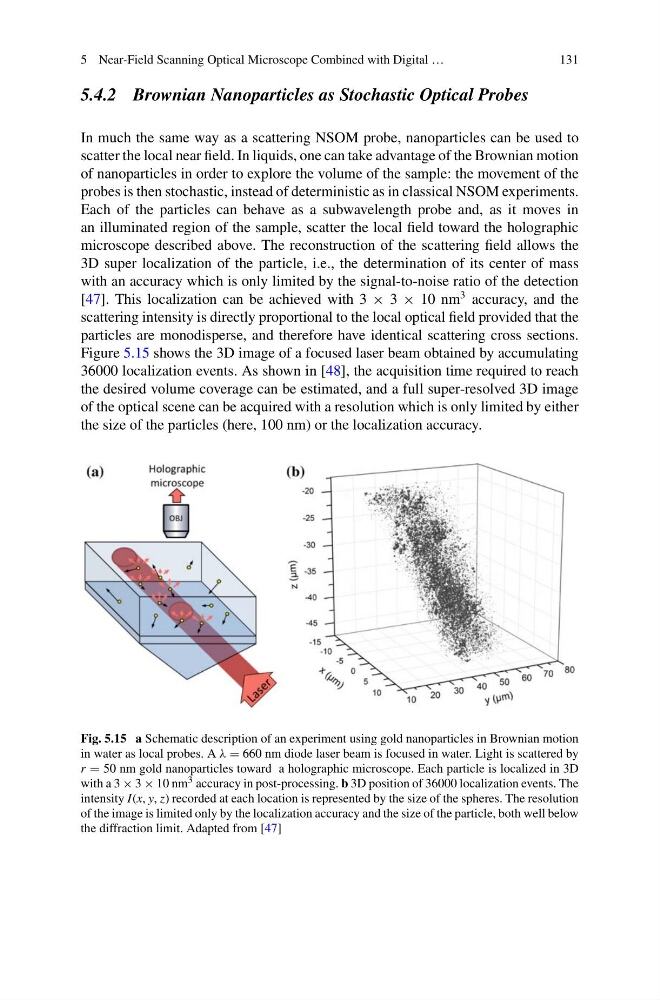
Figure 5.15 shows the 3D image of a focused laser beam obtained by accumulating
36000 localization events. As shown in [48], the acquisition time required to reach
the desired volume coverage can be estimated, and a full super-resolved 3D image
of the optical scene can be acquired with a resolution which is only limited by either
the size of the particles (here, 100 nm) or the localization accuracy.
Fig. 5.15 a Schematic description of an experiment using gold nanoparticles in Brownian motion
in water as local probes. A λ = 660 nm diode laser beam is focused in water. Light is scattered by
r = 50 nm gold nanoparticles toward a holographic microscope. Each particle is localized in 3D
with a 3 × 3 × 10 nm 3 accuracy in post-processing. b 3D position of 36000 localization events. The
intensity I(x, y, z) recorded at each location is represented by the size of the spheres. The resolution
of the image is limited only by the localization accuracy and the size of the particle, both well below
the diffraction limit. Adapted from [47]
131
5.4.2 Brownian Nanoparticles as Stochastic Optical Probes
In much the same way as a scattering NSOM probe, nanoparticles can be used to
scatter the local near field. In liquids, one can take advantage of the Brownian motion
of nanoparticles in order to explore the volume of the sample: the movement of the
probes is then stochastic, instead of deterministic as in classical NSOM experiments.
Each of the particles can behave as a subwavelength probe and, as it moves in
an illuminated region of the sample, scatter the local field toward the holographic
microscope described above. The reconstruction of the scattering field allows the
3D super localization of the particle, i.e., the determination of its center of mass
with an accuracy which is only limited by the signal-to-noise ratio of the detection
[47]. This localization can be achieved with 3 × 3 × 10 nm
3 accuracy, and the
scattering intensity is directly proportional to the local optical field provided that the
particles are monodisperse, and therefore have identical scattering cross sections.
Figure 5.15 shows the 3D image of a focused laser beam obtained by accumulating
36000 localization events. As shown in [48], the acquisition time required to reach
the desired volume coverage can be estimated, and a full super-resolved 3D image
of the optical scene can be acquired with a resolution which is only limited by either
the size of the particles (here, 100 nm) or the localization accuracy.
Fig. 5.15 a Schematic description of an experiment using gold nanoparticles in Brownian motion
in water as local probes. A λ = 660 nm diode laser beam is focused in water. Light is scattered by
r = 50 nm gold nanoparticles toward a holographic microscope. Each particle is localized in 3D
with a 3 × 3 × 10 nm 3 accuracy in post-processing. b 3D position of 36000 localization events. The
intensity I(x, y, z) recorded at each location is represented by the size of the spheres. The resolution
of the image is limited only by the localization accuracy and the size of the particle, both well below
the diffraction limit. Adapted from [47]