

130
N. Rahbany et al.
disk chain is clearly identified, as well as electromagnetic hotspots that are created
in the nanoantennas. In addition, strong directional scattering is observed (note the
different scalebars in Fig. 5.13a, b, showing an approximately 6 times enhancement
of the scattering near the resonant wavelength).
With the combined NSOM-holography setup described in the present chapter,
such studies can be extended further to study the coupling between NSOM tips and
different types of optical nanoantennas. The full 3D scattering pattern of a locally
excited nanoantenna and the influence of the position of the excitation source should
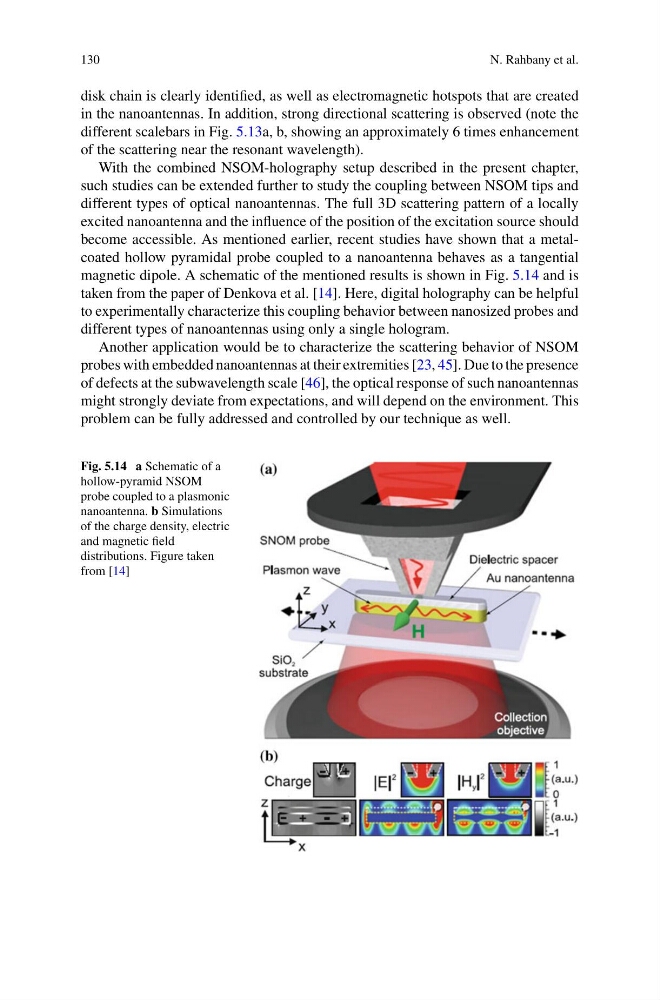
become accessible. As mentioned earlier, recent studies have shown that a metalcoated hollow pyramidal probe coupled to a nanoantenna behaves as a tangential
magnetic dipole. A schematic of the mentioned results is shown in Fig. 5.14 and is
taken from the paper of Denkova et al. [14]. Here, digital holography can be helpful
to experimentally characterize this coupling behavior between nanosized probes and
different types of nanoantennas using only a single hologram.
Another application would be to characterize the scattering behavior of NSOM
probes with embedded nanoantennas at their extremities [23, 45]. Due to the presence
of defects at the subwavelength scale [46], the optical response of such nanoantennas
might strongly deviate from expectations, and will depend on the environment. This
problem can be fully addressed and controlled by our technique as well.
Fig. 5.14 a Schematic of a
hollow-pyramid NSOM
probe coupled to a plasmonic
nanoantenna. b Simulations
of the charge density, electric
and magnetic field
distributions. Figure taken
from [14]
N. Rahbany et al.
disk chain is clearly identified, as well as electromagnetic hotspots that are created
in the nanoantennas. In addition, strong directional scattering is observed (note the
different scalebars in Fig. 5.13a, b, showing an approximately 6 times enhancement
of the scattering near the resonant wavelength).
With the combined NSOM-holography setup described in the present chapter,
such studies can be extended further to study the coupling between NSOM tips and
different types of optical nanoantennas. The full 3D scattering pattern of a locally
excited nanoantenna and the influence of the position of the excitation source should
become accessible. As mentioned earlier, recent studies have shown that a metalcoated hollow pyramidal probe coupled to a nanoantenna behaves as a tangential
magnetic dipole. A schematic of the mentioned results is shown in Fig. 5.14 and is
taken from the paper of Denkova et al. [14]. Here, digital holography can be helpful
to experimentally characterize this coupling behavior between nanosized probes and
different types of nanoantennas using only a single hologram.
Another application would be to characterize the scattering behavior of NSOM
probes with embedded nanoantennas at their extremities [23, 45]. Due to the presence
of defects at the subwavelength scale [46], the optical response of such nanoantennas
might strongly deviate from expectations, and will depend on the environment. This
problem can be fully addressed and controlled by our technique as well.
Fig. 5.14 a Schematic of a
hollow-pyramid NSOM
probe coupled to a plasmonic
nanoantenna. b Simulations
of the charge density, electric
and magnetic field
distributions. Figure taken
from [14]