

4 Tomographic Diffractive Microscopy …
99
4.6 Combined Approaches
In TDM with illumination rotation, the lateral and axial resolutions are improved,
and true 3D imaging is possible. However, from Fig. 4.2, on can deduce that the
smaller extension of the OTF along the k z -direction (along the optical axis) and the
presence of the so-called “missing cone” of non-captured frequencies along same
axis will translate into lower axial resolution than lateral one, and will limit sectioning
capabilities for 3D samples.
In TDM with sample rotation (Fig. 4.8), an almost completely filled, spherical
OTF is obtained, but a small set of missing frequencies does exist along the rotation
axis, slightly degrading the resolution in this direction. Also, the diameter of the
spherical OTF is smaller than the lateral extension of the OTF with illumination
rotation. Furthermore, this approach requires a large number of sample rotations to
properly fill the quasi-spherical OTF.
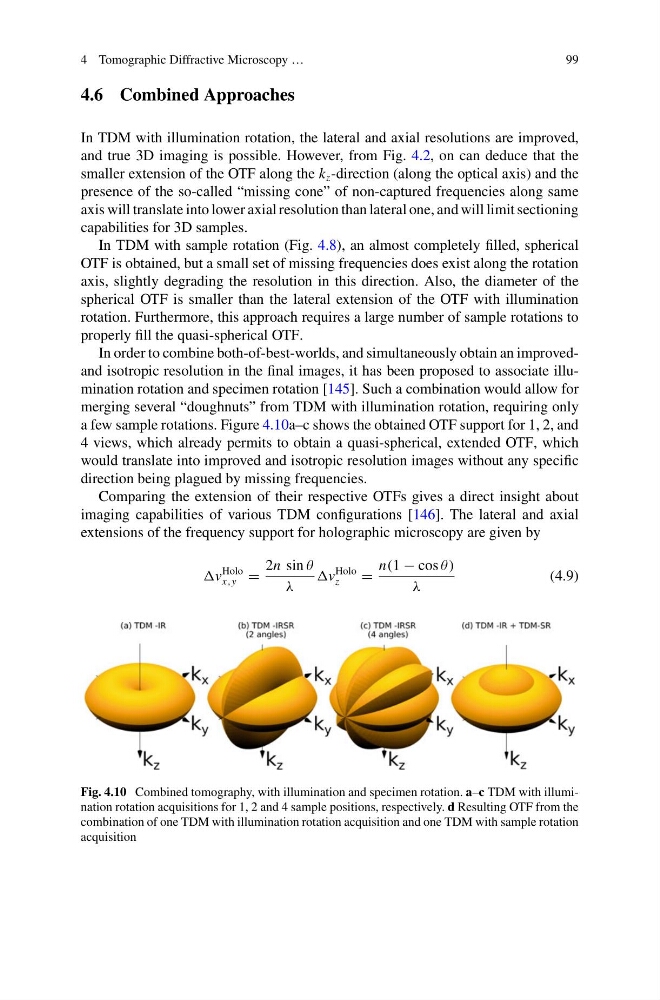
In order to combine both-of-best-worlds, and simultaneously obtain an improvedand isotropic resolution in the final images, it has been proposed to associate illumination rotation and specimen rotation [145]. Such a combination would allow for
merging several “doughnuts” from TDM with illumination rotation, requiring only
a few sample rotations. Figure 4.10a–c shows the obtained OTF support for 1, 2, and
4 views, which already permits to obtain a quasi-spherical, extended OTF, which
would translate into improved and isotropic resolution images without any specific
direction being plagued by missing frequencies.
Comparing the extension of their respective OTFs gives a direct insight about
imaging capabilities of various TDM configurations [146]. The lateral and axial
extensions of the frequency support for holographic microscopy are given by
v
Holo
x,y =
2n sin θ
λ
v
Holo
z
=
n(1 − cos θ)
λ
(4.9)
Fig. 4.10 Combined tomography, with illumination and specimen rotation. a–c TDM with illumination rotation acquisitions for 1, 2 and 4 sample positions, respectively. d Resulting OTF from the
combination of one TDM with illumination rotation acquisition and one TDM with sample rotation
acquisition
99
4.6 Combined Approaches
In TDM with illumination rotation, the lateral and axial resolutions are improved,
and true 3D imaging is possible. However, from Fig. 4.2, on can deduce that the
smaller extension of the OTF along the k z -direction (along the optical axis) and the
presence of the so-called “missing cone” of non-captured frequencies along same
axis will translate into lower axial resolution than lateral one, and will limit sectioning
capabilities for 3D samples.
In TDM with sample rotation (Fig. 4.8), an almost completely filled, spherical
OTF is obtained, but a small set of missing frequencies does exist along the rotation
axis, slightly degrading the resolution in this direction. Also, the diameter of the
spherical OTF is smaller than the lateral extension of the OTF with illumination
rotation. Furthermore, this approach requires a large number of sample rotations to
properly fill the quasi-spherical OTF.
In order to combine both-of-best-worlds, and simultaneously obtain an improvedand isotropic resolution in the final images, it has been proposed to associate illumination rotation and specimen rotation [145]. Such a combination would allow for
merging several “doughnuts” from TDM with illumination rotation, requiring only
a few sample rotations. Figure 4.10a–c shows the obtained OTF support for 1, 2, and
4 views, which already permits to obtain a quasi-spherical, extended OTF, which
would translate into improved and isotropic resolution images without any specific
direction being plagued by missing frequencies.
Comparing the extension of their respective OTFs gives a direct insight about
imaging capabilities of various TDM configurations [146]. The lateral and axial
extensions of the frequency support for holographic microscopy are given by
v
Holo
x,y =
2n sin θ
λ
v
Holo
z
=
n(1 − cos θ)
λ
(4.9)
Fig. 4.10 Combined tomography, with illumination and specimen rotation. a–c TDM with illumination rotation acquisitions for 1, 2 and 4 sample positions, respectively. d Resulting OTF from the
combination of one TDM with illumination rotation acquisition and one TDM with sample rotation
acquisition