

4 Brain Tissue Mechanical Properties
85
Hyperelastic models were originally developed to describe the nonlinear elastic
behaviour of rubbers. They use the concept of a strain energy potential function,
from which the relationship between stress and strain tensors is derived. The strain
energy function, W, is usually defined in terms of the invariants (I 1 , I 2 , I 3 ) of
the strain tensor, S, which is itself defined by the deformation gradient tensor,
F. If a material is incompressible, then the third strain invariant is unity, and the
strain energy function is only a function of the first two invariants. The stressstrain relationship is then obtained from a partial derivative of the strain energy
potential with respect to F. Depending on the choice of the strain energy potential,
the particular stress and strain tensors used, and the invariants that the definition
uses, this derivation can become algebraically complex, and the reader is referred to
solid mechanics texts for further details. Common hyperelastic models include those
that use strain energy functions that are polynomial functions of the invariants, such
as the Mooney-Rivlin model, and the Ogden model, which uses a strain energy
function defined in terms of the principal stretch ratios occurring in a material.
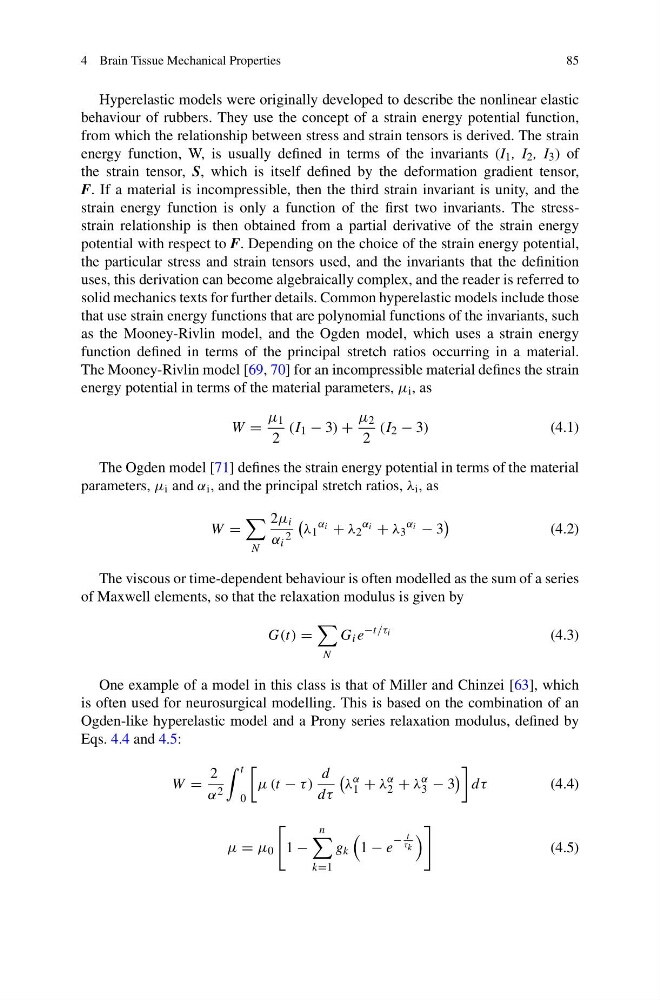
The Mooney-Rivlin model [69, 70] for an incompressible material defines the strain
energy potential in terms of the material parameters, μ i , as
W =
μ 1
2
(I 1 − 3) +
μ 2
2
(I 2 − 3)
(4.1)
The Ogden model [71] defines the strain energy potential in terms of the material
parameters, μ i and α i , and the principal stretch ratios, λ i , as
W =
N
2μ i
α i
2
λ 1
α i + λ 2
α i + λ 3
α i − 3
(4.2)
The viscous or time-dependent behaviour is often modelled as the sum of a series
of Maxwell elements, so that the relaxation modulus is given by
G(t) =
N
G i e
−t/τ i
(4.3)
One example of a model in this class is that of Miller and Chinzei [63], which
is often used for neurosurgical modelling. This is based on the combination of an
Ogden-like hyperelastic model and a Prony series relaxation modulus, defined by
Eqs. 4.4 and 4.5:
W =
2
α 2
t
0
μ (t − τ )
d
dτ
λ
α
1 + λ
α
2 + λ
α
3 − 3
dτ
(4.4)
μ = μ 0
1 −
n
k=1
g k
1 − e
−
t
τ k
(4.5)
85
Hyperelastic models were originally developed to describe the nonlinear elastic
behaviour of rubbers. They use the concept of a strain energy potential function,
from which the relationship between stress and strain tensors is derived. The strain
energy function, W, is usually defined in terms of the invariants (I 1 , I 2 , I 3 ) of
the strain tensor, S, which is itself defined by the deformation gradient tensor,
F. If a material is incompressible, then the third strain invariant is unity, and the
strain energy function is only a function of the first two invariants. The stressstrain relationship is then obtained from a partial derivative of the strain energy
potential with respect to F. Depending on the choice of the strain energy potential,
the particular stress and strain tensors used, and the invariants that the definition
uses, this derivation can become algebraically complex, and the reader is referred to
solid mechanics texts for further details. Common hyperelastic models include those
that use strain energy functions that are polynomial functions of the invariants, such
as the Mooney-Rivlin model, and the Ogden model, which uses a strain energy
function defined in terms of the principal stretch ratios occurring in a material.
The Mooney-Rivlin model [69, 70] for an incompressible material defines the strain
energy potential in terms of the material parameters, μ i , as
W =
μ 1
2
(I 1 − 3) +
μ 2
2
(I 2 − 3)
(4.1)
The Ogden model [71] defines the strain energy potential in terms of the material
parameters, μ i and α i , and the principal stretch ratios, λ i , as
W =
N
2μ i
α i
2
λ 1
α i + λ 2
α i + λ 3
α i − 3
(4.2)
The viscous or time-dependent behaviour is often modelled as the sum of a series
of Maxwell elements, so that the relaxation modulus is given by
G(t) =
N
G i e
−t/τ i
(4.3)
One example of a model in this class is that of Miller and Chinzei [63], which
is often used for neurosurgical modelling. This is based on the combination of an
Ogden-like hyperelastic model and a Prony series relaxation modulus, defined by
Eqs. 4.4 and 4.5:
W =
2
α 2
t
0
μ (t − τ )
d
dτ
λ
α
1 + λ
α
2 + λ
α
3 − 3
dτ
(4.4)
μ = μ 0
1 −
n
k=1
g k
1 − e
−
t
τ k
(4.5)