

84
L. E. Bilston
0
100
200
300
400
500
600
700
800
900
0
0.1
0.2
0.3
0.4
0.5
0.6
0.7
Strain
)
a
P
(
s
s
e
r
t
S
Velardi et al 0.01/s
Miller & Chinzei 0.0064/s
Miller & Chinzei 0.64/s
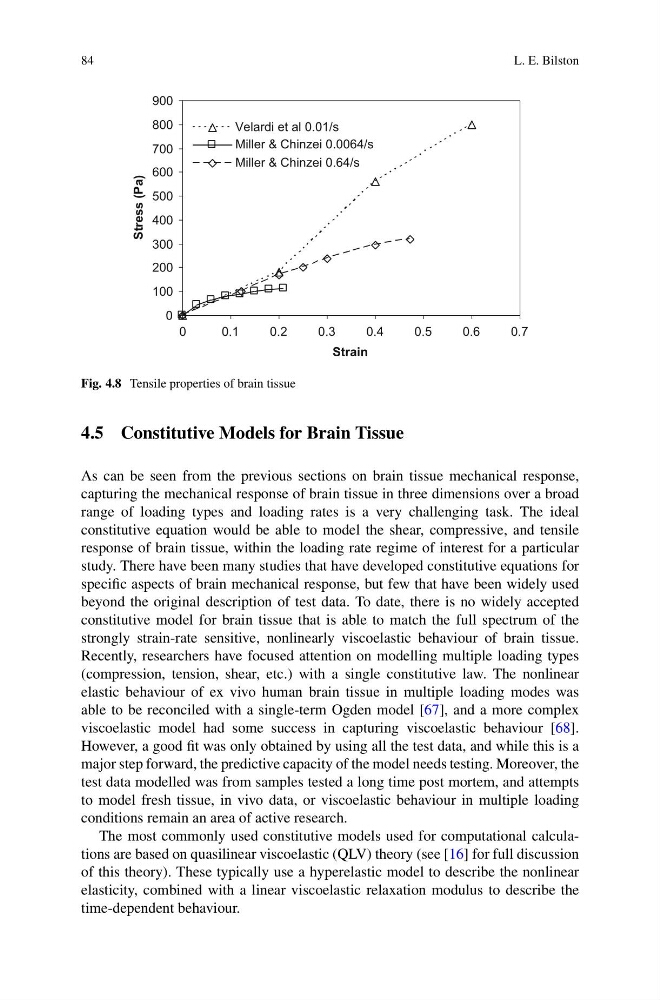
Fig. 4.8 Tensile properties of brain tissue
4.5 Constitutive Models for Brain Tissue
As can be seen from the previous sections on brain tissue mechanical response,
capturing the mechanical response of brain tissue in three dimensions over a broad
range of loading types and loading rates is a very challenging task. The ideal
constitutive equation would be able to model the shear, compressive, and tensile
response of brain tissue, within the loading rate regime of interest for a particular
study. There have been many studies that have developed constitutive equations for
specific aspects of brain mechanical response, but few that have been widely used
beyond the original description of test data. To date, there is no widely accepted
constitutive model for brain tissue that is able to match the full spectrum of the
strongly strain-rate sensitive, nonlinearly viscoelastic behaviour of brain tissue.
Recently, researchers have focused attention on modelling multiple loading types
(compression, tension, shear, etc.) with a single constitutive law. The nonlinear
elastic behaviour of ex vivo human brain tissue in multiple loading modes was
able to be reconciled with a single-term Ogden model [67], and a more complex
viscoelastic model had some success in capturing viscoelastic behaviour [68].
However, a good fit was only obtained by using all the test data, and while this is a
major step forward, the predictive capacity of the model needs testing. Moreover, the
test data modelled was from samples tested a long time post mortem, and attempts
to model fresh tissue, in vivo data, or viscoelastic behaviour in multiple loading
conditions remain an area of active research.
The most commonly used constitutive models used for computational calculations are based on quasilinear viscoelastic (QLV) theory (see [16] for full discussion
of this theory). These typically use a hyperelastic model to describe the nonlinear
elasticity, combined with a linear viscoelastic relaxation modulus to describe the
time-dependent behaviour.
L. E. Bilston
0
100
200
300
400
500
600
700
800
900
0
0.1
0.2
0.3
0.4
0.5
0.6
0.7
Strain
)
a
P
(
s
s
e
r
t
S
Velardi et al 0.01/s
Miller & Chinzei 0.0064/s
Miller & Chinzei 0.64/s
Fig. 4.8 Tensile properties of brain tissue
4.5 Constitutive Models for Brain Tissue
As can be seen from the previous sections on brain tissue mechanical response,
capturing the mechanical response of brain tissue in three dimensions over a broad
range of loading types and loading rates is a very challenging task. The ideal
constitutive equation would be able to model the shear, compressive, and tensile
response of brain tissue, within the loading rate regime of interest for a particular
study. There have been many studies that have developed constitutive equations for
specific aspects of brain mechanical response, but few that have been widely used
beyond the original description of test data. To date, there is no widely accepted
constitutive model for brain tissue that is able to match the full spectrum of the
strongly strain-rate sensitive, nonlinearly viscoelastic behaviour of brain tissue.
Recently, researchers have focused attention on modelling multiple loading types
(compression, tension, shear, etc.) with a single constitutive law. The nonlinear
elastic behaviour of ex vivo human brain tissue in multiple loading modes was
able to be reconciled with a single-term Ogden model [67], and a more complex
viscoelastic model had some success in capturing viscoelastic behaviour [68].
However, a good fit was only obtained by using all the test data, and while this is a
major step forward, the predictive capacity of the model needs testing. Moreover, the
test data modelled was from samples tested a long time post mortem, and attempts
to model fresh tissue, in vivo data, or viscoelastic behaviour in multiple loading
conditions remain an area of active research.
The most commonly used constitutive models used for computational calculations are based on quasilinear viscoelastic (QLV) theory (see [16] for full discussion
of this theory). These typically use a hyperelastic model to describe the nonlinear
elasticity, combined with a linear viscoelastic relaxation modulus to describe the
time-dependent behaviour.