

86
L. E. Bilston
Values for the material constants, α, and the Prony series coefficients suitable for
modelling of surgical procedures are given in [63]. The model has been based on
tension and compression data from animals, and it has not yet been validated for
human brain or for shear loading.
Other models use rate-dependent viscosity, such as the Carreau model (e.g. [47])
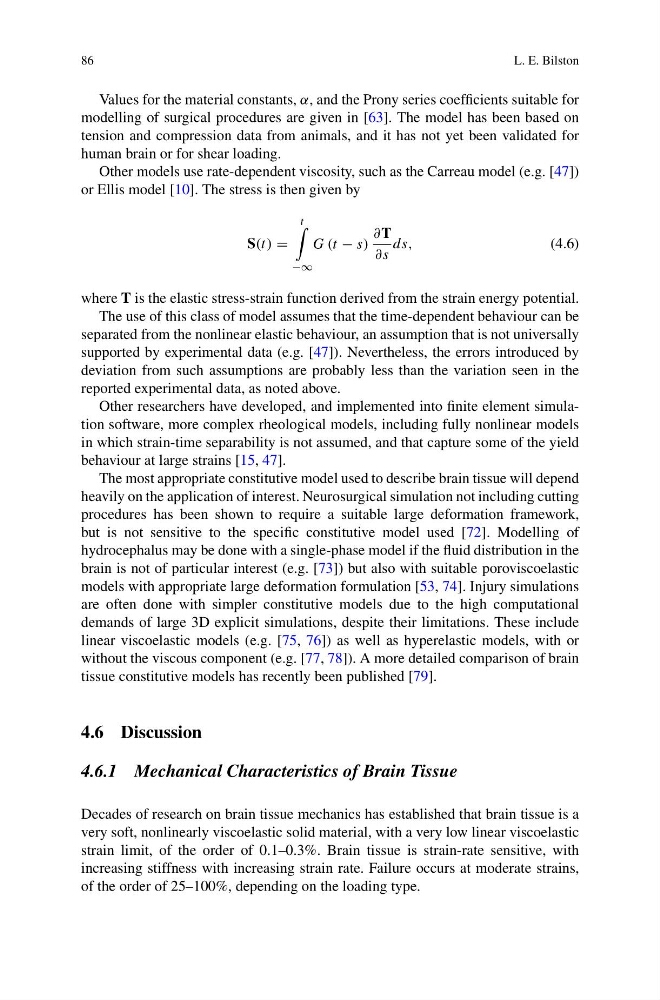
or Ellis model [10]. The stress is then given by
S(t) =
t
−∞
G (t − s)
∂T
∂s
ds,
(4.6)
where T is the elastic stress-strain function derived from the strain energy potential.
The use of this class of model assumes that the time-dependent behaviour can be
separated from the nonlinear elastic behaviour, an assumption that is not universally
supported by experimental data (e.g. [47]). Nevertheless, the errors introduced by
deviation from such assumptions are probably less than the variation seen in the
reported experimental data, as noted above.
Other researchers have developed, and implemented into finite element simulation software, more complex rheological models, including fully nonlinear models
in which strain-time separability is not assumed, and that capture some of the yield
behaviour at large strains [15, 47].
The most appropriate constitutive model used to describe brain tissue will depend
heavily on the application of interest. Neurosurgical simulation not including cutting
procedures has been shown to require a suitable large deformation framework,
but is not sensitive to the specific constitutive model used [72]. Modelling of
hydrocephalus may be done with a single-phase model if the fluid distribution in the
brain is not of particular interest (e.g. [73]) but also with suitable poroviscoelastic
models with appropriate large deformation formulation [53, 74]. Injury simulations
are often done with simpler constitutive models due to the high computational
demands of large 3D explicit simulations, despite their limitations. These include
linear viscoelastic models (e.g. [75, 76]) as well as hyperelastic models, with or
without the viscous component (e.g. [77, 78]). A more detailed comparison of brain
tissue constitutive models has recently been published [79].
4.6 Discussion
4.6.1 Mechanical Characteristics of Brain Tissue
Decades of research on brain tissue mechanics has established that brain tissue is a
very soft, nonlinearly viscoelastic solid material, with a very low linear viscoelastic
strain limit, of the order of 0.1–0.3%. Brain tissue is strain-rate sensitive, with
increasing stiffness with increasing strain rate. Failure occurs at moderate strains,
of the order of 25–100%, depending on the loading type.
L. E. Bilston
Values for the material constants, α, and the Prony series coefficients suitable for
modelling of surgical procedures are given in [63]. The model has been based on
tension and compression data from animals, and it has not yet been validated for
human brain or for shear loading.
Other models use rate-dependent viscosity, such as the Carreau model (e.g. [47])
or Ellis model [10]. The stress is then given by
S(t) =
t
−∞
G (t − s)
∂T
∂s
ds,
(4.6)
where T is the elastic stress-strain function derived from the strain energy potential.
The use of this class of model assumes that the time-dependent behaviour can be
separated from the nonlinear elastic behaviour, an assumption that is not universally
supported by experimental data (e.g. [47]). Nevertheless, the errors introduced by
deviation from such assumptions are probably less than the variation seen in the
reported experimental data, as noted above.
Other researchers have developed, and implemented into finite element simulation software, more complex rheological models, including fully nonlinear models
in which strain-time separability is not assumed, and that capture some of the yield
behaviour at large strains [15, 47].
The most appropriate constitutive model used to describe brain tissue will depend
heavily on the application of interest. Neurosurgical simulation not including cutting
procedures has been shown to require a suitable large deformation framework,
but is not sensitive to the specific constitutive model used [72]. Modelling of
hydrocephalus may be done with a single-phase model if the fluid distribution in the
brain is not of particular interest (e.g. [73]) but also with suitable poroviscoelastic
models with appropriate large deformation formulation [53, 74]. Injury simulations
are often done with simpler constitutive models due to the high computational
demands of large 3D explicit simulations, despite their limitations. These include
linear viscoelastic models (e.g. [75, 76]) as well as hyperelastic models, with or
without the viscous component (e.g. [77, 78]). A more detailed comparison of brain
tissue constitutive models has recently been published [79].
4.6 Discussion
4.6.1 Mechanical Characteristics of Brain Tissue
Decades of research on brain tissue mechanics has established that brain tissue is a
very soft, nonlinearly viscoelastic solid material, with a very low linear viscoelastic
strain limit, of the order of 0.1–0.3%. Brain tissue is strain-rate sensitive, with
increasing stiffness with increasing strain rate. Failure occurs at moderate strains,
of the order of 25–100%, depending on the loading type.