

4 Brain Tissue Mechanical Properties
81
new information that would help in developing and establishing the validity of
constitutive models for brain tissue.
4.3 Compressive Properties of Brain Tissue
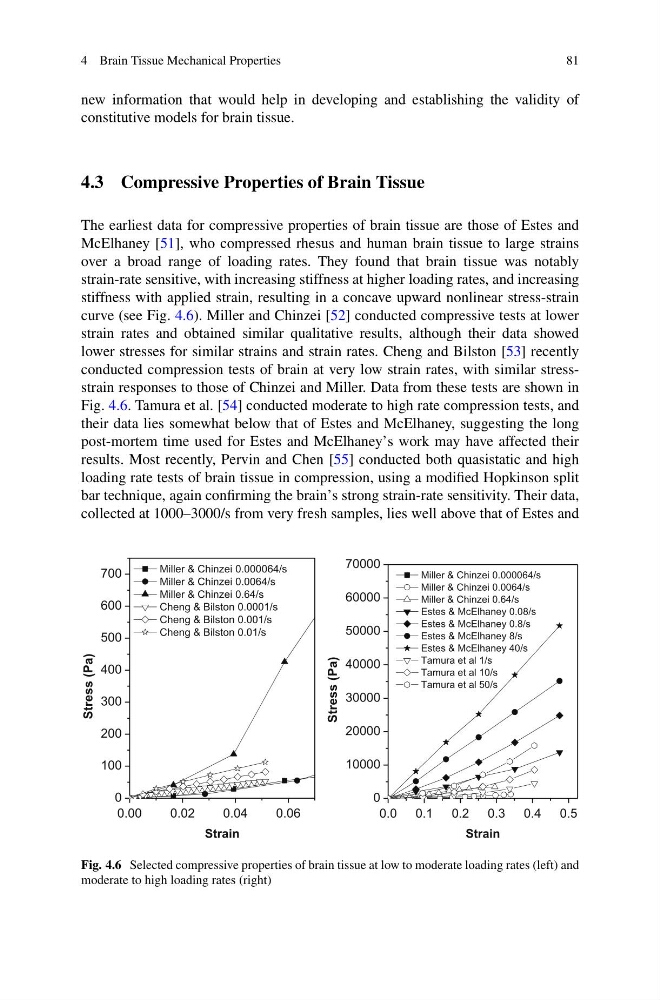
The earliest data for compressive properties of brain tissue are those of Estes and
McElhaney [51], who compressed rhesus and human brain tissue to large strains
over a broad range of loading rates. They found that brain tissue was notably
strain-rate sensitive, with increasing stiffness at higher loading rates, and increasing
stiffness with applied strain, resulting in a concave upward nonlinear stress-strain
curve (see Fig. 4.6). Miller and Chinzei [52] conducted compressive tests at lower
strain rates and obtained similar qualitative results, although their data showed
lower stresses for similar strains and strain rates. Cheng and Bilston [53] recently
conducted compression tests of brain at very low strain rates, with similar stressstrain responses to those of Chinzei and Miller. Data from these tests are shown in
Fig. 4.6. Tamura et al. [54] conducted moderate to high rate compression tests, and
their data lies somewhat below that of Estes and McElhaney, suggesting the long
post-mortem time used for Estes and McElhaney’s work may have affected their
results. Most recently, Pervin and Chen [55] conducted both quasistatic and high
loading rate tests of brain tissue in compression, using a modified Hopkinson split
bar technique, again confirming the brain’s strong strain-rate sensitivity. Their data,
collected at 1000–3000/s from very fresh samples, lies well above that of Estes and
0.00
0.02
0.04
0.06
0
100
200
300
400
500
600
700
)
a
P
(
s
s
e
r
t
S
Strain
Miller & Chinzei 0.000064/s
Miller & Chinzei 0.0064/s
Miller & Chinzei 0.64/s
Cheng & Bilston 0.0001/s
Cheng & Bilston 0.001/s
Cheng & Bilston 0.01/s
0.0 0.1 0.2 0.3 0.4 0.5
0
10000
20000
30000
40000
50000
60000
70000
)
a
P
(
s
s
e
r
t
S
Strain
Miller & Chinzei 0.000064/s
Miller & Chinzei 0.0064/s
Miller & Chinzei 0.64/s
Estes & McElhaney 0.08/s
Estes & McElhaney 0.8/s
Estes & McElhaney 8/s
Estes & McElhaney 40/s
Tamura et al 1/s
Tamura et al 10/s
Tamura et al 50/s
Fig. 4.6 Selected compressive properties of brain tissue at low to moderate loading rates (left) and
moderate to high loading rates (right)
81
new information that would help in developing and establishing the validity of
constitutive models for brain tissue.
4.3 Compressive Properties of Brain Tissue
The earliest data for compressive properties of brain tissue are those of Estes and
McElhaney [51], who compressed rhesus and human brain tissue to large strains
over a broad range of loading rates. They found that brain tissue was notably
strain-rate sensitive, with increasing stiffness at higher loading rates, and increasing
stiffness with applied strain, resulting in a concave upward nonlinear stress-strain
curve (see Fig. 4.6). Miller and Chinzei [52] conducted compressive tests at lower
strain rates and obtained similar qualitative results, although their data showed
lower stresses for similar strains and strain rates. Cheng and Bilston [53] recently
conducted compression tests of brain at very low strain rates, with similar stressstrain responses to those of Chinzei and Miller. Data from these tests are shown in
Fig. 4.6. Tamura et al. [54] conducted moderate to high rate compression tests, and
their data lies somewhat below that of Estes and McElhaney, suggesting the long
post-mortem time used for Estes and McElhaney’s work may have affected their
results. Most recently, Pervin and Chen [55] conducted both quasistatic and high
loading rate tests of brain tissue in compression, using a modified Hopkinson split
bar technique, again confirming the brain’s strong strain-rate sensitivity. Their data,
collected at 1000–3000/s from very fresh samples, lies well above that of Estes and
0.00
0.02
0.04
0.06
0
100
200
300
400
500
600
700
)
a
P
(
s
s
e
r
t
S
Strain
Miller & Chinzei 0.000064/s
Miller & Chinzei 0.0064/s
Miller & Chinzei 0.64/s
Cheng & Bilston 0.0001/s
Cheng & Bilston 0.001/s
Cheng & Bilston 0.01/s
0.0 0.1 0.2 0.3 0.4 0.5
0
10000
20000
30000
40000
50000
60000
70000
)
a
P
(
s
s
e
r
t
S
Strain
Miller & Chinzei 0.000064/s
Miller & Chinzei 0.0064/s
Miller & Chinzei 0.64/s
Estes & McElhaney 0.08/s
Estes & McElhaney 0.8/s
Estes & McElhaney 8/s
Estes & McElhaney 40/s
Tamura et al 1/s
Tamura et al 10/s
Tamura et al 50/s
Fig. 4.6 Selected compressive properties of brain tissue at low to moderate loading rates (left) and
moderate to high loading rates (right)