

80
L. E. Bilston
4.2.2.3 Constant Loading Rate
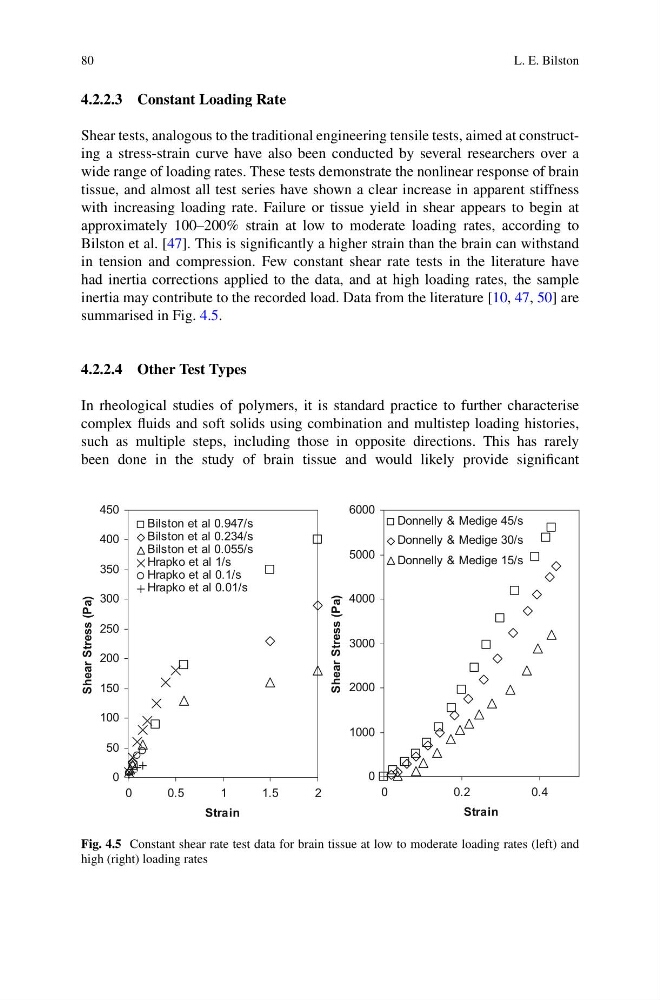
Shear tests, analogous to the traditional engineering tensile tests, aimed at constructing a stress-strain curve have also been conducted by several researchers over a
wide range of loading rates. These tests demonstrate the nonlinear response of brain
tissue, and almost all test series have shown a clear increase in apparent stiffness
with increasing loading rate. Failure or tissue yield in shear appears to begin at
approximately 100–200% strain at low to moderate loading rates, according to
Bilston et al. [47]. This is significantly a higher strain than the brain can withstand
in tension and compression. Few constant shear rate tests in the literature have
had inertia corrections applied to the data, and at high loading rates, the sample
inertia may contribute to the recorded load. Data from the literature [10, 47, 50] are
summarised in Fig. 4.5.
4.2.2.4 Other Test Types
In rheological studies of polymers, it is standard practice to further characterise
complex fluids and soft solids using combination and multistep loading histories,
such as multiple steps, including those in opposite directions. This has rarely
been done in the study of brain tissue and would likely provide significant
0
1000
2000
3000
4000
5000
6000
0
0 . 2
0 . 4
Strain
Shear Stress (Pa)
Donnelly & Medige 45/s
Donnelly & Medige 30/s
Donnelly & Medige 15/s
0
50
100
150
200
250
300
350
400
450
0
0 . 5
1
1 . 5
2
Strain
Shear Stress (Pa)
Bilston et al 0.947/s
Bilston et al 0.234/s
Bilston et al 0.055/s
Hrapko et al 1/s
Hrapko et al 0.1/s
Hrapko et al 0.01/s
Fig. 4.5 Constant shear rate test data for brain tissue at low to moderate loading rates (left) and
high (right) loading rates
L. E. Bilston
4.2.2.3 Constant Loading Rate
Shear tests, analogous to the traditional engineering tensile tests, aimed at constructing a stress-strain curve have also been conducted by several researchers over a
wide range of loading rates. These tests demonstrate the nonlinear response of brain
tissue, and almost all test series have shown a clear increase in apparent stiffness
with increasing loading rate. Failure or tissue yield in shear appears to begin at
approximately 100–200% strain at low to moderate loading rates, according to
Bilston et al. [47]. This is significantly a higher strain than the brain can withstand
in tension and compression. Few constant shear rate tests in the literature have
had inertia corrections applied to the data, and at high loading rates, the sample
inertia may contribute to the recorded load. Data from the literature [10, 47, 50] are
summarised in Fig. 4.5.
4.2.2.4 Other Test Types
In rheological studies of polymers, it is standard practice to further characterise
complex fluids and soft solids using combination and multistep loading histories,
such as multiple steps, including those in opposite directions. This has rarely
been done in the study of brain tissue and would likely provide significant
0
1000
2000
3000
4000
5000
6000
0
0 . 2
0 . 4
Strain
Shear Stress (Pa)
Donnelly & Medige 45/s
Donnelly & Medige 30/s
Donnelly & Medige 15/s
0
50
100
150
200
250
300
350
400
450
0
0 . 5
1
1 . 5
2
Strain
Shear Stress (Pa)
Bilston et al 0.947/s
Bilston et al 0.234/s
Bilston et al 0.055/s
Hrapko et al 1/s
Hrapko et al 0.1/s
Hrapko et al 0.01/s
Fig. 4.5 Constant shear rate test data for brain tissue at low to moderate loading rates (left) and
high (right) loading rates