

296
A. Wittek et al.
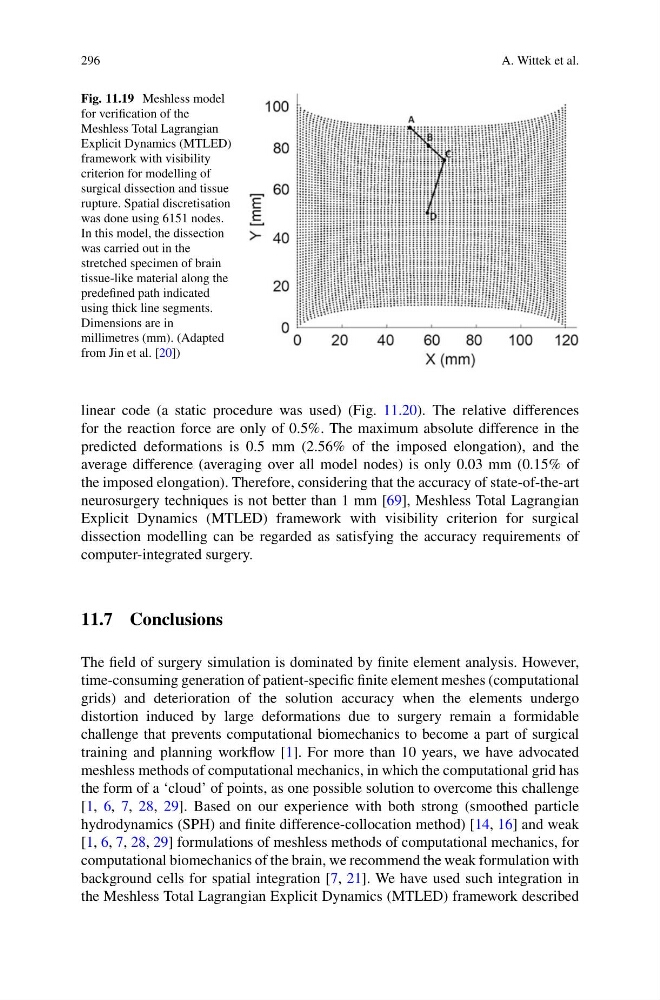
Fig. 11.19 Meshless model
for verification of the
Meshless Total Lagrangian
Explicit Dynamics (MTLED)
framework with visibility
criterion for modelling of
surgical dissection and tissue
rupture. Spatial discretisation
was done using 6151 nodes.
In this model, the dissection
was carried out in the
stretched specimen of brain
tissue-like material along the
predefined path indicated
using thick line segments.
Dimensions are in
millimetres (mm). (Adapted
from Jin et al. [20])
linear code (a static procedure was used) (Fig. 11.20). The relative differences
for the reaction force are only of 0.5%. The maximum absolute difference in the
predicted deformations is 0.5 mm (2.56% of the imposed elongation), and the
average difference (averaging over all model nodes) is only 0.03 mm (0.15% of
the imposed elongation). Therefore, considering that the accuracy of state-of-the-art
neurosurgery techniques is not better than 1 mm [69], Meshless Total Lagrangian
Explicit Dynamics (MTLED) framework with visibility criterion for surgical
dissection modelling can be regarded as satisfying the accuracy requirements of
computer-integrated surgery.
11.7 Conclusions
The field of surgery simulation is dominated by finite element analysis. However,
time-consuming generation of patient-specific finite element meshes (computational
grids) and deterioration of the solution accuracy when the elements undergo
distortion induced by large deformations due to surgery remain a formidable
challenge that prevents computational biomechanics to become a part of surgical
training and planning workflow [1]. For more than 10 years, we have advocated
meshless methods of computational mechanics, in which the computational grid has
the form of a ‘cloud’ of points, as one possible solution to overcome this challenge
[1, 6, 7, 28, 29]. Based on our experience with both strong (smoothed particle
hydrodynamics (SPH) and finite difference-collocation method) [14, 16] and weak
[1, 6, 7, 28, 29] formulations of meshless methods of computational mechanics, for
computational biomechanics of the brain, we recommend the weak formulation with
background cells for spatial integration [7, 21]. We have used such integration in
the Meshless Total Lagrangian Explicit Dynamics (MTLED) framework described
A. Wittek et al.
Fig. 11.19 Meshless model
for verification of the
Meshless Total Lagrangian
Explicit Dynamics (MTLED)
framework with visibility
criterion for modelling of
surgical dissection and tissue
rupture. Spatial discretisation
was done using 6151 nodes.
In this model, the dissection
was carried out in the
stretched specimen of brain
tissue-like material along the
predefined path indicated
using thick line segments.
Dimensions are in
millimetres (mm). (Adapted
from Jin et al. [20])
linear code (a static procedure was used) (Fig. 11.20). The relative differences
for the reaction force are only of 0.5%. The maximum absolute difference in the
predicted deformations is 0.5 mm (2.56% of the imposed elongation), and the
average difference (averaging over all model nodes) is only 0.03 mm (0.15% of
the imposed elongation). Therefore, considering that the accuracy of state-of-the-art
neurosurgery techniques is not better than 1 mm [69], Meshless Total Lagrangian
Explicit Dynamics (MTLED) framework with visibility criterion for surgical
dissection modelling can be regarded as satisfying the accuracy requirements of
computer-integrated surgery.
11.7 Conclusions
The field of surgery simulation is dominated by finite element analysis. However,
time-consuming generation of patient-specific finite element meshes (computational
grids) and deterioration of the solution accuracy when the elements undergo
distortion induced by large deformations due to surgery remain a formidable
challenge that prevents computational biomechanics to become a part of surgical
training and planning workflow [1]. For more than 10 years, we have advocated
meshless methods of computational mechanics, in which the computational grid has
the form of a ‘cloud’ of points, as one possible solution to overcome this challenge
[1, 6, 7, 28, 29]. Based on our experience with both strong (smoothed particle
hydrodynamics (SPH) and finite difference-collocation method) [14, 16] and weak
[1, 6, 7, 28, 29] formulations of meshless methods of computational mechanics, for
computational biomechanics of the brain, we recommend the weak formulation with
background cells for spatial integration [7, 21]. We have used such integration in
the Meshless Total Lagrangian Explicit Dynamics (MTLED) framework described