

11 Meshless Algorithms for Computational Biomechanics of the Brain
297
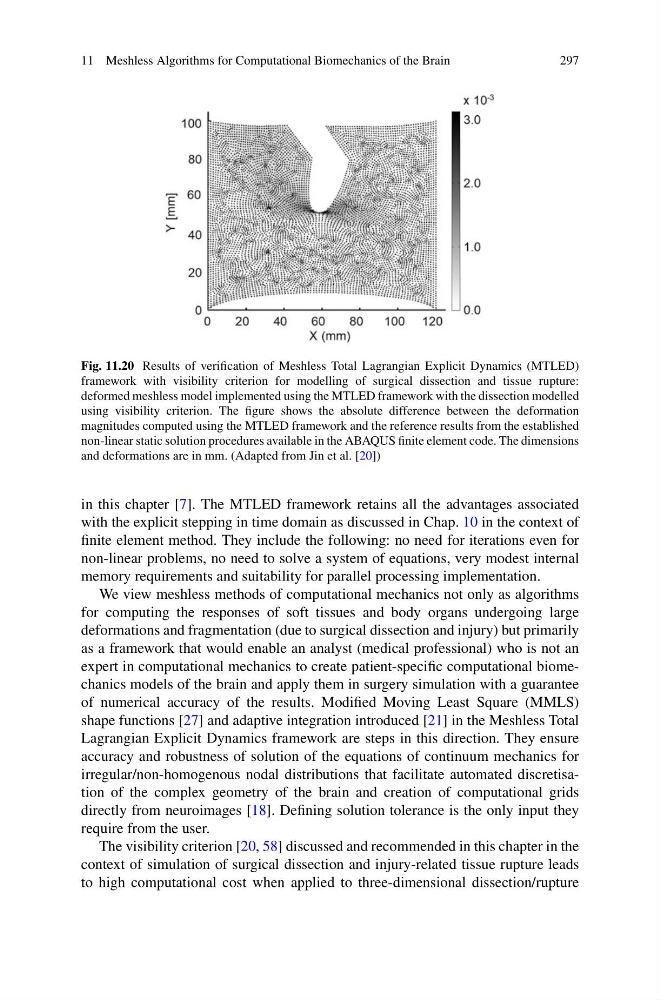
Fig. 11.20 Results of verification of Meshless Total Lagrangian Explicit Dynamics (MTLED)
framework with visibility criterion for modelling of surgical dissection and tissue rupture:
deformed meshless model implemented using the MTLED framework with the dissection modelled
using visibility criterion. The figure shows the absolute difference between the deformation
magnitudes computed using the MTLED framework and the reference results from the established
non-linear static solution procedures available in the ABAQUS finite element code. The dimensions
and deformations are in mm. (Adapted from Jin et al. [20])
in this chapter [7]. The MTLED framework retains all the advantages associated
with the explicit stepping in time domain as discussed in Chap. 10 in the context of
finite element method. They include the following: no need for iterations even for
non-linear problems, no need to solve a system of equations, very modest internal
memory requirements and suitability for parallel processing implementation.
We view meshless methods of computational mechanics not only as algorithms
for computing the responses of soft tissues and body organs undergoing large
deformations and fragmentation (due to surgical dissection and injury) but primarily
as a framework that would enable an analyst (medical professional) who is not an
expert in computational mechanics to create patient-specific computational biomechanics models of the brain and apply them in surgery simulation with a guarantee
of numerical accuracy of the results. Modified Moving Least Square (MMLS)
shape functions [27] and adaptive integration introduced [21] in the Meshless Total
Lagrangian Explicit Dynamics framework are steps in this direction. They ensure
accuracy and robustness of solution of the equations of continuum mechanics for
irregular/non-homogenous nodal distributions that facilitate automated discretisation of the complex geometry of the brain and creation of computational grids
directly from neuroimages [18]. Defining solution tolerance is the only input they
require from the user.
The visibility criterion [20, 58] discussed and recommended in this chapter in the
context of simulation of surgical dissection and injury-related tissue rupture leads
to high computational cost when applied to three-dimensional dissection/rupture
297
Fig. 11.20 Results of verification of Meshless Total Lagrangian Explicit Dynamics (MTLED)
framework with visibility criterion for modelling of surgical dissection and tissue rupture:
deformed meshless model implemented using the MTLED framework with the dissection modelled
using visibility criterion. The figure shows the absolute difference between the deformation
magnitudes computed using the MTLED framework and the reference results from the established
non-linear static solution procedures available in the ABAQUS finite element code. The dimensions
and deformations are in mm. (Adapted from Jin et al. [20])
in this chapter [7]. The MTLED framework retains all the advantages associated
with the explicit stepping in time domain as discussed in Chap. 10 in the context of
finite element method. They include the following: no need for iterations even for
non-linear problems, no need to solve a system of equations, very modest internal
memory requirements and suitability for parallel processing implementation.
We view meshless methods of computational mechanics not only as algorithms
for computing the responses of soft tissues and body organs undergoing large
deformations and fragmentation (due to surgical dissection and injury) but primarily
as a framework that would enable an analyst (medical professional) who is not an
expert in computational mechanics to create patient-specific computational biomechanics models of the brain and apply them in surgery simulation with a guarantee
of numerical accuracy of the results. Modified Moving Least Square (MMLS)
shape functions [27] and adaptive integration introduced [21] in the Meshless Total
Lagrangian Explicit Dynamics framework are steps in this direction. They ensure
accuracy and robustness of solution of the equations of continuum mechanics for
irregular/non-homogenous nodal distributions that facilitate automated discretisation of the complex geometry of the brain and creation of computational grids
directly from neuroimages [18]. Defining solution tolerance is the only input they
require from the user.
The visibility criterion [20, 58] discussed and recommended in this chapter in the
context of simulation of surgical dissection and injury-related tissue rupture leads
to high computational cost when applied to three-dimensional dissection/rupture