

11 Meshless Algorithms for Computational Biomechanics of the Brain
279
100
ABAQUS
a)
b)
Classical MLS, Linear basis
Tumour, Deformed position (Classical MLS)
Tumour, Undeformed position
Skull
ABAQUS
Modified MLS, quadratic basis
Tumour, Deformed position (MMLS)
Tumour, Undeformed position
Skull
0.6
0.5
0.4
0.3
0.2
0.1
80
60
40
20
y (mm)
0
-20
-20 0
20
x (mm)
40 60 80
-40
-40
-60
-60
-80
100
mm
mm 0.5
0.45
0.35
0.25
0.15
0.05
0.4
0.3
0.2
0.1
80
60
40
20
y (mm)
0
-20
-20 0
20
x (mm)
40 60 80
-40
-40
-60
-60
-80
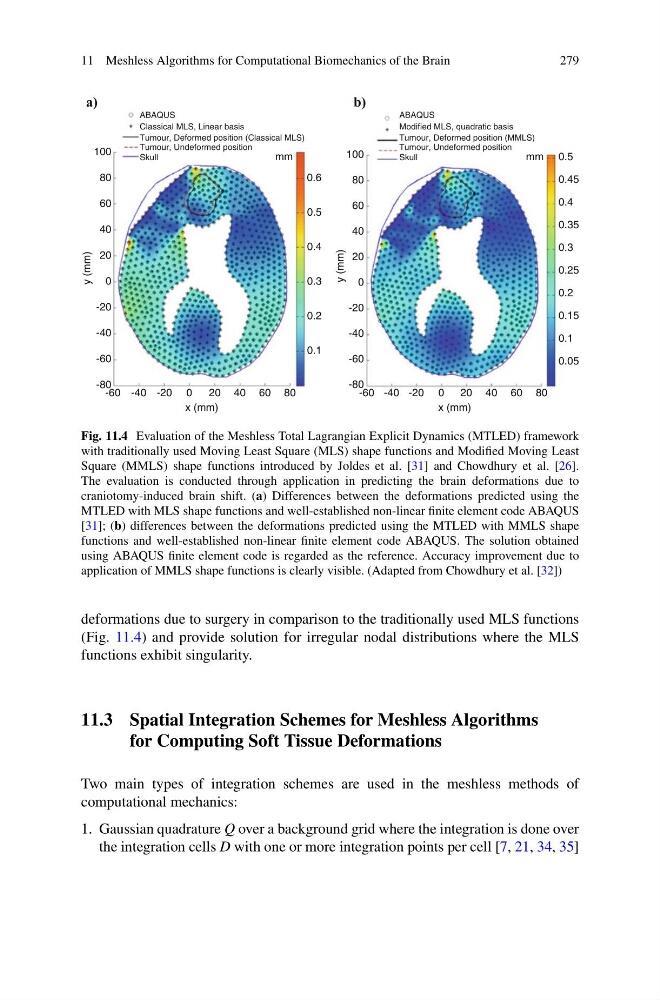
Fig. 11.4 Evaluation of the Meshless Total Lagrangian Explicit Dynamics (MTLED) framework
with traditionally used Moving Least Square (MLS) shape functions and Modified Moving Least
Square (MMLS) shape functions introduced by Joldes et al. [31] and Chowdhury et al. [26].
The evaluation is conducted through application in predicting the brain deformations due to
craniotomy-induced brain shift. (a) Differences between the deformations predicted using the
MTLED with MLS shape functions and well-established non-linear finite element code ABAQUS
[31]; (b) differences between the deformations predicted using the MTLED with MMLS shape
functions and well-established non-linear finite element code ABAQUS. The solution obtained
using ABAQUS finite element code is regarded as the reference. Accuracy improvement due to
application of MMLS shape functions is clearly visible. (Adapted from Chowdhury et al. [32])
deformations due to surgery in comparison to the traditionally used MLS functions
(Fig. 11.4) and provide solution for irregular nodal distributions where the MLS
functions exhibit singularity.
11.3 Spatial Integration Schemes for Meshless Algorithms
for Computing Soft Tissue Deformations
Two main types of integration schemes are used in the meshless methods of
computational mechanics:
1. Gaussian quadrature Q over a background grid where the integration is done over
the integration cells D with one or more integration points per cell [7, 21, 34, 35]
279
100
ABAQUS
a)
b)
Classical MLS, Linear basis
Tumour, Deformed position (Classical MLS)
Tumour, Undeformed position
Skull
ABAQUS
Modified MLS, quadratic basis
Tumour, Deformed position (MMLS)
Tumour, Undeformed position
Skull
0.6
0.5
0.4
0.3
0.2
0.1
80
60
40
20
y (mm)
0
-20
-20 0
20
x (mm)
40 60 80
-40
-40
-60
-60
-80
100
mm
mm 0.5
0.45
0.35
0.25
0.15
0.05
0.4
0.3
0.2
0.1
80
60
40
20
y (mm)
0
-20
-20 0
20
x (mm)
40 60 80
-40
-40
-60
-60
-80
Fig. 11.4 Evaluation of the Meshless Total Lagrangian Explicit Dynamics (MTLED) framework
with traditionally used Moving Least Square (MLS) shape functions and Modified Moving Least
Square (MMLS) shape functions introduced by Joldes et al. [31] and Chowdhury et al. [26].
The evaluation is conducted through application in predicting the brain deformations due to
craniotomy-induced brain shift. (a) Differences between the deformations predicted using the
MTLED with MLS shape functions and well-established non-linear finite element code ABAQUS
[31]; (b) differences between the deformations predicted using the MTLED with MMLS shape
functions and well-established non-linear finite element code ABAQUS. The solution obtained
using ABAQUS finite element code is regarded as the reference. Accuracy improvement due to
application of MMLS shape functions is clearly visible. (Adapted from Chowdhury et al. [32])
deformations due to surgery in comparison to the traditionally used MLS functions
(Fig. 11.4) and provide solution for irregular nodal distributions where the MLS
functions exhibit singularity.
11.3 Spatial Integration Schemes for Meshless Algorithms
for Computing Soft Tissue Deformations
Two main types of integration schemes are used in the meshless methods of
computational mechanics:
1. Gaussian quadrature Q over a background grid where the integration is done over
the integration cells D with one or more integration points per cell [7, 21, 34, 35]