

278
A. Wittek et al.
meshes, but as no elements need to be constructed, the usual constraints on the node
placement due to element quality considerations disappear.
We require from the shape functions in the MTLED framework to facilitate
robust approximation for irregular nodal distributions without the need for the user
to control/adjust the parameters of the distributions to achieve accurate solution.
Modified moving least shape functions introduced by Joldes et al. [27] and
Chowdhury et al. [22] address this challenge for higher-order bases functions.
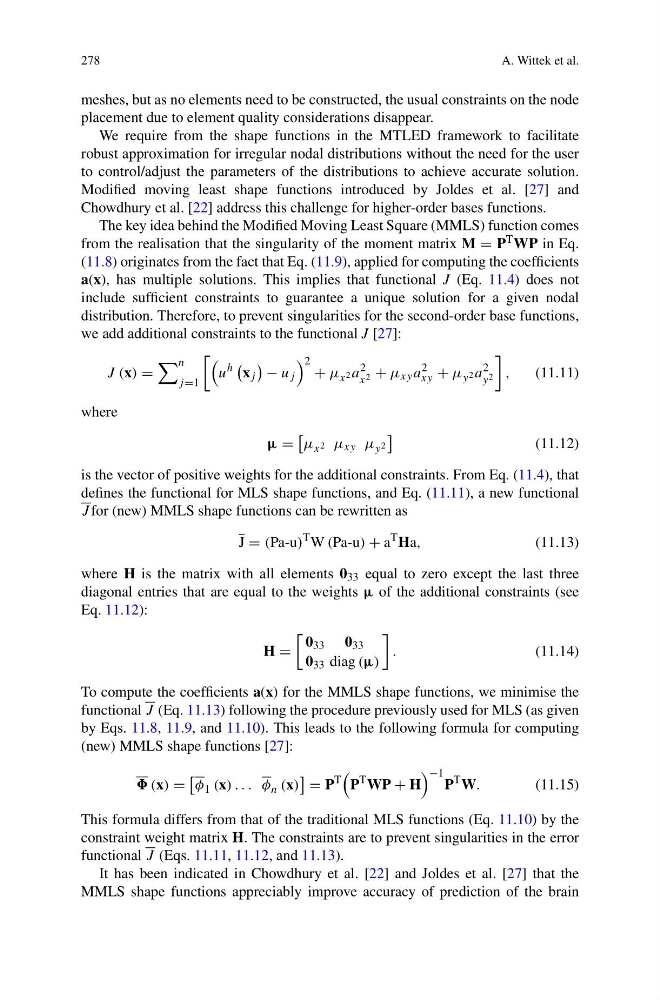
The key idea behind the Modified Moving Least Square (MMLS) function comes
from the realisation that the singularity of the moment matrix M = P T WP in Eq.
(11.8) originates from the fact that Eq. (11.9), applied for computing the coefficients
a(x), has multiple solutions. This implies that functional J (Eq. 11.4) does not
include sufficient constraints to guarantee a unique solution for a given nodal
distribution. Therefore, to prevent singularities for the second-order base functions,
we add additional constraints to the functional J [27]:
J (x) =
n
j =1
u
h
x j
− u j
2 + μ x 2 a
2
x 2 + μ xy a
2
xy + μ y 2 a
2
y 2
,
(11.11)
where
μ =
μ x 2 μ xy μ y 2
(11.12)
is the vector of positive weights for the additional constraints. From Eq. (11.4), that
defines the functional for MLS shape functions, and Eq. (11.11), a new functional
J for (new) MMLS shape functions can be rewritten as
J = (Pa-u)
T W (Pa-u) + a
T Ha,
(11.13)
where H is the matrix with all elements 0 33 equal to zero except the last three
diagonal entries that are equal to the weights μ of the additional constraints (see
Eq. 11.12):
H =
0 33 0 33
0 33 diag (μ)
.
(11.14)
To compute the coefficients a(x) for the MMLS shape functions, we minimise the
functional J (Eq. 11.13) following the procedure previously used for MLS (as given
by Eqs. 11.8, 11.9, and 11.10). This leads to the following formula for computing
(new) MMLS shape functions [27]:
(x) =
φ 1 (x) . . . φ n (x)
= P
T
P
T WP + H
−1
P
T W.
(11.15)
This formula differs from that of the traditional MLS functions (Eq. 11.10) by the
constraint weight matrix H. The constraints are to prevent singularities in the error
functional J (Eqs. 11.11, 11.12, and 11.13).
It has been indicated in Chowdhury et al. [22] and Joldes et al. [27] that the
MMLS shape functions appreciably improve accuracy of prediction of the brain
A. Wittek et al.
meshes, but as no elements need to be constructed, the usual constraints on the node
placement due to element quality considerations disappear.
We require from the shape functions in the MTLED framework to facilitate
robust approximation for irregular nodal distributions without the need for the user
to control/adjust the parameters of the distributions to achieve accurate solution.
Modified moving least shape functions introduced by Joldes et al. [27] and
Chowdhury et al. [22] address this challenge for higher-order bases functions.
The key idea behind the Modified Moving Least Square (MMLS) function comes
from the realisation that the singularity of the moment matrix M = P T WP in Eq.
(11.8) originates from the fact that Eq. (11.9), applied for computing the coefficients
a(x), has multiple solutions. This implies that functional J (Eq. 11.4) does not
include sufficient constraints to guarantee a unique solution for a given nodal
distribution. Therefore, to prevent singularities for the second-order base functions,
we add additional constraints to the functional J [27]:
J (x) =
n
j =1
u
h
x j
− u j
2 + μ x 2 a
2
x 2 + μ xy a
2
xy + μ y 2 a
2
y 2
,
(11.11)
where
μ =
μ x 2 μ xy μ y 2
(11.12)
is the vector of positive weights for the additional constraints. From Eq. (11.4), that
defines the functional for MLS shape functions, and Eq. (11.11), a new functional
J for (new) MMLS shape functions can be rewritten as
J = (Pa-u)
T W (Pa-u) + a
T Ha,
(11.13)
where H is the matrix with all elements 0 33 equal to zero except the last three
diagonal entries that are equal to the weights μ of the additional constraints (see
Eq. 11.12):
H =
0 33 0 33
0 33 diag (μ)
.
(11.14)
To compute the coefficients a(x) for the MMLS shape functions, we minimise the
functional J (Eq. 11.13) following the procedure previously used for MLS (as given
by Eqs. 11.8, 11.9, and 11.10). This leads to the following formula for computing
(new) MMLS shape functions [27]:
(x) =
φ 1 (x) . . . φ n (x)
= P
T
P
T WP + H
−1
P
T W.
(11.15)
This formula differs from that of the traditional MLS functions (Eq. 11.10) by the
constraint weight matrix H. The constraints are to prevent singularities in the error
functional J (Eqs. 11.11, 11.12, and 11.13).
It has been indicated in Chowdhury et al. [22] and Joldes et al. [27] that the
MMLS shape functions appreciably improve accuracy of prediction of the brain