

11 Meshless Algorithms for Computational Biomechanics of the Brain
277
∂J
∂a
= P
T WPa (x) − P
T Wu = 0
(11.8)
and the coefficients a(x) at the evaluation points are obtained as
a (x) =
P
T WP
−1
P
T Wu,
(11.9)
where P T WP is also referred to as the moment matrix M = P T WP.
Following Joldes et al. [27], from Eq. (11.9), the shape functions can be
defined as
(x) = [φ 1 (x) . . . φ n (x)] = P
T
P
T WP
−1
P
T W.
(11.10)
According to Eq. (11.10), the shape functions can be constructed only if the
moment M = P T WP is non-singular. This implies that although the requirements
regarding the nodal distribution are much less stringent than in the finite element
method, where the nodes need to be arranged in a mesh of high-quality tetrahedral
or hexahedral elements (see Chap. 10), some conditions still apply, and not all
the nodal distributions are acceptable/admissible. These conditions depend on the
bases of the shape functions. This poses a challenge for meshless algorithms for
surgical simulation as the end-users are medical professionals rather than experts in
computational mechanics and, due to complex geometry of the brain and other body
organs, irregular nodal distributions are an effective and convenient approach for
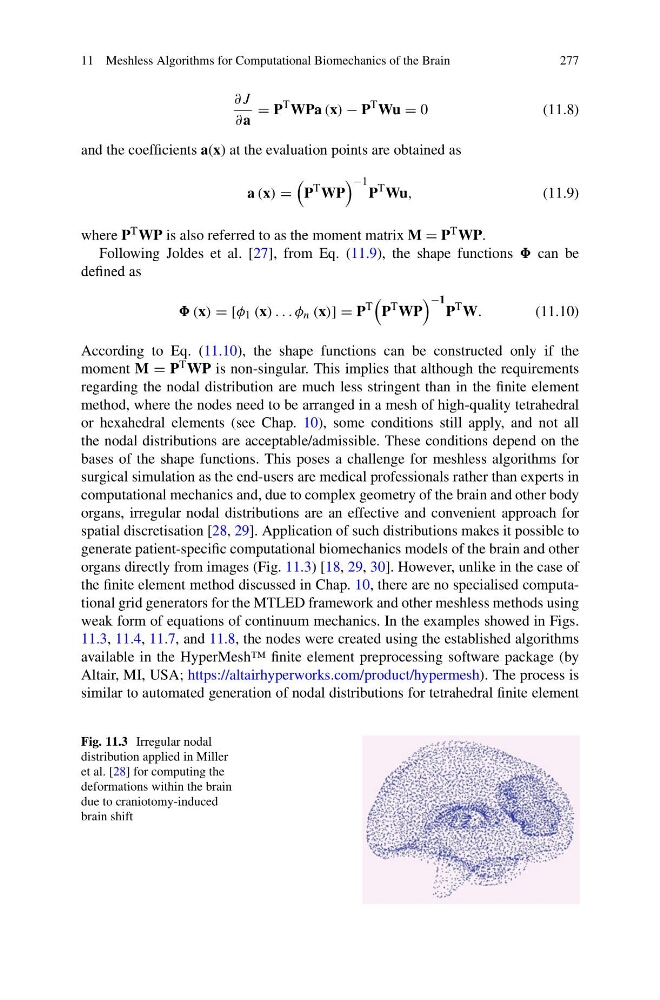
spatial discretisation [28, 29]. Application of such distributions makes it possible to
generate patient-specific computational biomechanics models of the brain and other
organs directly from images (Fig. 11.3) [18, 29, 30]. However, unlike in the case of
the finite element method discussed in Chap. 10, there are no specialised computational grid generators for the MTLED framework and other meshless methods using
weak form of equations of continuum mechanics. In the examples showed in Figs.
11.3, 11.4, 11.7, and 11.8, the nodes were created using the established algorithms
available in the HyperMesh™ finite element preprocessing software package (by
Altair, MI, USA; https://altairhyperworks.com/product/hypermesh). The process is
similar to automated generation of nodal distributions for tetrahedral finite element
Fig. 11.3 Irregular nodal
distribution applied in Miller
et al. [28] for computing the
deformations within the brain
due to craniotomy-induced
brain shift
277
∂J
∂a
= P
T WPa (x) − P
T Wu = 0
(11.8)
and the coefficients a(x) at the evaluation points are obtained as
a (x) =
P
T WP
−1
P
T Wu,
(11.9)
where P T WP is also referred to as the moment matrix M = P T WP.
Following Joldes et al. [27], from Eq. (11.9), the shape functions can be
defined as
(x) = [φ 1 (x) . . . φ n (x)] = P
T
P
T WP
−1
P
T W.
(11.10)
According to Eq. (11.10), the shape functions can be constructed only if the
moment M = P T WP is non-singular. This implies that although the requirements
regarding the nodal distribution are much less stringent than in the finite element
method, where the nodes need to be arranged in a mesh of high-quality tetrahedral
or hexahedral elements (see Chap. 10), some conditions still apply, and not all
the nodal distributions are acceptable/admissible. These conditions depend on the
bases of the shape functions. This poses a challenge for meshless algorithms for
surgical simulation as the end-users are medical professionals rather than experts in
computational mechanics and, due to complex geometry of the brain and other body
organs, irregular nodal distributions are an effective and convenient approach for
spatial discretisation [28, 29]. Application of such distributions makes it possible to
generate patient-specific computational biomechanics models of the brain and other
organs directly from images (Fig. 11.3) [18, 29, 30]. However, unlike in the case of
the finite element method discussed in Chap. 10, there are no specialised computational grid generators for the MTLED framework and other meshless methods using
weak form of equations of continuum mechanics. In the examples showed in Figs.
11.3, 11.4, 11.7, and 11.8, the nodes were created using the established algorithms
available in the HyperMesh™ finite element preprocessing software package (by
Altair, MI, USA; https://altairhyperworks.com/product/hypermesh). The process is
similar to automated generation of nodal distributions for tetrahedral finite element
Fig. 11.3 Irregular nodal
distribution applied in Miller
et al. [28] for computing the
deformations within the brain
due to craniotomy-induced
brain shift