

266
A. Wittek et al.
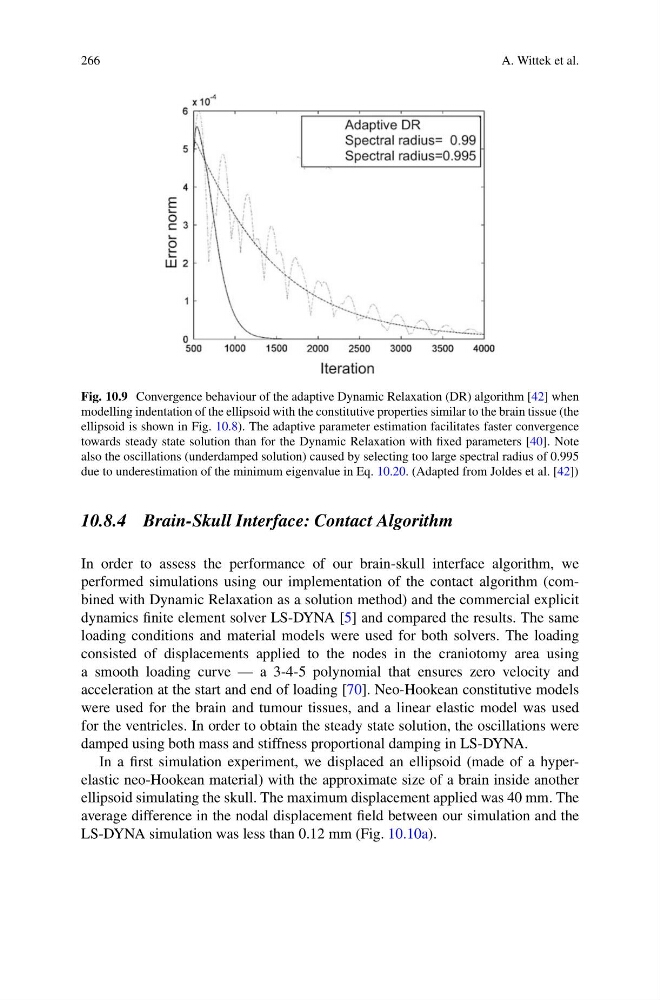
Fig. 10.9 Convergence behaviour of the adaptive Dynamic Relaxation (DR) algorithm [42] when
modelling indentation of the ellipsoid with the constitutive properties similar to the brain tissue (the
ellipsoid is shown in Fig. 10.8). The adaptive parameter estimation facilitates faster convergence
towards steady state solution than for the Dynamic Relaxation with fixed parameters [40]. Note
also the oscillations (underdamped solution) caused by selecting too large spectral radius of 0.995
due to underestimation of the minimum eigenvalue in Eq. 10.20. (Adapted from Joldes et al. [42])
10.8.4 Brain-Skull Interface: Contact Algorithm
In order to assess the performance of our brain-skull interface algorithm, we
performed simulations using our implementation of the contact algorithm (combined with Dynamic Relaxation as a solution method) and the commercial explicit
dynamics finite element solver LS-DYNA [5] and compared the results. The same
loading conditions and material models were used for both solvers. The loading
consisted of displacements applied to the nodes in the craniotomy area using
a smooth loading curve — a 3-4-5 polynomial that ensures zero velocity and
acceleration at the start and end of loading [70]. Neo-Hookean constitutive models
were used for the brain and tumour tissues, and a linear elastic model was used
for the ventricles. In order to obtain the steady state solution, the oscillations were
damped using both mass and stiffness proportional damping in LS-DYNA.
In a first simulation experiment, we displaced an ellipsoid (made of a hyperelastic neo-Hookean material) with the approximate size of a brain inside another
ellipsoid simulating the skull. The maximum displacement applied was 40 mm. The
average difference in the nodal displacement field between our simulation and the
LS-DYNA simulation was less than 0.12 mm (Fig. 10.10a).
A. Wittek et al.
Fig. 10.9 Convergence behaviour of the adaptive Dynamic Relaxation (DR) algorithm [42] when
modelling indentation of the ellipsoid with the constitutive properties similar to the brain tissue (the
ellipsoid is shown in Fig. 10.8). The adaptive parameter estimation facilitates faster convergence
towards steady state solution than for the Dynamic Relaxation with fixed parameters [40]. Note
also the oscillations (underdamped solution) caused by selecting too large spectral radius of 0.995
due to underestimation of the minimum eigenvalue in Eq. 10.20. (Adapted from Joldes et al. [42])
10.8.4 Brain-Skull Interface: Contact Algorithm
In order to assess the performance of our brain-skull interface algorithm, we
performed simulations using our implementation of the contact algorithm (combined with Dynamic Relaxation as a solution method) and the commercial explicit
dynamics finite element solver LS-DYNA [5] and compared the results. The same
loading conditions and material models were used for both solvers. The loading
consisted of displacements applied to the nodes in the craniotomy area using
a smooth loading curve — a 3-4-5 polynomial that ensures zero velocity and
acceleration at the start and end of loading [70]. Neo-Hookean constitutive models
were used for the brain and tumour tissues, and a linear elastic model was used
for the ventricles. In order to obtain the steady state solution, the oscillations were
damped using both mass and stiffness proportional damping in LS-DYNA.
In a first simulation experiment, we displaced an ellipsoid (made of a hyperelastic neo-Hookean material) with the approximate size of a brain inside another
ellipsoid simulating the skull. The maximum displacement applied was 40 mm. The
average difference in the nodal displacement field between our simulation and the
LS-DYNA simulation was less than 0.12 mm (Fig. 10.10a).