

10 Finite Element Algorithms for Computational Biomechanics of the Brain
265
We performed the displacement computation first by using our algorithm and
second by using ABAQUS finite element code [8, 60]. For computational efficiency we use under-integrated hexahedral elements with the hourglass control
implemented based on the relations presented in [69]. In ABAQUS, we used
hybrid displacement-pressure hexahedral elements, which are the ‘gold standard’
for almost incompressible materials. We used the non-linear static solver from
ABAQUS with the default configuration and assumed that the simulation using this
solver provides the accurate results.
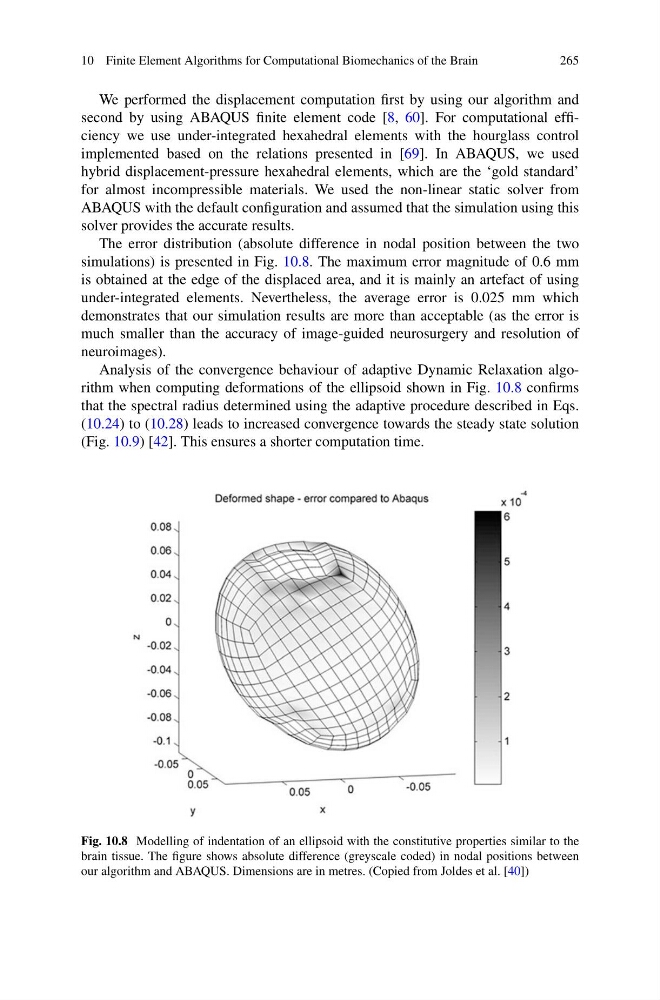
The error distribution (absolute difference in nodal position between the two
simulations) is presented in Fig. 10.8. The maximum error magnitude of 0.6 mm
is obtained at the edge of the displaced area, and it is mainly an artefact of using
under-integrated elements. Nevertheless, the average error is 0.025 mm which
demonstrates that our simulation results are more than acceptable (as the error is
much smaller than the accuracy of image-guided neurosurgery and resolution of
neuroimages).
Analysis of the convergence behaviour of adaptive Dynamic Relaxation algorithm when computing deformations of the ellipsoid shown in Fig. 10.8 confirms
that the spectral radius determined using the adaptive procedure described in Eqs.
(10.24) to (10.28) leads to increased convergence towards the steady state solution
(Fig. 10.9) [42]. This ensures a shorter computation time.
Fig. 10.8 Modelling of indentation of an ellipsoid with the constitutive properties similar to the
brain tissue. The figure shows absolute difference (greyscale coded) in nodal positions between
our algorithm and ABAQUS. Dimensions are in metres. (Copied from Joldes et al. [40])
265
We performed the displacement computation first by using our algorithm and
second by using ABAQUS finite element code [8, 60]. For computational efficiency we use under-integrated hexahedral elements with the hourglass control
implemented based on the relations presented in [69]. In ABAQUS, we used
hybrid displacement-pressure hexahedral elements, which are the ‘gold standard’
for almost incompressible materials. We used the non-linear static solver from
ABAQUS with the default configuration and assumed that the simulation using this
solver provides the accurate results.
The error distribution (absolute difference in nodal position between the two
simulations) is presented in Fig. 10.8. The maximum error magnitude of 0.6 mm
is obtained at the edge of the displaced area, and it is mainly an artefact of using
under-integrated elements. Nevertheless, the average error is 0.025 mm which
demonstrates that our simulation results are more than acceptable (as the error is
much smaller than the accuracy of image-guided neurosurgery and resolution of
neuroimages).
Analysis of the convergence behaviour of adaptive Dynamic Relaxation algorithm when computing deformations of the ellipsoid shown in Fig. 10.8 confirms
that the spectral radius determined using the adaptive procedure described in Eqs.
(10.24) to (10.28) leads to increased convergence towards the steady state solution
(Fig. 10.9) [42]. This ensures a shorter computation time.
Fig. 10.8 Modelling of indentation of an ellipsoid with the constitutive properties similar to the
brain tissue. The figure shows absolute difference (greyscale coded) in nodal positions between
our algorithm and ABAQUS. Dimensions are in metres. (Copied from Joldes et al. [40])