

264
A. Wittek et al.
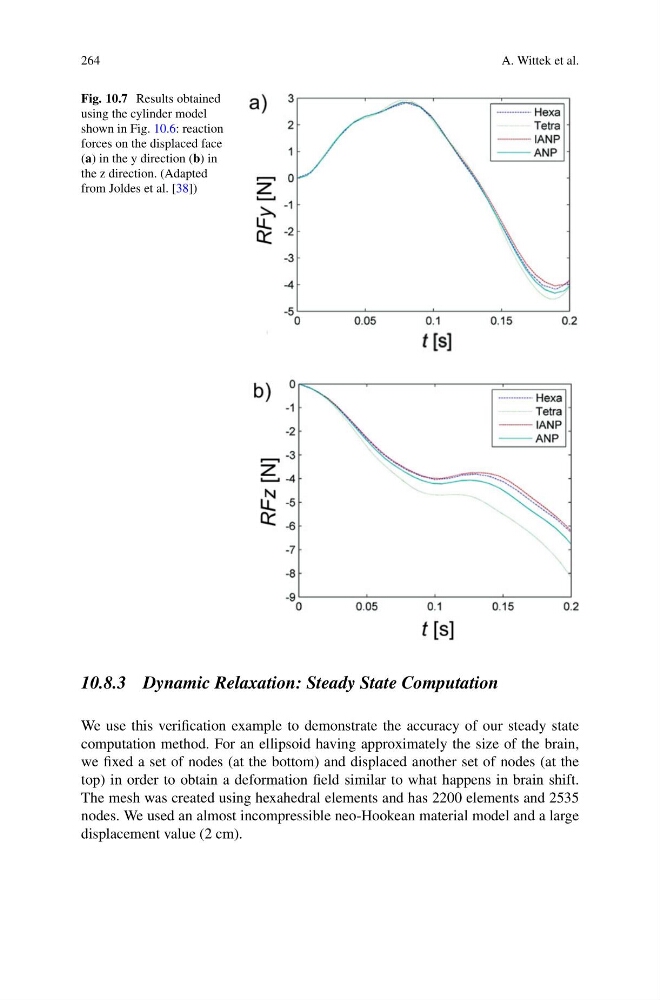
Fig. 10.7 Results obtained
using the cylinder model
shown in Fig. 10.6: reaction
forces on the displaced face
(a) in the y direction (b) in
the z direction. (Adapted
from Joldes et al. [38])
10.8.3 Dynamic Relaxation: Steady State Computation
We use this verification example to demonstrate the accuracy of our steady state
computation method. For an ellipsoid having approximately the size of the brain,
we fixed a set of nodes (at the bottom) and displaced another set of nodes (at the
top) in order to obtain a deformation field similar to what happens in brain shift.
The mesh was created using hexahedral elements and has 2200 elements and 2535
nodes. We used an almost incompressible neo-Hookean material model and a large
displacement value (2 cm).
A. Wittek et al.
Fig. 10.7 Results obtained
using the cylinder model
shown in Fig. 10.6: reaction
forces on the displaced face
(a) in the y direction (b) in
the z direction. (Adapted
from Joldes et al. [38])
10.8.3 Dynamic Relaxation: Steady State Computation
We use this verification example to demonstrate the accuracy of our steady state
computation method. For an ellipsoid having approximately the size of the brain,
we fixed a set of nodes (at the bottom) and displaced another set of nodes (at the
top) in order to obtain a deformation field similar to what happens in brain shift.
The mesh was created using hexahedral elements and has 2200 elements and 2535
nodes. We used an almost incompressible neo-Hookean material model and a large
displacement value (2 cm).