

10 Finite Element Algorithms for Computational Biomechanics of the Brain
267
0.08
x10
-3
2 [mm]
a)
b)
X[m]
X[m]
Z[m]
Z[m]
Y[m]
Y[m]
1.5
0.5
0
1
x10
-3
[mm]
1.5
2.5
3
2
0.5
0
1
-0.08
0.06
-0.06
0.04
-0.04
-0.05
-0.05
0.05
0.05
-0.05
0.05
0.02
-0.02
0
0
-0.05
0.05
0
0
0
-0.1
-0.08
-0.06
-0.04
-0.02
0.02
0.04
0
-0.1
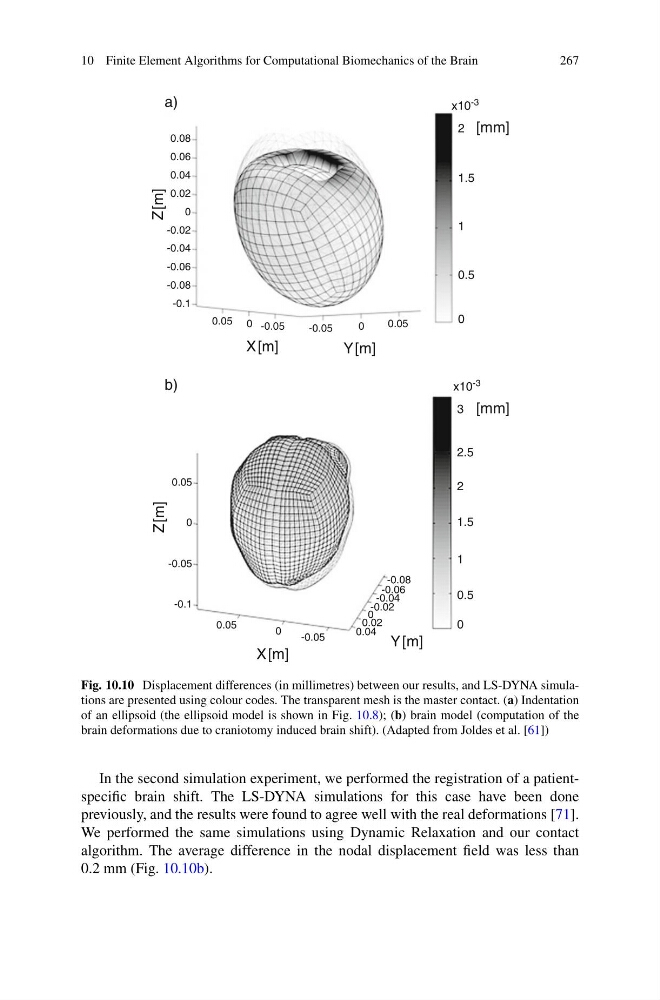
Fig. 10.10 Displacement differences (in millimetres) between our results, and LS-DYNA simulations are presented using colour codes. The transparent mesh is the master contact. (a) Indentation
of an ellipsoid (the ellipsoid model is shown in Fig. 10.8); (b) brain model (computation of the
brain deformations due to craniotomy induced brain shift). (Adapted from Joldes et al. [61])
In the second simulation experiment, we performed the registration of a patientspecific brain shift. The LS-DYNA simulations for this case have been done
previously, and the results were found to agree well with the real deformations [71].
We performed the same simulations using Dynamic Relaxation and our contact
algorithm. The average difference in the nodal displacement field was less than
0.2 mm (Fig. 10.10b).
267
0.08
x10
-3
2 [mm]
a)
b)
X[m]
X[m]
Z[m]
Z[m]
Y[m]
Y[m]
1.5
0.5
0
1
x10
-3
[mm]
1.5
2.5
3
2
0.5
0
1
-0.08
0.06
-0.06
0.04
-0.04
-0.05
-0.05
0.05
0.05
-0.05
0.05
0.02
-0.02
0
0
-0.05
0.05
0
0
0
-0.1
-0.08
-0.06
-0.04
-0.02
0.02
0.04
0
-0.1
Fig. 10.10 Displacement differences (in millimetres) between our results, and LS-DYNA simulations are presented using colour codes. The transparent mesh is the master contact. (a) Indentation
of an ellipsoid (the ellipsoid model is shown in Fig. 10.8); (b) brain model (computation of the
brain deformations due to craniotomy induced brain shift). (Adapted from Joldes et al. [61])
In the second simulation experiment, we performed the registration of a patientspecific brain shift. The LS-DYNA simulations for this case have been done
previously, and the results were found to agree well with the real deformations [71].
We performed the same simulations using Dynamic Relaxation and our contact
algorithm. The average difference in the nodal displacement field was less than
0.2 mm (Fig. 10.10b).