

262
A. Wittek et al.
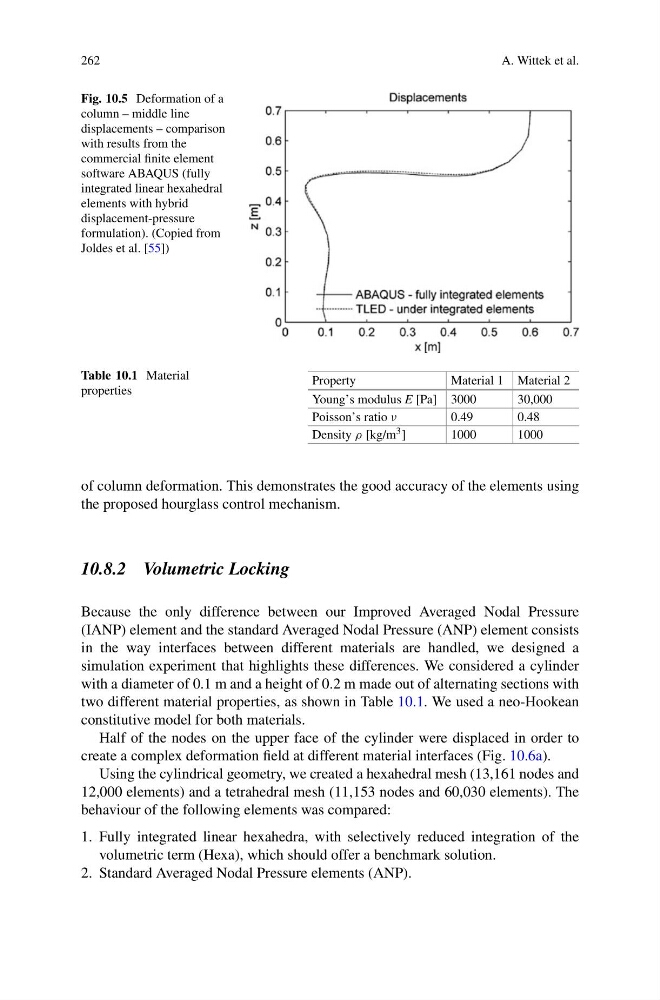
Fig. 10.5 Deformation of a
column – middle line
displacements – comparison
with results from the
commercial finite element
software ABAQUS (fully
integrated linear hexahedral
elements with hybrid
displacement-pressure
formulation). (Copied from
Joldes et al. [55])
Table 10.1 Material
properties
Property
Material 1 Material 2
Young’s modulus E [Pa] 3000
30,000
Poisson’s ratio ν
0.49
0.48
Density ρ [kg/m 3 ]
1000
1000
of column deformation. This demonstrates the good accuracy of the elements using
the proposed hourglass control mechanism.
10.8.2 Volumetric Locking
Because the only difference between our Improved Averaged Nodal Pressure
(IANP) element and the standard Averaged Nodal Pressure (ANP) element consists
in the way interfaces between different materials are handled, we designed a
simulation experiment that highlights these differences. We considered a cylinder
with a diameter of 0.1 m and a height of 0.2 m made out of alternating sections with
two different material properties, as shown in Table 10.1. We used a neo-Hookean
constitutive model for both materials.
Half of the nodes on the upper face of the cylinder were displaced in order to
create a complex deformation field at different material interfaces (Fig. 10.6a).
Using the cylindrical geometry, we created a hexahedral mesh (13,161 nodes and
12,000 elements) and a tetrahedral mesh (11,153 nodes and 60,030 elements). The
behaviour of the following elements was compared:
1. Fully integrated linear hexahedra, with selectively reduced integration of the
volumetric term (Hexa), which should offer a benchmark solution.
2. Standard Averaged Nodal Pressure elements (ANP).
A. Wittek et al.
Fig. 10.5 Deformation of a
column – middle line
displacements – comparison
with results from the
commercial finite element
software ABAQUS (fully
integrated linear hexahedral
elements with hybrid
displacement-pressure
formulation). (Copied from
Joldes et al. [55])
Table 10.1 Material
properties
Property
Material 1 Material 2
Young’s modulus E [Pa] 3000
30,000
Poisson’s ratio ν
0.49
0.48
Density ρ [kg/m 3 ]
1000
1000
of column deformation. This demonstrates the good accuracy of the elements using
the proposed hourglass control mechanism.
10.8.2 Volumetric Locking
Because the only difference between our Improved Averaged Nodal Pressure
(IANP) element and the standard Averaged Nodal Pressure (ANP) element consists
in the way interfaces between different materials are handled, we designed a
simulation experiment that highlights these differences. We considered a cylinder
with a diameter of 0.1 m and a height of 0.2 m made out of alternating sections with
two different material properties, as shown in Table 10.1. We used a neo-Hookean
constitutive model for both materials.
Half of the nodes on the upper face of the cylinder were displaced in order to
create a complex deformation field at different material interfaces (Fig. 10.6a).
Using the cylindrical geometry, we created a hexahedral mesh (13,161 nodes and
12,000 elements) and a tetrahedral mesh (11,153 nodes and 60,030 elements). The
behaviour of the following elements was compared:
1. Fully integrated linear hexahedra, with selectively reduced integration of the
volumetric term (Hexa), which should offer a benchmark solution.
2. Standard Averaged Nodal Pressure elements (ANP).