

10 Finite Element Algorithms for Computational Biomechanics of the Brain
261
In the following sections, we will present verification results for some of the
algorithm described in this chapter: hourglass control, volumetric locking, Dynamic
Relaxation and brain-skull interaction (contact).
10.8.1 Hourglass Control
The verification experiment was artificially designed to compound difficulties
associated with hourglass control: large deformations, bending and rigid body
motions. A column having a height of 1 m and a square section with the side
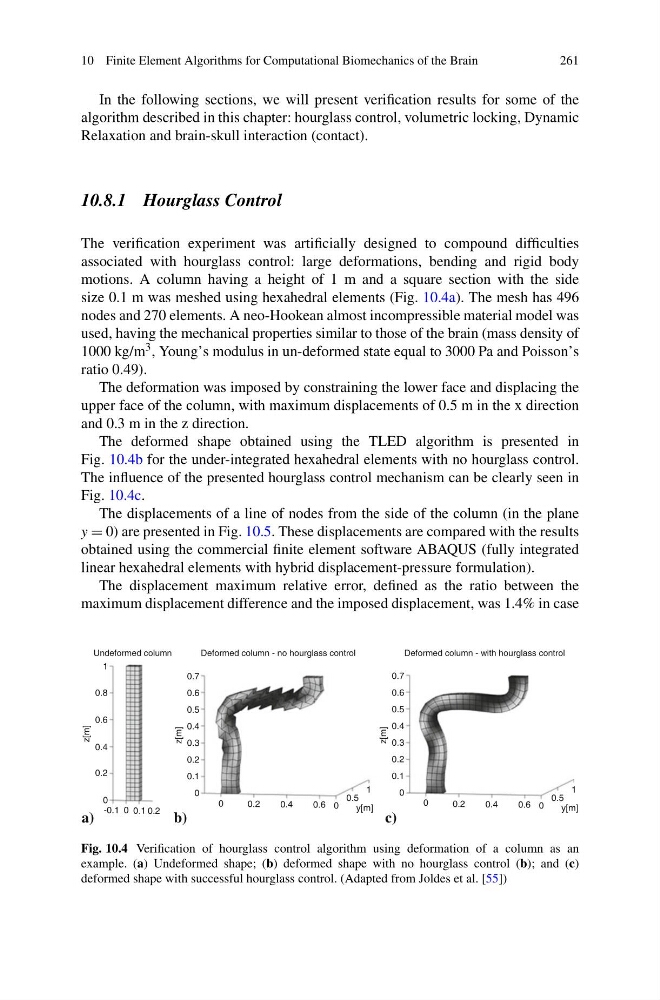
size 0.1 m was meshed using hexahedral elements (Fig. 10.4a). The mesh has 496
nodes and 270 elements. A neo-Hookean almost incompressible material model was
used, having the mechanical properties similar to those of the brain (mass density of
1000 kg/m 3 , Young’s modulus in un-deformed state equal to 3000 Pa and Poisson’s
ratio 0.49).
The deformation was imposed by constraining the lower face and displacing the
upper face of the column, with maximum displacements of 0.5 m in the x direction
and 0.3 m in the z direction.
The deformed shape obtained using the TLED algorithm is presented in
Fig. 10.4b for the under-integrated hexahedral elements with no hourglass control.
The influence of the presented hourglass control mechanism can be clearly seen in
Fig. 10.4c.
The displacements of a line of nodes from the side of the column (in the plane
y = 0) are presented in Fig. 10.5. These displacements are compared with the results
obtained using the commercial finite element software ABAQUS (fully integrated
linear hexahedral elements with hybrid displacement-pressure formulation).
The displacement maximum relative error, defined as the ratio between the
maximum displacement difference and the imposed displacement, was 1.4% in case
Undeformed column
1
Deformed column - no hourglass control
Deformed column - with hourglass control
0.8
0.6
z[m]
a)
b)
c)
z[m]
z[m]
0.4
0.2
0.7
0.6
0.5
0.4
0.3
0.2
0.1
0
0.7
0.6
0.5
0.4
0.3
0.2
0.1
0
0
0.2
0.4
0.6
0.5
1
0
-0.1
0.1 0.2
0
0
y[m]
0.2
0
0.4
0.6
0.5
1
0
y[m]
Fig. 10.4 Verification of hourglass control algorithm using deformation of a column as an
example. (a) Undeformed shape; (b) deformed shape with no hourglass control (b); and (c)
deformed shape with successful hourglass control. (Adapted from Joldes et al. [55])
261
In the following sections, we will present verification results for some of the
algorithm described in this chapter: hourglass control, volumetric locking, Dynamic
Relaxation and brain-skull interaction (contact).
10.8.1 Hourglass Control
The verification experiment was artificially designed to compound difficulties
associated with hourglass control: large deformations, bending and rigid body
motions. A column having a height of 1 m and a square section with the side
size 0.1 m was meshed using hexahedral elements (Fig. 10.4a). The mesh has 496
nodes and 270 elements. A neo-Hookean almost incompressible material model was
used, having the mechanical properties similar to those of the brain (mass density of
1000 kg/m 3 , Young’s modulus in un-deformed state equal to 3000 Pa and Poisson’s
ratio 0.49).
The deformation was imposed by constraining the lower face and displacing the
upper face of the column, with maximum displacements of 0.5 m in the x direction
and 0.3 m in the z direction.
The deformed shape obtained using the TLED algorithm is presented in
Fig. 10.4b for the under-integrated hexahedral elements with no hourglass control.
The influence of the presented hourglass control mechanism can be clearly seen in
Fig. 10.4c.
The displacements of a line of nodes from the side of the column (in the plane
y = 0) are presented in Fig. 10.5. These displacements are compared with the results
obtained using the commercial finite element software ABAQUS (fully integrated
linear hexahedral elements with hybrid displacement-pressure formulation).
The displacement maximum relative error, defined as the ratio between the
maximum displacement difference and the imposed displacement, was 1.4% in case
Undeformed column
1
Deformed column - no hourglass control
Deformed column - with hourglass control
0.8
0.6
z[m]
a)
b)
c)
z[m]
z[m]
0.4
0.2
0.7
0.6
0.5
0.4
0.3
0.2
0.1
0
0.7
0.6
0.5
0.4
0.3
0.2
0.1
0
0
0.2
0.4
0.6
0.5
1
0
-0.1
0.1 0.2
0
0
y[m]
0.2
0
0.4
0.6
0.5
1
0
y[m]
Fig. 10.4 Verification of hourglass control algorithm using deformation of a column as an
example. (a) Undeformed shape; (b) deformed shape with no hourglass control (b); and (c)
deformed shape with successful hourglass control. (Adapted from Joldes et al. [55])