

10 Finite Element Algorithms for Computational Biomechanics of the Brain
247
non-diagonal components equal zero. Such lumped mass matrix corresponds to
discretising the mass distribution by concentrating the mass at the nodes of each
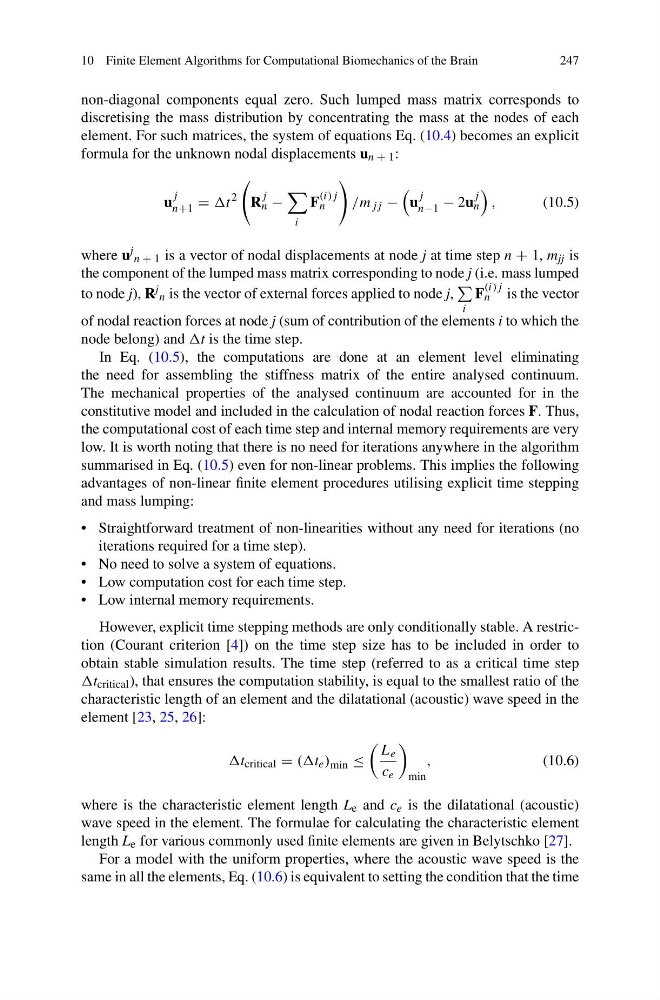
element. For such matrices, the system of equations Eq. (10.4) becomes an explicit
formula for the unknown nodal displacements u n + 1 :
u
j
n+1 = t
2
R
j
n −
i
F
(i)j
n
/m jj −
u
j
n−1 − 2u
j
n
,
(10.5)
where u j n + 1 is a vector of nodal displacements at node j at time step n + 1, m jj is
the component of the lumped mass matrix corresponding to node j (i.e. mass lumped
to node j), R j n is the vector of external forces applied to node j,
i
F
(i)j
n is the vector
of nodal reaction forces at node j (sum of contribution of the elements i to which the
node belong) and t is the time step.
In Eq. (10.5), the computations are done at an element level eliminating
the need for assembling the stiffness matrix of the entire analysed continuum.
The mechanical properties of the analysed continuum are accounted for in the
constitutive model and included in the calculation of nodal reaction forces F. Thus,
the computational cost of each time step and internal memory requirements are very
low. It is worth noting that there is no need for iterations anywhere in the algorithm
summarised in Eq. (10.5) even for non-linear problems. This implies the following
advantages of non-linear finite element procedures utilising explicit time stepping
and mass lumping:
• Straightforward treatment of non-linearities without any need for iterations (no
iterations required for a time step).
• No need to solve a system of equations.
• Low computation cost for each time step.
• Low internal memory requirements.
However, explicit time stepping methods are only conditionally stable. A restriction (Courant criterion [4]) on the time step size has to be included in order to
obtain stable simulation results. The time step (referred to as a critical time step
t critical ), that ensures the computation stability, is equal to the smallest ratio of the
characteristic length of an element and the dilatational (acoustic) wave speed in the
element [23, 25, 26]:
t critical = (t e ) min ≤
L e
c e
min
,
(10.6)
where is the characteristic element length L e and c e is the dilatational (acoustic)
wave speed in the element. The formulae for calculating the characteristic element
length L e for various commonly used finite elements are given in Belytschko [27].
For a model with the uniform properties, where the acoustic wave speed is the
same in all the elements, Eq. (10.6) is equivalent to setting the condition that the time
247
non-diagonal components equal zero. Such lumped mass matrix corresponds to
discretising the mass distribution by concentrating the mass at the nodes of each
element. For such matrices, the system of equations Eq. (10.4) becomes an explicit
formula for the unknown nodal displacements u n + 1 :
u
j
n+1 = t
2
R
j
n −
i
F
(i)j
n
/m jj −
u
j
n−1 − 2u
j
n
,
(10.5)
where u j n + 1 is a vector of nodal displacements at node j at time step n + 1, m jj is
the component of the lumped mass matrix corresponding to node j (i.e. mass lumped
to node j), R j n is the vector of external forces applied to node j,
i
F
(i)j
n is the vector
of nodal reaction forces at node j (sum of contribution of the elements i to which the
node belong) and t is the time step.
In Eq. (10.5), the computations are done at an element level eliminating
the need for assembling the stiffness matrix of the entire analysed continuum.
The mechanical properties of the analysed continuum are accounted for in the
constitutive model and included in the calculation of nodal reaction forces F. Thus,
the computational cost of each time step and internal memory requirements are very
low. It is worth noting that there is no need for iterations anywhere in the algorithm
summarised in Eq. (10.5) even for non-linear problems. This implies the following
advantages of non-linear finite element procedures utilising explicit time stepping
and mass lumping:
• Straightforward treatment of non-linearities without any need for iterations (no
iterations required for a time step).
• No need to solve a system of equations.
• Low computation cost for each time step.
• Low internal memory requirements.
However, explicit time stepping methods are only conditionally stable. A restriction (Courant criterion [4]) on the time step size has to be included in order to
obtain stable simulation results. The time step (referred to as a critical time step
t critical ), that ensures the computation stability, is equal to the smallest ratio of the
characteristic length of an element and the dilatational (acoustic) wave speed in the
element [23, 25, 26]:
t critical = (t e ) min ≤
L e
c e
min
,
(10.6)
where is the characteristic element length L e and c e is the dilatational (acoustic)
wave speed in the element. The formulae for calculating the characteristic element
length L e for various commonly used finite elements are given in Belytschko [27].
For a model with the uniform properties, where the acoustic wave speed is the
same in all the elements, Eq. (10.6) is equivalent to setting the condition that the time