

248
A. Wittek et al.
step cannot be longer than the travel time of the wave across the smallest element
(i.e. the element with the smallest characteristic length L e ) in the mesh [23]. Based
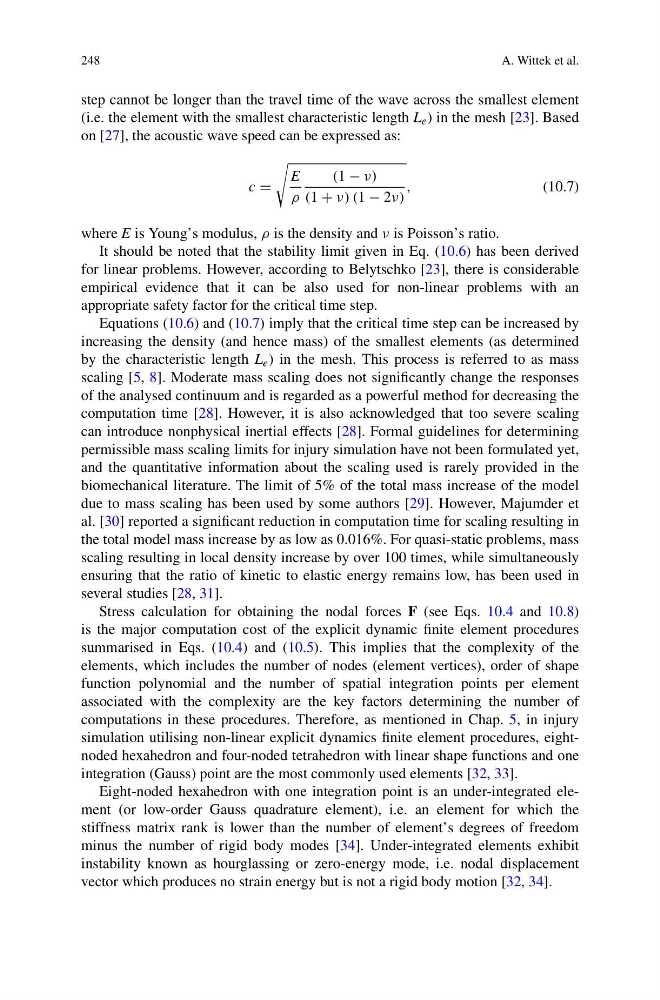
on [27], the acoustic wave speed can be expressed as:
c =
E
ρ
(1 − ν)
(1 + ν) (1 − 2ν)
,
(10.7)
where E is Young’s modulus, ρ is the density and ν is Poisson’s ratio.
It should be noted that the stability limit given in Eq. (10.6) has been derived
for linear problems. However, according to Belytschko [23], there is considerable
empirical evidence that it can be also used for non-linear problems with an
appropriate safety factor for the critical time step.
Equations (10.6) and (10.7) imply that the critical time step can be increased by
increasing the density (and hence mass) of the smallest elements (as determined
by the characteristic length L e ) in the mesh. This process is referred to as mass
scaling [5, 8]. Moderate mass scaling does not significantly change the responses
of the analysed continuum and is regarded as a powerful method for decreasing the
computation time [28]. However, it is also acknowledged that too severe scaling
can introduce nonphysical inertial effects [28]. Formal guidelines for determining
permissible mass scaling limits for injury simulation have not been formulated yet,
and the quantitative information about the scaling used is rarely provided in the
biomechanical literature. The limit of 5% of the total mass increase of the model
due to mass scaling has been used by some authors [29]. However, Majumder et
al. [30] reported a significant reduction in computation time for scaling resulting in
the total model mass increase by as low as 0.016%. For quasi-static problems, mass
scaling resulting in local density increase by over 100 times, while simultaneously
ensuring that the ratio of kinetic to elastic energy remains low, has been used in
several studies [28, 31].
Stress calculation for obtaining the nodal forces F (see Eqs. 10.4 and 10.8)
is the major computation cost of the explicit dynamic finite element procedures
summarised in Eqs. (10.4) and (10.5). This implies that the complexity of the
elements, which includes the number of nodes (element vertices), order of shape
function polynomial and the number of spatial integration points per element
associated with the complexity are the key factors determining the number of
computations in these procedures. Therefore, as mentioned in Chap. 5, in injury
simulation utilising non-linear explicit dynamics finite element procedures, eightnoded hexahedron and four-noded tetrahedron with linear shape functions and one
integration (Gauss) point are the most commonly used elements [32, 33].
Eight-noded hexahedron with one integration point is an under-integrated element (or low-order Gauss quadrature element), i.e. an element for which the
stiffness matrix rank is lower than the number of element’s degrees of freedom
minus the number of rigid body modes [34]. Under-integrated elements exhibit
instability known as hourglassing or zero-energy mode, i.e. nodal displacement
vector which produces no strain energy but is not a rigid body motion [32, 34].
A. Wittek et al.
step cannot be longer than the travel time of the wave across the smallest element
(i.e. the element with the smallest characteristic length L e ) in the mesh [23]. Based
on [27], the acoustic wave speed can be expressed as:
c =
E
ρ
(1 − ν)
(1 + ν) (1 − 2ν)
,
(10.7)
where E is Young’s modulus, ρ is the density and ν is Poisson’s ratio.
It should be noted that the stability limit given in Eq. (10.6) has been derived
for linear problems. However, according to Belytschko [23], there is considerable
empirical evidence that it can be also used for non-linear problems with an
appropriate safety factor for the critical time step.
Equations (10.6) and (10.7) imply that the critical time step can be increased by
increasing the density (and hence mass) of the smallest elements (as determined
by the characteristic length L e ) in the mesh. This process is referred to as mass
scaling [5, 8]. Moderate mass scaling does not significantly change the responses
of the analysed continuum and is regarded as a powerful method for decreasing the
computation time [28]. However, it is also acknowledged that too severe scaling
can introduce nonphysical inertial effects [28]. Formal guidelines for determining
permissible mass scaling limits for injury simulation have not been formulated yet,
and the quantitative information about the scaling used is rarely provided in the
biomechanical literature. The limit of 5% of the total mass increase of the model
due to mass scaling has been used by some authors [29]. However, Majumder et
al. [30] reported a significant reduction in computation time for scaling resulting in
the total model mass increase by as low as 0.016%. For quasi-static problems, mass
scaling resulting in local density increase by over 100 times, while simultaneously
ensuring that the ratio of kinetic to elastic energy remains low, has been used in
several studies [28, 31].
Stress calculation for obtaining the nodal forces F (see Eqs. 10.4 and 10.8)
is the major computation cost of the explicit dynamic finite element procedures
summarised in Eqs. (10.4) and (10.5). This implies that the complexity of the
elements, which includes the number of nodes (element vertices), order of shape
function polynomial and the number of spatial integration points per element
associated with the complexity are the key factors determining the number of
computations in these procedures. Therefore, as mentioned in Chap. 5, in injury
simulation utilising non-linear explicit dynamics finite element procedures, eightnoded hexahedron and four-noded tetrahedron with linear shape functions and one
integration (Gauss) point are the most commonly used elements [32, 33].
Eight-noded hexahedron with one integration point is an under-integrated element (or low-order Gauss quadrature element), i.e. an element for which the
stiffness matrix rank is lower than the number of element’s degrees of freedom
minus the number of rigid body modes [34]. Under-integrated elements exhibit
instability known as hourglassing or zero-energy mode, i.e. nodal displacement
vector which produces no strain energy but is not a rigid body motion [32, 34].