

246
A. Wittek et al.
10.2 Algorithms for Injury Biomechanics
Impact/injury biomechanics of the brain deals with events of very short duration
(hundreds of milliseconds) in which the head is subjected to transient loads due
to either direct impact or rapid acceleration that result in large deformation (or
even mechanical damage) of the brain tissue. As indicated in [4, 23], non-linear
finite element procedures with explicit time stepping outperform other algorithms
in modelling of three-dimensional continua subjected to short-duration transient
loads. Therefore, they have been a preferable choice in injury biomechanics [24]
(see also Chap. 5) and are implemented in numerous finite elements codes (such
as LS-DYNA, PAM-CRASH, ABAQUS, RADIOSS) industrially applied in impact
injury simulation.
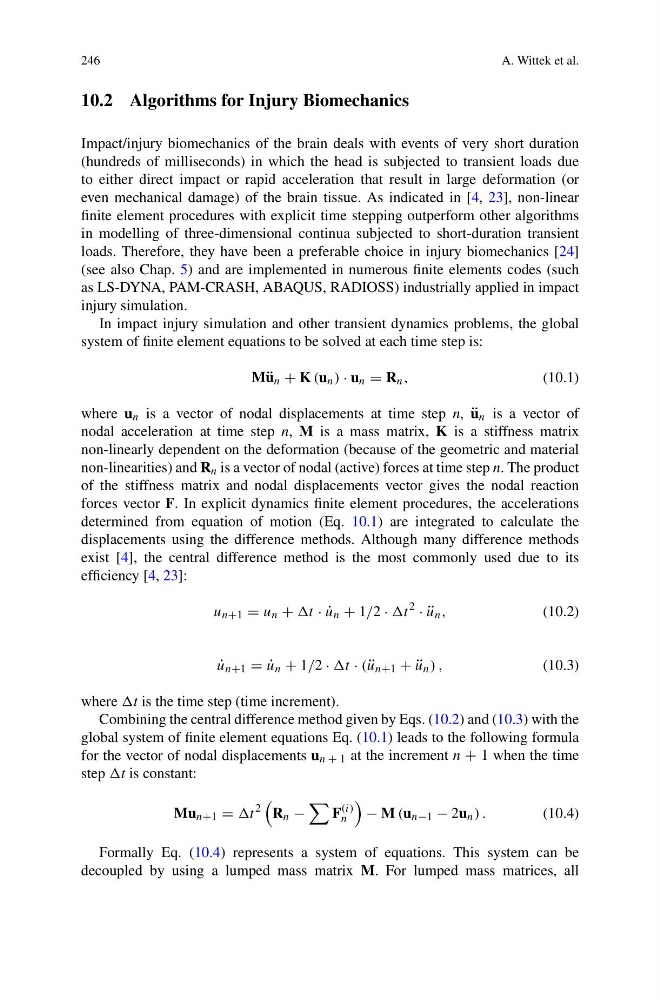
In impact injury simulation and other transient dynamics problems, the global
system of finite element equations to be solved at each time step is:
M ¨
u n + K (u n ) · u n = R n ,
(10.1)
where u n is a vector of nodal displacements at time step n, ¨
u n is a vector of
nodal acceleration at time step n, M is a mass matrix, K is a stiffness matrix
non-linearly dependent on the deformation (because of the geometric and material
non-linearities) and R n is a vector of nodal (active) forces at time step n. The product
of the stiffness matrix and nodal displacements vector gives the nodal reaction
forces vector F. In explicit dynamics finite element procedures, the accelerations
determined from equation of motion (Eq. 10.1) are integrated to calculate the
displacements using the difference methods. Although many difference methods
exist [4], the central difference method is the most commonly used due to its
efficiency [4, 23]:
u n+1 = u n + t · ˙
u n + 1/2 · t
2
· ¨
u n ,
(10.2)
˙
u n+1 = ˙
u n + 1/2 · t · ( ¨
u n+1 + ¨
u n ) ,
(10.3)
where t is the time step (time increment).
Combining the central difference method given by Eqs. (10.2) and (10.3) with the
global system of finite element equations Eq. (10.1) leads to the following formula
for the vector of nodal displacements u n + 1 at the increment n + 1 when the time
step t is constant:
Mu n+1 = t
2
R n −
F
(i)
n
− M (u n−1 − 2u n ) .
(10.4)
Formally Eq. (10.4) represents a system of equations. This system can be
decoupled by using a lumped mass matrix M. For lumped mass matrices, all
A. Wittek et al.
10.2 Algorithms for Injury Biomechanics
Impact/injury biomechanics of the brain deals with events of very short duration
(hundreds of milliseconds) in which the head is subjected to transient loads due
to either direct impact or rapid acceleration that result in large deformation (or
even mechanical damage) of the brain tissue. As indicated in [4, 23], non-linear
finite element procedures with explicit time stepping outperform other algorithms
in modelling of three-dimensional continua subjected to short-duration transient
loads. Therefore, they have been a preferable choice in injury biomechanics [24]
(see also Chap. 5) and are implemented in numerous finite elements codes (such
as LS-DYNA, PAM-CRASH, ABAQUS, RADIOSS) industrially applied in impact
injury simulation.
In impact injury simulation and other transient dynamics problems, the global
system of finite element equations to be solved at each time step is:
M ¨
u n + K (u n ) · u n = R n ,
(10.1)
where u n is a vector of nodal displacements at time step n, ¨
u n is a vector of
nodal acceleration at time step n, M is a mass matrix, K is a stiffness matrix
non-linearly dependent on the deformation (because of the geometric and material
non-linearities) and R n is a vector of nodal (active) forces at time step n. The product
of the stiffness matrix and nodal displacements vector gives the nodal reaction
forces vector F. In explicit dynamics finite element procedures, the accelerations
determined from equation of motion (Eq. 10.1) are integrated to calculate the
displacements using the difference methods. Although many difference methods
exist [4], the central difference method is the most commonly used due to its
efficiency [4, 23]:
u n+1 = u n + t · ˙
u n + 1/2 · t
2
· ¨
u n ,
(10.2)
˙
u n+1 = ˙
u n + 1/2 · t · ( ¨
u n+1 + ¨
u n ) ,
(10.3)
where t is the time step (time increment).
Combining the central difference method given by Eqs. (10.2) and (10.3) with the
global system of finite element equations Eq. (10.1) leads to the following formula
for the vector of nodal displacements u n + 1 at the increment n + 1 when the time
step t is constant:
Mu n+1 = t
2
R n −
F
(i)
n
− M (u n−1 − 2u n ) .
(10.4)
Formally Eq. (10.4) represents a system of equations. This system can be
decoupled by using a lumped mass matrix M. For lumped mass matrices, all