

8 Dynamics of Cerebrospinal Fluid: From Theoretical Models to Clinical Applications
203
60
0.8
0.8
20:20
20:40
21:00
21:20
Time [h:m]
ICP
[mm Hg]
RAP
0.6
0.6
0.4
0.4
0.2
0.2
0
50
40
30
20
10
0
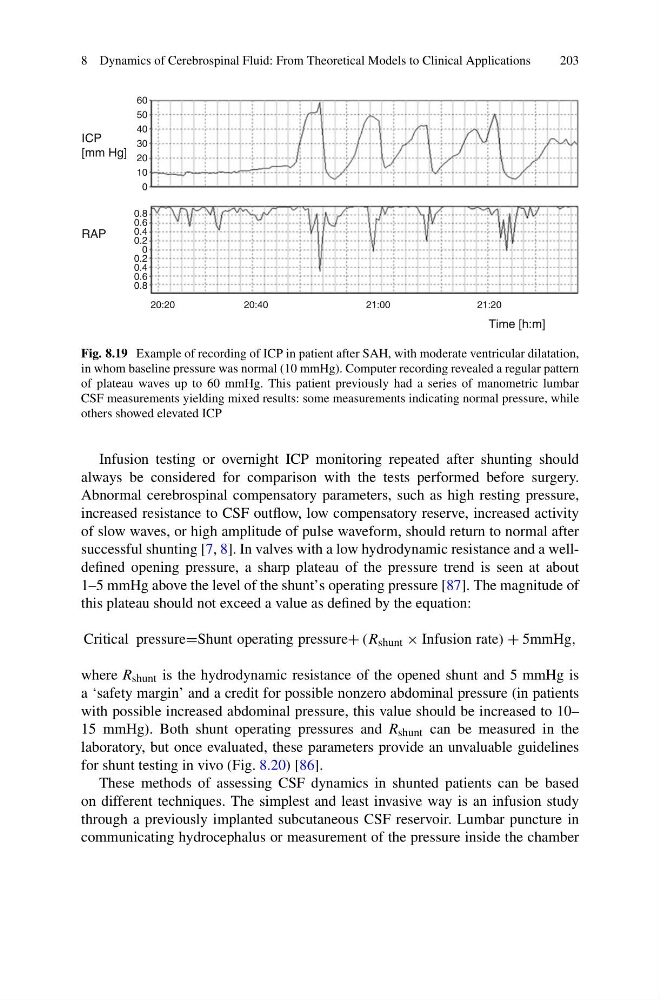
Fig. 8.19 Example of recording of ICP in patient after SAH, with moderate ventricular dilatation,
in whom baseline pressure was normal (10 mmHg). Computer recording revealed a regular pattern
of plateau waves up to 60 mmHg. This patient previously had a series of manometric lumbar
CSF measurements yielding mixed results: some measurements indicating normal pressure, while
others showed elevated ICP
Infusion testing or overnight ICP monitoring repeated after shunting should
always be considered for comparison with the tests performed before surgery.
Abnormal cerebrospinal compensatory parameters, such as high resting pressure,
increased resistance to CSF outflow, low compensatory reserve, increased activity
of slow waves, or high amplitude of pulse waveform, should return to normal after
successful shunting [7, 8]. In valves with a low hydrodynamic resistance and a welldefined opening pressure, a sharp plateau of the pressure trend is seen at about
1–5 mmHg above the level of the shunt’s operating pressure [87]. The magnitude of
this plateau should not exceed a value as defined by the equation:
Critical pressure=Shunt operating pressure+ (R shunt × Infusion rate) + 5mmHg,
where R shunt is the hydrodynamic resistance of the opened shunt and 5 mmHg is
a ‘safety margin’ and a credit for possible nonzero abdominal pressure (in patients
with possible increased abdominal pressure, this value should be increased to 10–
15 mmHg). Both shunt operating pressures and R shunt can be measured in the
laboratory, but once evaluated, these parameters provide an unvaluable guidelines
for shunt testing in vivo (Fig. 8.20) [86].
These methods of assessing CSF dynamics in shunted patients can be based
on different techniques. The simplest and least invasive way is an infusion study
through a previously implanted subcutaneous CSF reservoir. Lumbar puncture in
communicating hydrocephalus or measurement of the pressure inside the chamber
203
60
0.8
0.8
20:20
20:40
21:00
21:20
Time [h:m]
ICP
[mm Hg]
RAP
0.6
0.6
0.4
0.4
0.2
0.2
0
50
40
30
20
10
0
Fig. 8.19 Example of recording of ICP in patient after SAH, with moderate ventricular dilatation,
in whom baseline pressure was normal (10 mmHg). Computer recording revealed a regular pattern
of plateau waves up to 60 mmHg. This patient previously had a series of manometric lumbar
CSF measurements yielding mixed results: some measurements indicating normal pressure, while
others showed elevated ICP
Infusion testing or overnight ICP monitoring repeated after shunting should
always be considered for comparison with the tests performed before surgery.
Abnormal cerebrospinal compensatory parameters, such as high resting pressure,
increased resistance to CSF outflow, low compensatory reserve, increased activity
of slow waves, or high amplitude of pulse waveform, should return to normal after
successful shunting [7, 8]. In valves with a low hydrodynamic resistance and a welldefined opening pressure, a sharp plateau of the pressure trend is seen at about
1–5 mmHg above the level of the shunt’s operating pressure [87]. The magnitude of
this plateau should not exceed a value as defined by the equation:
Critical pressure=Shunt operating pressure+ (R shunt × Infusion rate) + 5mmHg,
where R shunt is the hydrodynamic resistance of the opened shunt and 5 mmHg is
a ‘safety margin’ and a credit for possible nonzero abdominal pressure (in patients
with possible increased abdominal pressure, this value should be increased to 10–
15 mmHg). Both shunt operating pressures and R shunt can be measured in the
laboratory, but once evaluated, these parameters provide an unvaluable guidelines
for shunt testing in vivo (Fig. 8.20) [86].
These methods of assessing CSF dynamics in shunted patients can be based
on different techniques. The simplest and least invasive way is an infusion study
through a previously implanted subcutaneous CSF reservoir. Lumbar puncture in
communicating hydrocephalus or measurement of the pressure inside the chamber