

8 Dynamics of Cerebrospinal Fluid: From Theoretical Models to Clinical Applications
191
8.6.5 ICP Waveform Components
Furthermore, ICP recording made overnight [46] or at baseline before the infusion
test allows the observation of various cyclical or random dynamic changes in ICP
of vasogenic origin (i.e. forced by change in cerebral blood volume). These include
pulse, respiratory, or slow vasogenic waves.
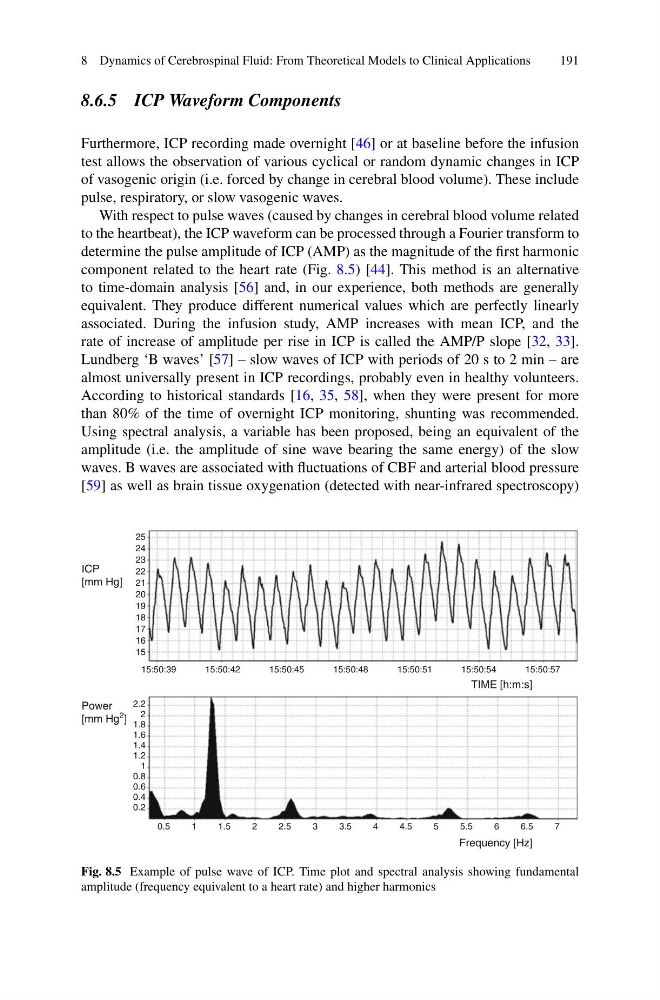
With respect to pulse waves (caused by changes in cerebral blood volume related
to the heartbeat), the ICP waveform can be processed through a Fourier transform to
determine the pulse amplitude of ICP (AMP) as the magnitude of the first harmonic
component related to the heart rate (Fig. 8.5) [44]. This method is an alternative
to time-domain analysis [56] and, in our experience, both methods are generally
equivalent. They produce different numerical values which are perfectly linearly
associated. During the infusion study, AMP increases with mean ICP, and the
rate of increase of amplitude per rise in ICP is called the AMP/P slope [32, 33].
Lundberg ‘B waves’ [57] – slow waves of ICP with periods of 20 s to 2 min – are
almost universally present in ICP recordings, probably even in healthy volunteers.
According to historical standards [16, 35, 58], when they were present for more
than 80% of the time of overnight ICP monitoring, shunting was recommended.
Using spectral analysis, a variable has been proposed, being an equivalent of the
amplitude (i.e. the amplitude of sine wave bearing the same energy) of the slow
waves. B waves are associated with fluctuations of CBF and arterial blood pressure
[59] as well as brain tissue oxygenation (detected with near-infrared spectroscopy)
25
2.2
2
1.8
24
23
22
ICP
[mm Hg]
Power
[mm Hg
2 ]
Frequency [Hz]
TIME [h:m:s]
21
20
19
18
17
16
15
15:50:39
15:50:42
15:50:45
15:50:48
15:50:51
15:50:54
15:50:57
1.6
1.4
1.2
1
0.8
0.6
0.4
0.2
0.5
1.5
2.5
3.5
4
5
6
4.5
5.5
6.5
7
3
2
1
Fig. 8.5 Example of pulse wave of ICP. Time plot and spectral analysis showing fundamental
amplitude (frequency equivalent to a heart rate) and higher harmonics
191
8.6.5 ICP Waveform Components
Furthermore, ICP recording made overnight [46] or at baseline before the infusion
test allows the observation of various cyclical or random dynamic changes in ICP
of vasogenic origin (i.e. forced by change in cerebral blood volume). These include
pulse, respiratory, or slow vasogenic waves.
With respect to pulse waves (caused by changes in cerebral blood volume related
to the heartbeat), the ICP waveform can be processed through a Fourier transform to
determine the pulse amplitude of ICP (AMP) as the magnitude of the first harmonic
component related to the heart rate (Fig. 8.5) [44]. This method is an alternative
to time-domain analysis [56] and, in our experience, both methods are generally
equivalent. They produce different numerical values which are perfectly linearly
associated. During the infusion study, AMP increases with mean ICP, and the
rate of increase of amplitude per rise in ICP is called the AMP/P slope [32, 33].
Lundberg ‘B waves’ [57] – slow waves of ICP with periods of 20 s to 2 min – are
almost universally present in ICP recordings, probably even in healthy volunteers.
According to historical standards [16, 35, 58], when they were present for more
than 80% of the time of overnight ICP monitoring, shunting was recommended.
Using spectral analysis, a variable has been proposed, being an equivalent of the
amplitude (i.e. the amplitude of sine wave bearing the same energy) of the slow
waves. B waves are associated with fluctuations of CBF and arterial blood pressure
[59] as well as brain tissue oxygenation (detected with near-infrared spectroscopy)
25
2.2
2
1.8
24
23
22
ICP
[mm Hg]
Power
[mm Hg
2 ]
Frequency [Hz]
TIME [h:m:s]
21
20
19
18
17
16
15
15:50:39
15:50:42
15:50:45
15:50:48
15:50:51
15:50:54
15:50:57
1.6
1.4
1.2
1
0.8
0.6
0.4
0.2
0.5
1.5
2.5
3.5
4
5
6
4.5
5.5
6.5
7
3
2
1
Fig. 8.5 Example of pulse wave of ICP. Time plot and spectral analysis showing fundamental
amplitude (frequency equivalent to a heart rate) and higher harmonics