

170
K. Miller et al.
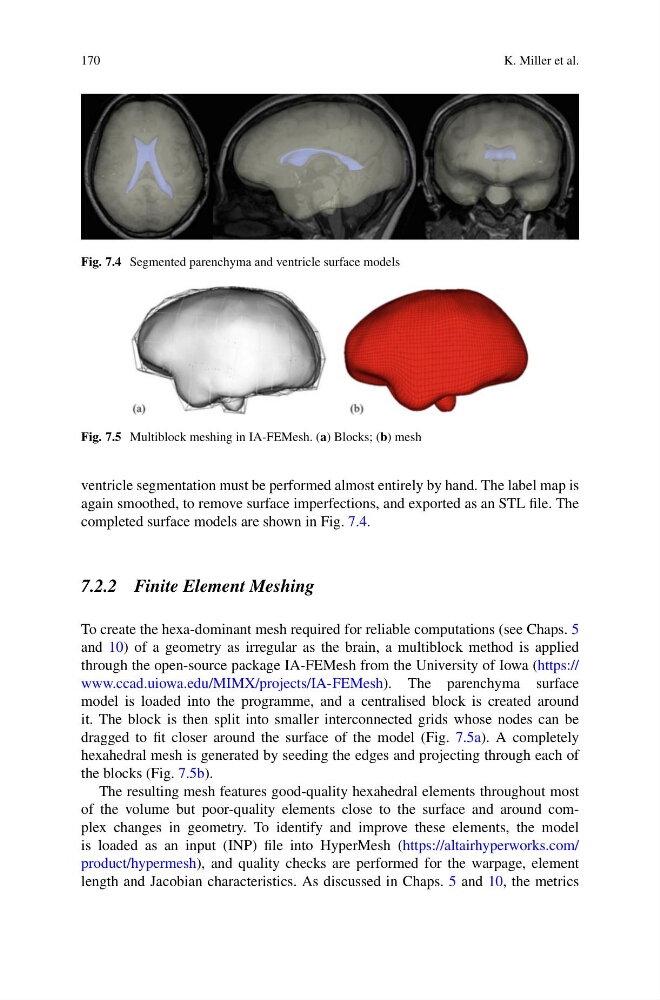
Fig. 7.4 Segmented parenchyma and ventricle surface models
Fig. 7.5 Multiblock meshing in IA-FEMesh. (a) Blocks; (b) mesh
ventricle segmentation must be performed almost entirely by hand. The label map is
again smoothed, to remove surface imperfections, and exported as an STL file. The
completed surface models are shown in Fig. 7.4.
7.2.2 Finite Element Meshing
To create the hexa-dominant mesh required for reliable computations (see Chaps. 5
and 10) of a geometry as irregular as the brain, a multiblock method is applied
through the open-source package IA-FEMesh from the University of Iowa (https://
www.ccad.uiowa.edu/MIMX/projects/IA-FEMesh). The parenchyma surface
model is loaded into the programme, and a centralised block is created around
it. The block is then split into smaller interconnected grids whose nodes can be
dragged to fit closer around the surface of the model (Fig. 7.5a). A completely
hexahedral mesh is generated by seeding the edges and projecting through each of
the blocks (Fig. 7.5b).
The resulting mesh features good-quality hexahedral elements throughout most
of the volume but poor-quality elements close to the surface and around complex changes in geometry. To identify and improve these elements, the model
is loaded as an input (INP) file into HyperMesh (https://altairhyperworks.com/
product/hypermesh), and quality checks are performed for the warpage, element
length and Jacobian characteristics. As discussed in Chaps. 5 and 10, the metrics
K. Miller et al.
Fig. 7.4 Segmented parenchyma and ventricle surface models
Fig. 7.5 Multiblock meshing in IA-FEMesh. (a) Blocks; (b) mesh
ventricle segmentation must be performed almost entirely by hand. The label map is
again smoothed, to remove surface imperfections, and exported as an STL file. The
completed surface models are shown in Fig. 7.4.
7.2.2 Finite Element Meshing
To create the hexa-dominant mesh required for reliable computations (see Chaps. 5
and 10) of a geometry as irregular as the brain, a multiblock method is applied
through the open-source package IA-FEMesh from the University of Iowa (https://
www.ccad.uiowa.edu/MIMX/projects/IA-FEMesh). The parenchyma surface
model is loaded into the programme, and a centralised block is created around
it. The block is then split into smaller interconnected grids whose nodes can be
dragged to fit closer around the surface of the model (Fig. 7.5a). A completely
hexahedral mesh is generated by seeding the edges and projecting through each of
the blocks (Fig. 7.5b).
The resulting mesh features good-quality hexahedral elements throughout most
of the volume but poor-quality elements close to the surface and around complex changes in geometry. To identify and improve these elements, the model
is loaded as an input (INP) file into HyperMesh (https://altairhyperworks.com/
product/hypermesh), and quality checks are performed for the warpage, element
length and Jacobian characteristics. As discussed in Chaps. 5 and 10, the metrics