

6 Biomechanical Modelling of the Brain for Neurosurgical Simulation. . .
145
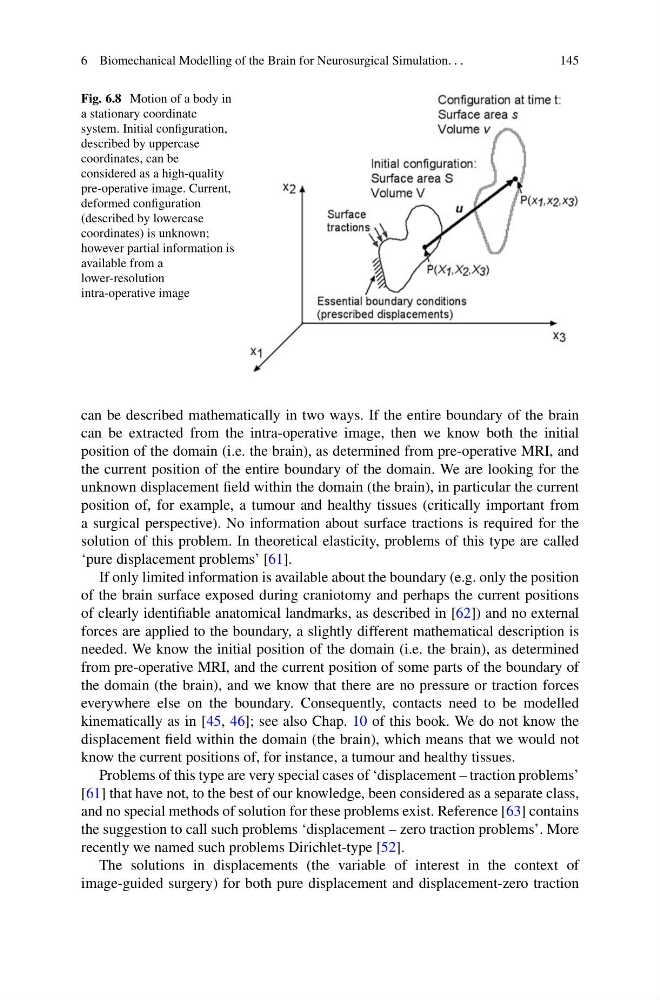
Fig. 6.8 Motion of a body in
a stationary coordinate
system. Initial configuration,
described by uppercase
coordinates, can be
considered as a high-quality
pre-operative image. Current,
deformed configuration
(described by lowercase
coordinates) is unknown;
however partial information is
available from a
lower-resolution
intra-operative image
can be described mathematically in two ways. If the entire boundary of the brain
can be extracted from the intra-operative image, then we know both the initial
position of the domain (i.e. the brain), as determined from pre-operative MRI, and
the current position of the entire boundary of the domain. We are looking for the
unknown displacement field within the domain (the brain), in particular the current
position of, for example, a tumour and healthy tissues (critically important from
a surgical perspective). No information about surface tractions is required for the
solution of this problem. In theoretical elasticity, problems of this type are called
‘pure displacement problems’ [61].
If only limited information is available about the boundary (e.g. only the position
of the brain surface exposed during craniotomy and perhaps the current positions
of clearly identifiable anatomical landmarks, as described in [62]) and no external
forces are applied to the boundary, a slightly different mathematical description is
needed. We know the initial position of the domain (i.e. the brain), as determined
from pre-operative MRI, and the current position of some parts of the boundary of
the domain (the brain), and we know that there are no pressure or traction forces
everywhere else on the boundary. Consequently, contacts need to be modelled
kinematically as in [45, 46]; see also Chap. 10 of this book. We do not know the
displacement field within the domain (the brain), which means that we would not
know the current positions of, for instance, a tumour and healthy tissues.
Problems of this type are very special cases of ‘displacement – traction problems’
[61] that have not, to the best of our knowledge, been considered as a separate class,
and no special methods of solution for these problems exist. Reference [63] contains
the suggestion to call such problems ‘displacement – zero traction problems’. More
recently we named such problems Dirichlet-type [52].
The solutions in displacements (the variable of interest in the context of
image-guided surgery) for both pure displacement and displacement-zero traction
145
Fig. 6.8 Motion of a body in
a stationary coordinate
system. Initial configuration,
described by uppercase
coordinates, can be
considered as a high-quality
pre-operative image. Current,
deformed configuration
(described by lowercase
coordinates) is unknown;
however partial information is
available from a
lower-resolution
intra-operative image
can be described mathematically in two ways. If the entire boundary of the brain
can be extracted from the intra-operative image, then we know both the initial
position of the domain (i.e. the brain), as determined from pre-operative MRI, and
the current position of the entire boundary of the domain. We are looking for the
unknown displacement field within the domain (the brain), in particular the current
position of, for example, a tumour and healthy tissues (critically important from
a surgical perspective). No information about surface tractions is required for the
solution of this problem. In theoretical elasticity, problems of this type are called
‘pure displacement problems’ [61].
If only limited information is available about the boundary (e.g. only the position
of the brain surface exposed during craniotomy and perhaps the current positions
of clearly identifiable anatomical landmarks, as described in [62]) and no external
forces are applied to the boundary, a slightly different mathematical description is
needed. We know the initial position of the domain (i.e. the brain), as determined
from pre-operative MRI, and the current position of some parts of the boundary of
the domain (the brain), and we know that there are no pressure or traction forces
everywhere else on the boundary. Consequently, contacts need to be modelled
kinematically as in [45, 46]; see also Chap. 10 of this book. We do not know the
displacement field within the domain (the brain), which means that we would not
know the current positions of, for instance, a tumour and healthy tissues.
Problems of this type are very special cases of ‘displacement – traction problems’
[61] that have not, to the best of our knowledge, been considered as a separate class,
and no special methods of solution for these problems exist. Reference [63] contains
the suggestion to call such problems ‘displacement – zero traction problems’. More
recently we named such problems Dirichlet-type [52].
The solutions in displacements (the variable of interest in the context of
image-guided surgery) for both pure displacement and displacement-zero traction