

146
K. Miller et al.
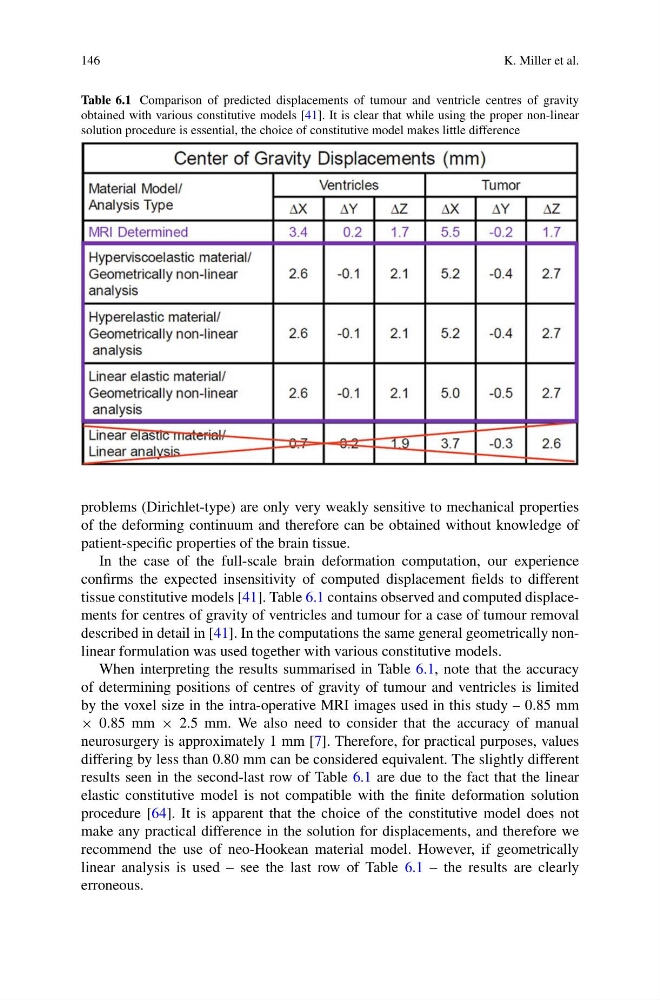
Table 6.1 Comparison of predicted displacements of tumour and ventricle centres of gravity
obtained with various constitutive models [41]. It is clear that while using the proper non-linear
solution procedure is essential, the choice of constitutive model makes little difference
problems (Dirichlet-type) are only very weakly sensitive to mechanical properties
of the deforming continuum and therefore can be obtained without knowledge of
patient-specific properties of the brain tissue.
In the case of the full-scale brain deformation computation, our experience
confirms the expected insensitivity of computed displacement fields to different
tissue constitutive models [41]. Table 6.1 contains observed and computed displacements for centres of gravity of ventricles and tumour for a case of tumour removal
described in detail in [41]. In the computations the same general geometrically nonlinear formulation was used together with various constitutive models.
When interpreting the results summarised in Table 6.1, note that the accuracy
of determining positions of centres of gravity of tumour and ventricles is limited
by the voxel size in the intra-operative MRI images used in this study – 0.85 mm
× 0.85 mm × 2.5 mm. We also need to consider that the accuracy of manual
neurosurgery is approximately 1 mm [7]. Therefore, for practical purposes, values
differing by less than 0.80 mm can be considered equivalent. The slightly different
results seen in the second-last row of Table 6.1 are due to the fact that the linear
elastic constitutive model is not compatible with the finite deformation solution
procedure [64]. It is apparent that the choice of the constitutive model does not
make any practical difference in the solution for displacements, and therefore we
recommend the use of neo-Hookean material model. However, if geometrically
linear analysis is used – see the last row of Table 6.1 – the results are clearly
erroneous.
K. Miller et al.
Table 6.1 Comparison of predicted displacements of tumour and ventricle centres of gravity
obtained with various constitutive models [41]. It is clear that while using the proper non-linear
solution procedure is essential, the choice of constitutive model makes little difference
problems (Dirichlet-type) are only very weakly sensitive to mechanical properties
of the deforming continuum and therefore can be obtained without knowledge of
patient-specific properties of the brain tissue.
In the case of the full-scale brain deformation computation, our experience
confirms the expected insensitivity of computed displacement fields to different
tissue constitutive models [41]. Table 6.1 contains observed and computed displacements for centres of gravity of ventricles and tumour for a case of tumour removal
described in detail in [41]. In the computations the same general geometrically nonlinear formulation was used together with various constitutive models.
When interpreting the results summarised in Table 6.1, note that the accuracy
of determining positions of centres of gravity of tumour and ventricles is limited
by the voxel size in the intra-operative MRI images used in this study – 0.85 mm
× 0.85 mm × 2.5 mm. We also need to consider that the accuracy of manual
neurosurgery is approximately 1 mm [7]. Therefore, for practical purposes, values
differing by less than 0.80 mm can be considered equivalent. The slightly different
results seen in the second-last row of Table 6.1 are due to the fact that the linear
elastic constitutive model is not compatible with the finite deformation solution
procedure [64]. It is apparent that the choice of the constitutive model does not
make any practical difference in the solution for displacements, and therefore we
recommend the use of neo-Hookean material model. However, if geometrically
linear analysis is used – see the last row of Table 6.1 – the results are clearly
erroneous.