

144
K. Miller et al.
Z/H
(a)
(b)
Z/H
f(Z)
Deformed Shapes for two extremes for
h/H = 0.9, 0.8, 0.7
1
0.5
1.3
1.25
1.2
1.15
1.1
1.05
1.3
1.25
1.2
1.15
1.1
1.05
-0.5
-1
1
0.5
-0.5
-1
1
-0.5
0.975
0.95
0.925
0.9
0.875
0.825
0.85
0.975
0.95
0.925
0.9
0.875
0.825
0.85
0.5
-1
1
0.5
-0.5
-1
Deformed shapes for two extremes for
h/H = 1.1, 1.2, 1.3
f(Z)
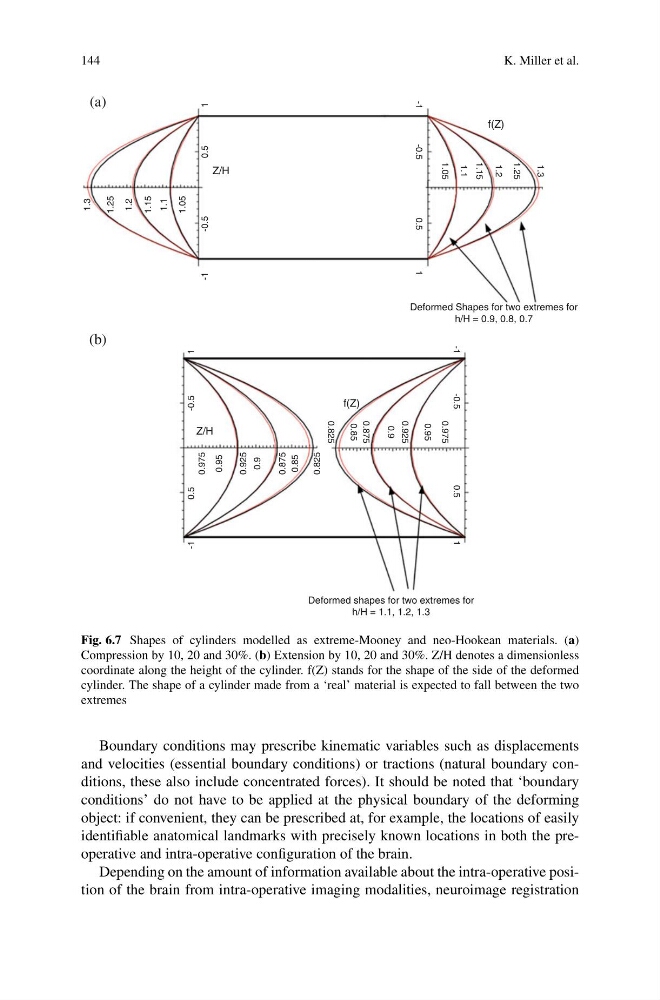
Fig. 6.7 Shapes of cylinders modelled as extreme-Mooney and neo-Hookean materials. (a)
Compression by 10, 20 and 30%. (b) Extension by 10, 20 and 30%. Z/H denotes a dimensionless
coordinate along the height of the cylinder. f(Z) stands for the shape of the side of the deformed
cylinder. The shape of a cylinder made from a ‘real’ material is expected to fall between the two
extremes
Boundary conditions may prescribe kinematic variables such as displacements
and velocities (essential boundary conditions) or tractions (natural boundary conditions, these also include concentrated forces). It should be noted that ‘boundary
conditions’ do not have to be applied at the physical boundary of the deforming
object: if convenient, they can be prescribed at, for example, the locations of easily
identifiable anatomical landmarks with precisely known locations in both the preoperative and intra-operative configuration of the brain.
Depending on the amount of information available about the intra-operative position of the brain from intra-operative imaging modalities, neuroimage registration
K. Miller et al.
Z/H
(a)
(b)
Z/H
f(Z)
Deformed Shapes for two extremes for
h/H = 0.9, 0.8, 0.7
1
0.5
1.3
1.25
1.2
1.15
1.1
1.05
1.3
1.25
1.2
1.15
1.1
1.05
-0.5
-1
1
0.5
-0.5
-1
1
-0.5
0.975
0.95
0.925
0.9
0.875
0.825
0.85
0.975
0.95
0.925
0.9
0.875
0.825
0.85
0.5
-1
1
0.5
-0.5
-1
Deformed shapes for two extremes for
h/H = 1.1, 1.2, 1.3
f(Z)
Fig. 6.7 Shapes of cylinders modelled as extreme-Mooney and neo-Hookean materials. (a)
Compression by 10, 20 and 30%. (b) Extension by 10, 20 and 30%. Z/H denotes a dimensionless
coordinate along the height of the cylinder. f(Z) stands for the shape of the side of the deformed
cylinder. The shape of a cylinder made from a ‘real’ material is expected to fall between the two
extremes
Boundary conditions may prescribe kinematic variables such as displacements
and velocities (essential boundary conditions) or tractions (natural boundary conditions, these also include concentrated forces). It should be noted that ‘boundary
conditions’ do not have to be applied at the physical boundary of the deforming
object: if convenient, they can be prescribed at, for example, the locations of easily
identifiable anatomical landmarks with precisely known locations in both the preoperative and intra-operative configuration of the brain.
Depending on the amount of information available about the intra-operative position of the brain from intra-operative imaging modalities, neuroimage registration