

142
K. Miller et al.
The skull should be included in the model either explicitly or in the form of an
appropriate boundary condition for the brain. As the skull is orders of magnitude
stiffer than the brain tissue, it can be assumed to be rigid. The constraining effects
of the spinal cord on the brain’s rigid body motion can be simulated by constraining
the spinal end of the model.
6.2.3 Loading
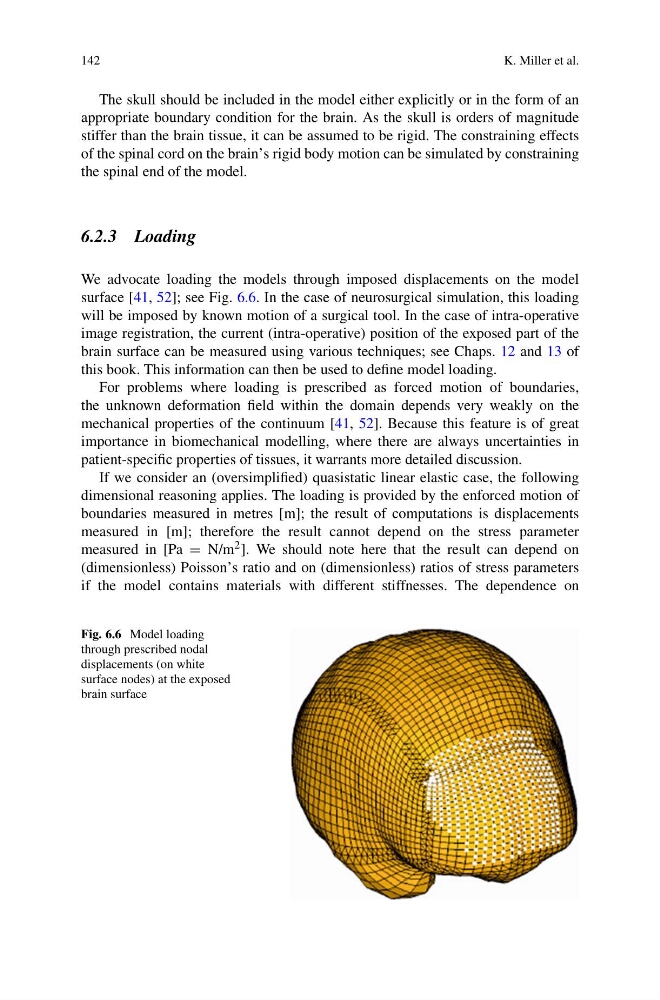
We advocate loading the models through imposed displacements on the model
surface [41, 52]; see Fig. 6.6. In the case of neurosurgical simulation, this loading
will be imposed by known motion of a surgical tool. In the case of intra-operative
image registration, the current (intra-operative) position of the exposed part of the
brain surface can be measured using various techniques; see Chaps. 12 and 13 of
this book. This information can then be used to define model loading.
For problems where loading is prescribed as forced motion of boundaries,
the unknown deformation field within the domain depends very weakly on the
mechanical properties of the continuum [41, 52]. Because this feature is of great
importance in biomechanical modelling, where there are always uncertainties in
patient-specific properties of tissues, it warrants more detailed discussion.
If we consider an (oversimplified) quasistatic linear elastic case, the following
dimensional reasoning applies. The loading is provided by the enforced motion of
boundaries measured in metres [m]; the result of computations is displacements
measured in [m]; therefore the result cannot depend on the stress parameter
measured in [Pa = N/m 2 ]. We should note here that the result can depend on
(dimensionless) Poisson’s ratio and on (dimensionless) ratios of stress parameters
if the model contains materials with different stiffnesses. The dependence on
Fig. 6.6 Model loading
through prescribed nodal
displacements (on white
surface nodes) at the exposed
brain surface
K. Miller et al.
The skull should be included in the model either explicitly or in the form of an
appropriate boundary condition for the brain. As the skull is orders of magnitude
stiffer than the brain tissue, it can be assumed to be rigid. The constraining effects
of the spinal cord on the brain’s rigid body motion can be simulated by constraining
the spinal end of the model.
6.2.3 Loading
We advocate loading the models through imposed displacements on the model
surface [41, 52]; see Fig. 6.6. In the case of neurosurgical simulation, this loading
will be imposed by known motion of a surgical tool. In the case of intra-operative
image registration, the current (intra-operative) position of the exposed part of the
brain surface can be measured using various techniques; see Chaps. 12 and 13 of
this book. This information can then be used to define model loading.
For problems where loading is prescribed as forced motion of boundaries,
the unknown deformation field within the domain depends very weakly on the
mechanical properties of the continuum [41, 52]. Because this feature is of great
importance in biomechanical modelling, where there are always uncertainties in
patient-specific properties of tissues, it warrants more detailed discussion.
If we consider an (oversimplified) quasistatic linear elastic case, the following
dimensional reasoning applies. The loading is provided by the enforced motion of
boundaries measured in metres [m]; the result of computations is displacements
measured in [m]; therefore the result cannot depend on the stress parameter
measured in [Pa = N/m 2 ]. We should note here that the result can depend on
(dimensionless) Poisson’s ratio and on (dimensionless) ratios of stress parameters
if the model contains materials with different stiffnesses. The dependence on
Fig. 6.6 Model loading
through prescribed nodal
displacements (on white
surface nodes) at the exposed
brain surface