

5 Modelling of the Brain for Injury Simulation and Prevention
115
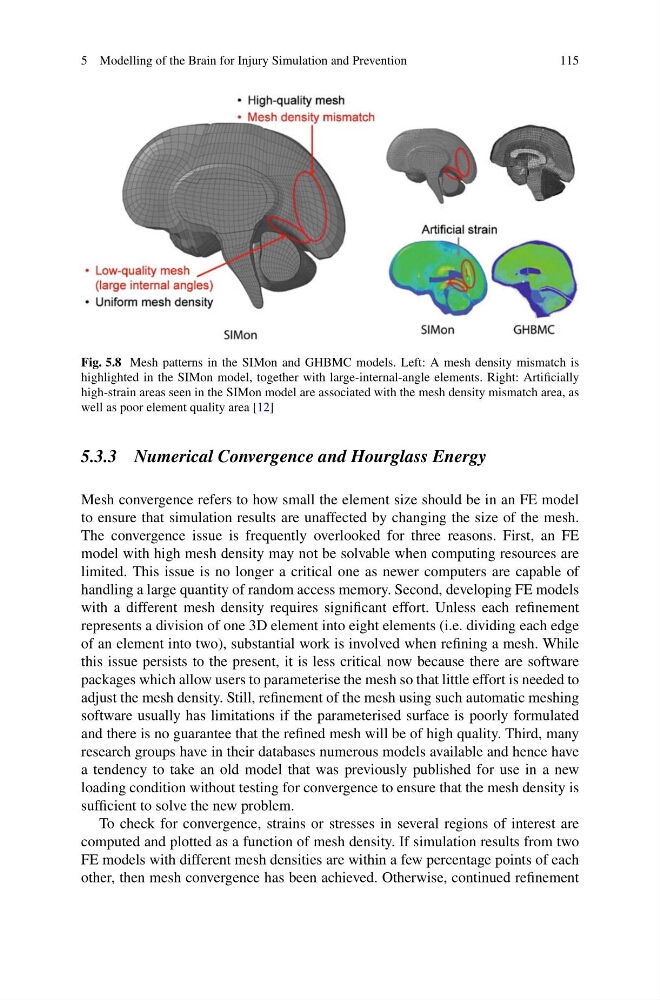
Fig. 5.8 Mesh patterns in the SIMon and GHBMC models. Left: A mesh density mismatch is
highlighted in the SIMon model, together with large-internal-angle elements. Right: Artificially
high-strain areas seen in the SIMon model are associated with the mesh density mismatch area, as
well as poor element quality area [12]
5.3.3 Numerical Convergence and Hourglass Energy
Mesh convergence refers to how small the element size should be in an FE model
to ensure that simulation results are unaffected by changing the size of the mesh.
The convergence issue is frequently overlooked for three reasons. First, an FE
model with high mesh density may not be solvable when computing resources are
limited. This issue is no longer a critical one as newer computers are capable of
handling a large quantity of random access memory. Second, developing FE models
with a different mesh density requires significant effort. Unless each refinement
represents a division of one 3D element into eight elements (i.e. dividing each edge
of an element into two), substantial work is involved when refining a mesh. While
this issue persists to the present, it is less critical now because there are software
packages which allow users to parameterise the mesh so that little effort is needed to
adjust the mesh density. Still, refinement of the mesh using such automatic meshing
software usually has limitations if the parameterised surface is poorly formulated
and there is no guarantee that the refined mesh will be of high quality. Third, many
research groups have in their databases numerous models available and hence have
a tendency to take an old model that was previously published for use in a new
loading condition without testing for convergence to ensure that the mesh density is
sufficient to solve the new problem.
To check for convergence, strains or stresses in several regions of interest are
computed and plotted as a function of mesh density. If simulation results from two
FE models with different mesh densities are within a few percentage points of each
other, then mesh convergence has been achieved. Otherwise, continued refinement
115
Fig. 5.8 Mesh patterns in the SIMon and GHBMC models. Left: A mesh density mismatch is
highlighted in the SIMon model, together with large-internal-angle elements. Right: Artificially
high-strain areas seen in the SIMon model are associated with the mesh density mismatch area, as
well as poor element quality area [12]
5.3.3 Numerical Convergence and Hourglass Energy
Mesh convergence refers to how small the element size should be in an FE model
to ensure that simulation results are unaffected by changing the size of the mesh.
The convergence issue is frequently overlooked for three reasons. First, an FE
model with high mesh density may not be solvable when computing resources are
limited. This issue is no longer a critical one as newer computers are capable of
handling a large quantity of random access memory. Second, developing FE models
with a different mesh density requires significant effort. Unless each refinement
represents a division of one 3D element into eight elements (i.e. dividing each edge
of an element into two), substantial work is involved when refining a mesh. While
this issue persists to the present, it is less critical now because there are software
packages which allow users to parameterise the mesh so that little effort is needed to
adjust the mesh density. Still, refinement of the mesh using such automatic meshing
software usually has limitations if the parameterised surface is poorly formulated
and there is no guarantee that the refined mesh will be of high quality. Third, many
research groups have in their databases numerous models available and hence have
a tendency to take an old model that was previously published for use in a new
loading condition without testing for convergence to ensure that the mesh density is
sufficient to solve the new problem.
To check for convergence, strains or stresses in several regions of interest are
computed and plotted as a function of mesh density. If simulation results from two
FE models with different mesh densities are within a few percentage points of each
other, then mesh convergence has been achieved. Otherwise, continued refinement