

116
K. H. Yang and H. Mao
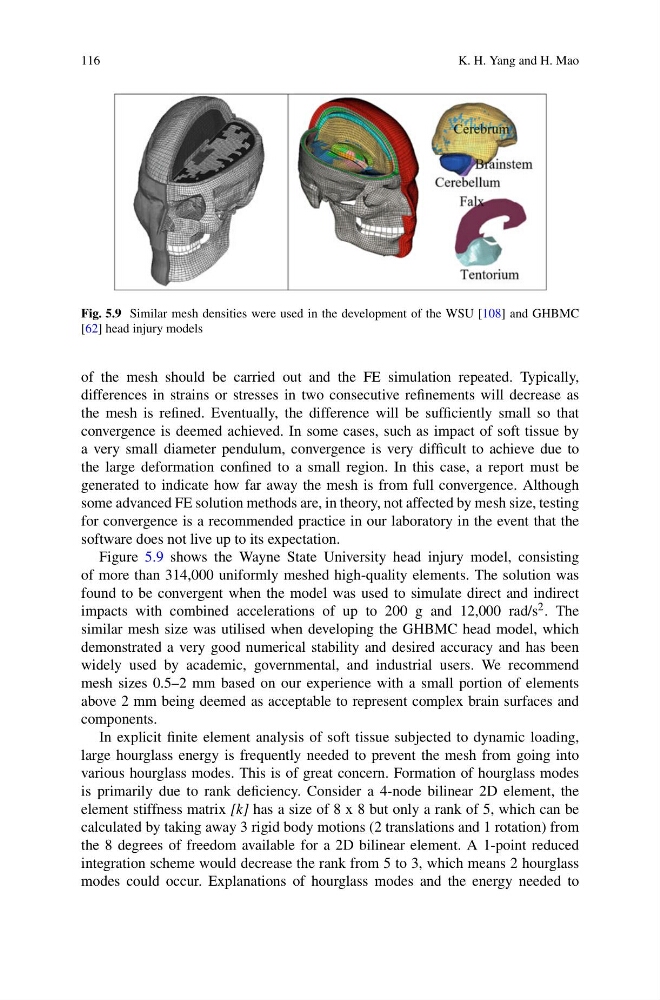
Fig. 5.9 Similar mesh densities were used in the development of the WSU [108] and GHBMC
[62] head injury models
of the mesh should be carried out and the FE simulation repeated. Typically,
differences in strains or stresses in two consecutive refinements will decrease as
the mesh is refined. Eventually, the difference will be sufficiently small so that
convergence is deemed achieved. In some cases, such as impact of soft tissue by
a very small diameter pendulum, convergence is very difficult to achieve due to
the large deformation confined to a small region. In this case, a report must be
generated to indicate how far away the mesh is from full convergence. Although
some advanced FE solution methods are, in theory, not affected by mesh size, testing
for convergence is a recommended practice in our laboratory in the event that the
software does not live up to its expectation.
Figure 5.9 shows the Wayne State University head injury model, consisting
of more than 314,000 uniformly meshed high-quality elements. The solution was
found to be convergent when the model was used to simulate direct and indirect
impacts with combined accelerations of up to 200 g and 12,000 rad/s 2 . The
similar mesh size was utilised when developing the GHBMC head model, which
demonstrated a very good numerical stability and desired accuracy and has been
widely used by academic, governmental, and industrial users. We recommend
mesh sizes 0.5–2 mm based on our experience with a small portion of elements
above 2 mm being deemed as acceptable to represent complex brain surfaces and
components.
In explicit finite element analysis of soft tissue subjected to dynamic loading,
large hourglass energy is frequently needed to prevent the mesh from going into
various hourglass modes. This is of great concern. Formation of hourglass modes
is primarily due to rank deficiency. Consider a 4-node bilinear 2D element, the
element stiffness matrix [k] has a size of 8 x 8 but only a rank of 5, which can be
calculated by taking away 3 rigid body motions (2 translations and 1 rotation) from
the 8 degrees of freedom available for a 2D bilinear element. A 1-point reduced
integration scheme would decrease the rank from 5 to 3, which means 2 hourglass
modes could occur. Explanations of hourglass modes and the energy needed to
K. H. Yang and H. Mao
Fig. 5.9 Similar mesh densities were used in the development of the WSU [108] and GHBMC
[62] head injury models
of the mesh should be carried out and the FE simulation repeated. Typically,
differences in strains or stresses in two consecutive refinements will decrease as
the mesh is refined. Eventually, the difference will be sufficiently small so that
convergence is deemed achieved. In some cases, such as impact of soft tissue by
a very small diameter pendulum, convergence is very difficult to achieve due to
the large deformation confined to a small region. In this case, a report must be
generated to indicate how far away the mesh is from full convergence. Although
some advanced FE solution methods are, in theory, not affected by mesh size, testing
for convergence is a recommended practice in our laboratory in the event that the
software does not live up to its expectation.
Figure 5.9 shows the Wayne State University head injury model, consisting
of more than 314,000 uniformly meshed high-quality elements. The solution was
found to be convergent when the model was used to simulate direct and indirect
impacts with combined accelerations of up to 200 g and 12,000 rad/s 2 . The
similar mesh size was utilised when developing the GHBMC head model, which
demonstrated a very good numerical stability and desired accuracy and has been
widely used by academic, governmental, and industrial users. We recommend
mesh sizes 0.5–2 mm based on our experience with a small portion of elements
above 2 mm being deemed as acceptable to represent complex brain surfaces and
components.
In explicit finite element analysis of soft tissue subjected to dynamic loading,
large hourglass energy is frequently needed to prevent the mesh from going into
various hourglass modes. This is of great concern. Formation of hourglass modes
is primarily due to rank deficiency. Consider a 4-node bilinear 2D element, the
element stiffness matrix [k] has a size of 8 x 8 but only a rank of 5, which can be
calculated by taking away 3 rigid body motions (2 translations and 1 rotation) from
the 8 degrees of freedom available for a 2D bilinear element. A 1-point reduced
integration scheme would decrease the rank from 5 to 3, which means 2 hourglass
modes could occur. Explanations of hourglass modes and the energy needed to