

5 Modelling of the Brain for Injury Simulation and Prevention
113
not practical to use only square- or cube-shaped elements to represent a complex
structure. Thus, isoparametric formulation, based on natural coordinate systems, is
needed to allow for elements with more general shapes. Intuitively, one is led to
believe that a mesh with all elements shaped very closely to their corresponding
parent elements will yield the best solution, and indeed this is the case.
The Jacobian matrix is a function which maps one Euclidean space to another.
The determinant of the Jacobian matrix (often simply called the Jacobian) reports
the maximum variation of an element from the idealised element based on the same
shape functions. Definition for the aspect ratio, warpage, and skew angle varies
slightly depending on the type of elements used [105]. For example, aspect ratio is
defined as the length to width ratio in a triangular or quadrilateral element, as the
ratio of height to square root of opposing face area in a tetrahedral element, or the
ratio of the maximum to minimum distance between opposing faces for a hexahedral
element. Warpage tests the extent of deviation out of the plane formed by the other
three nodes one of same face of a quadrilateral, wedge, or hexahedral element.
The skew angle is generally calculated using an edge bisector method. Although
there are no specific guidelines available, our in-house practice is to have an ideal
minimum Jacobian of 0.7 with a hard limit of 0.4, all internal angles between 45
and 135 degrees, a maximum aspect ratio of 3, and a maximum skew angle of 30
degrees. Additionally, the mesh quality goal for warpage angle, taper, and element
length to thickness ratio shall be less than 20 degrees, 0.5, and 3, respectively, for
2D elements, and the warpage angle and tetra collapse shall be less than 5 degrees
and 0.5, respectively, for 3D elements. The same recommendations for the mesh
quality check have been proposed at the onset of the GHBMC project and have
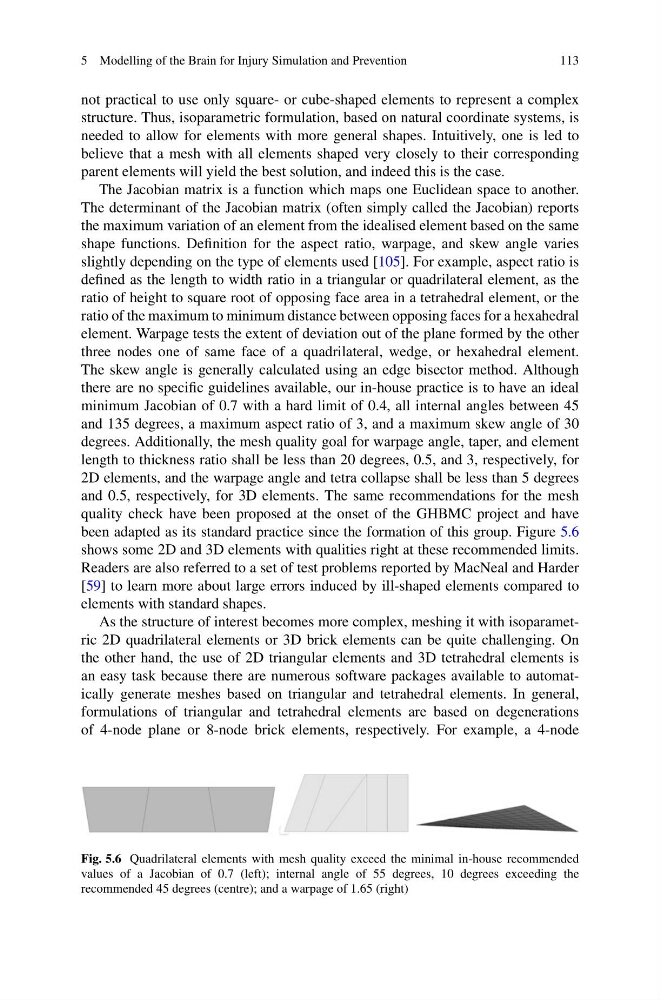
been adapted as its standard practice since the formation of this group. Figure 5.6
shows some 2D and 3D elements with qualities right at these recommended limits.
Readers are also referred to a set of test problems reported by MacNeal and Harder
[59] to learn more about large errors induced by ill-shaped elements compared to
elements with standard shapes.
As the structure of interest becomes more complex, meshing it with isoparametric 2D quadrilateral elements or 3D brick elements can be quite challenging. On
the other hand, the use of 2D triangular elements and 3D tetrahedral elements is
an easy task because there are numerous software packages available to automatically generate meshes based on triangular and tetrahedral elements. In general,
formulations of triangular and tetrahedral elements are based on degenerations
of 4-node plane or 8-node brick elements, respectively. For example, a 4-node
Fig. 5.6 Quadrilateral elements with mesh quality exceed the minimal in-house recommended
values of a Jacobian of 0.7 (left); internal angle of 55 degrees, 10 degrees exceeding the
recommended 45 degrees (centre); and a warpage of 1.65 (right)
113
not practical to use only square- or cube-shaped elements to represent a complex
structure. Thus, isoparametric formulation, based on natural coordinate systems, is
needed to allow for elements with more general shapes. Intuitively, one is led to
believe that a mesh with all elements shaped very closely to their corresponding
parent elements will yield the best solution, and indeed this is the case.
The Jacobian matrix is a function which maps one Euclidean space to another.
The determinant of the Jacobian matrix (often simply called the Jacobian) reports
the maximum variation of an element from the idealised element based on the same
shape functions. Definition for the aspect ratio, warpage, and skew angle varies
slightly depending on the type of elements used [105]. For example, aspect ratio is
defined as the length to width ratio in a triangular or quadrilateral element, as the
ratio of height to square root of opposing face area in a tetrahedral element, or the
ratio of the maximum to minimum distance between opposing faces for a hexahedral
element. Warpage tests the extent of deviation out of the plane formed by the other
three nodes one of same face of a quadrilateral, wedge, or hexahedral element.
The skew angle is generally calculated using an edge bisector method. Although
there are no specific guidelines available, our in-house practice is to have an ideal
minimum Jacobian of 0.7 with a hard limit of 0.4, all internal angles between 45
and 135 degrees, a maximum aspect ratio of 3, and a maximum skew angle of 30
degrees. Additionally, the mesh quality goal for warpage angle, taper, and element
length to thickness ratio shall be less than 20 degrees, 0.5, and 3, respectively, for
2D elements, and the warpage angle and tetra collapse shall be less than 5 degrees
and 0.5, respectively, for 3D elements. The same recommendations for the mesh
quality check have been proposed at the onset of the GHBMC project and have
been adapted as its standard practice since the formation of this group. Figure 5.6
shows some 2D and 3D elements with qualities right at these recommended limits.
Readers are also referred to a set of test problems reported by MacNeal and Harder
[59] to learn more about large errors induced by ill-shaped elements compared to
elements with standard shapes.
As the structure of interest becomes more complex, meshing it with isoparametric 2D quadrilateral elements or 3D brick elements can be quite challenging. On
the other hand, the use of 2D triangular elements and 3D tetrahedral elements is
an easy task because there are numerous software packages available to automatically generate meshes based on triangular and tetrahedral elements. In general,
formulations of triangular and tetrahedral elements are based on degenerations
of 4-node plane or 8-node brick elements, respectively. For example, a 4-node
Fig. 5.6 Quadrilateral elements with mesh quality exceed the minimal in-house recommended
values of a Jacobian of 0.7 (left); internal angle of 55 degrees, 10 degrees exceeding the
recommended 45 degrees (centre); and a warpage of 1.65 (right)