

72
4.2 Material Composition in Waste Electrical and Electronic
Equipment
Waste electrical and electronic equipment (WEEE) is considered one of the fastest
increasing waste deposits and is expected to reach 50 million tonnes by 2018 (Balde
et al. 2015). Waste electrical and electronic equipment (WEEE) can be classified
into the following categories (Zhang and Xu 2016):
1. Air-conditioning equipment
2. Washing machines, dishwashers and cooking devices
3. TV sets and monitors
4. Household devices, information technology and telecommunication equipment
5. Lighting equipment
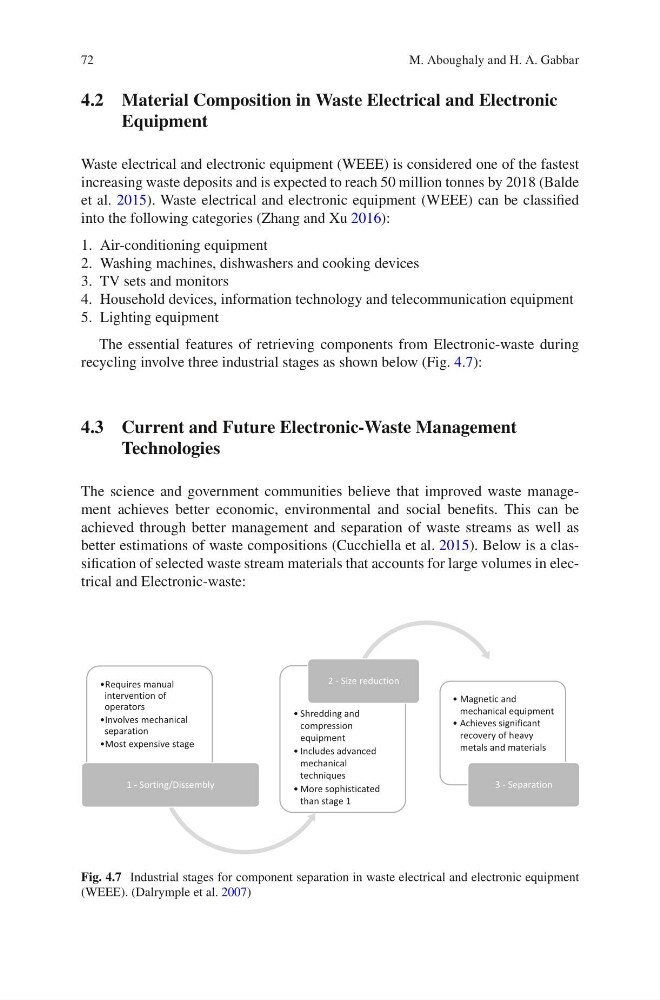
The essential features of retrieving components from Electronic-waste during
recycling involve three industrial stages as shown below (Fig. 4.7):
4.3 Current and Future Electronic-Waste Management
Technologies
The science and government communities believe that improved waste management achieves better economic, environmental and social benefits. This can be
achieved through better management and separation of waste streams as well as
better estimations of waste compositions (Cucchiella et al. 2015). Below is a classification of selected waste stream materials that accounts for large volumes in electrical and Electronic-waste:
•Requires manual
intervention of
operators
•Involves mechanical
separation
•Most expensive stage
1 - Sorting/Dissembly
• Shredding and
compression
equipment
• Includes advanced
mechanical
techniques
• More sophisticated
than stage 1
2 - Size reduction
• Magnetic and
mechanical equipment
• Achieves significant
recovery of heavy
metals and materials
3 - Separation
Fig. 4.7 Industrial stages for component separation in waste electrical and electronic equipment
(WEEE). (Dalrymple et al. 2007)
M. Aboughaly and H. A. Gabbar
4.2 Material Composition in Waste Electrical and Electronic
Equipment
Waste electrical and electronic equipment (WEEE) is considered one of the fastest
increasing waste deposits and is expected to reach 50 million tonnes by 2018 (Balde
et al. 2015). Waste electrical and electronic equipment (WEEE) can be classified
into the following categories (Zhang and Xu 2016):
1. Air-conditioning equipment
2. Washing machines, dishwashers and cooking devices
3. TV sets and monitors
4. Household devices, information technology and telecommunication equipment
5. Lighting equipment
The essential features of retrieving components from Electronic-waste during
recycling involve three industrial stages as shown below (Fig. 4.7):
4.3 Current and Future Electronic-Waste Management
Technologies
The science and government communities believe that improved waste management achieves better economic, environmental and social benefits. This can be
achieved through better management and separation of waste streams as well as
better estimations of waste compositions (Cucchiella et al. 2015). Below is a classification of selected waste stream materials that accounts for large volumes in electrical and Electronic-waste:
•Requires manual
intervention of
operators
•Involves mechanical
separation
•Most expensive stage
1 - Sorting/Dissembly
• Shredding and
compression
equipment
• Includes advanced
mechanical
techniques
• More sophisticated
than stage 1
2 - Size reduction
• Magnetic and
mechanical equipment
• Achieves significant
recovery of heavy
metals and materials
3 - Separation
Fig. 4.7 Industrial stages for component separation in waste electrical and electronic equipment
(WEEE). (Dalrymple et al. 2007)
M. Aboughaly and H. A. Gabbar