

73
4.3.1 Photovoltaic Panels
Photovoltaic panels are considered common electric equipment with an expected
lifespan of 20 years that consists of 90% silicon-based components as well as the
small percentage of key metals such as cadmium, tellurium, indium and gallium
(Drouiche et al. 2014). The economic advantages are never obtained by recyclers and
manufacturers, which motivates them to perform landfilling and incineration practices. Development of more advanced recycling techniques helps to increase recycling up to more than 90%. Both current collection and recycling rates of PV panels
are up to 65% in 2016 (Granata et al. 2014). Also, carbon emissions and energy cost
of recycling photovoltaic panels are relatively low in comparison with other waste
electrical and electronic materials. Most common materials in photovoltaic panels are
crystalline silicon either monocrystalline or polycrystalline, cadmium telluride
(CdTe), amorphous silicon or copper-indium selenide (CIS) (Granata et al. 2014).
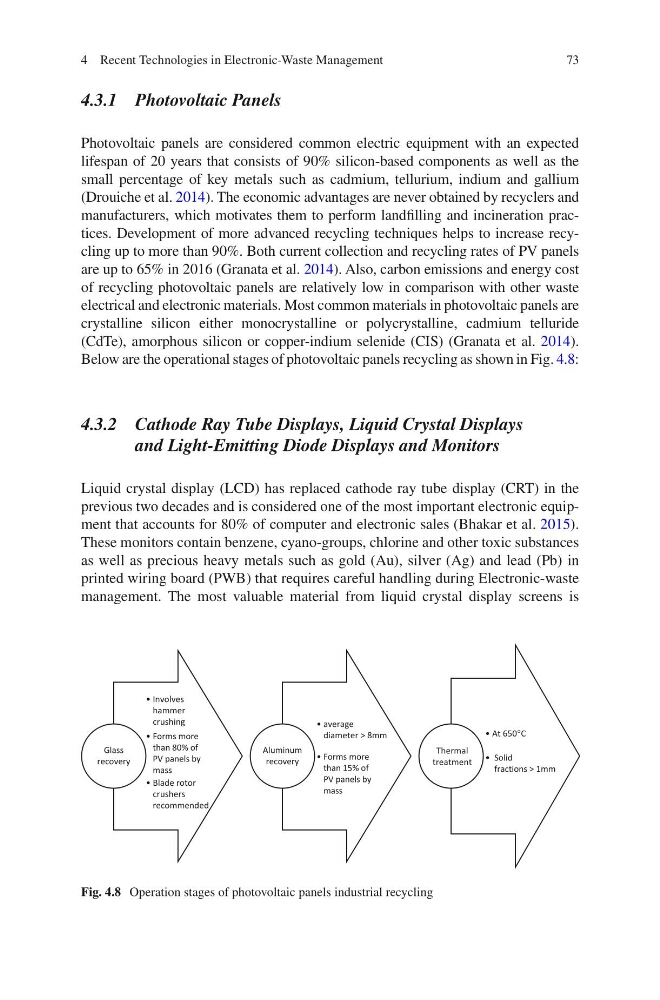
Below are the operational stages of photovoltaic panels recycling as shown in Fig. 4.8:
4.3.2 Cathode Ray Tube Displays, Liquid Crystal Displays
and Light-Emitting Diode Displays and Monitors
Liquid crystal display (LCD) has replaced cathode ray tube display (CRT) in the
previous two decades and is considered one of the most important electronic equipment that accounts for 80% of computer and electronic sales (Bhakar et al. 2015).
These monitors contain benzene, cyano-groups, chlorine and other toxic substances
as well as precious heavy metals such as gold (Au), silver (Ag) and lead (Pb) in
printed wiring board (PWB) that requires careful handling during Electronic-waste
management. The most valuable material from liquid crystal display screens is
• Involves
hammer
crushing
• Forms more
than 80% of
PV panels by
mass
• Blade rotor
crushers
recommended
Glass
recovery
• average
diameter > 8mm
• Forms more
than 15% of
PV panels by
mass
Aluminum
recovery
• At 650°C
• Solid
fractions > 1mm
Thermal
treatment
Fig. 4.8 Operation stages of photovoltaic panels industrial recycling
4 Recent Technologies in Electronic-Waste Management
4.3.1 Photovoltaic Panels
Photovoltaic panels are considered common electric equipment with an expected
lifespan of 20 years that consists of 90% silicon-based components as well as the
small percentage of key metals such as cadmium, tellurium, indium and gallium
(Drouiche et al. 2014). The economic advantages are never obtained by recyclers and
manufacturers, which motivates them to perform landfilling and incineration practices. Development of more advanced recycling techniques helps to increase recycling up to more than 90%. Both current collection and recycling rates of PV panels
are up to 65% in 2016 (Granata et al. 2014). Also, carbon emissions and energy cost
of recycling photovoltaic panels are relatively low in comparison with other waste
electrical and electronic materials. Most common materials in photovoltaic panels are
crystalline silicon either monocrystalline or polycrystalline, cadmium telluride
(CdTe), amorphous silicon or copper-indium selenide (CIS) (Granata et al. 2014).
Below are the operational stages of photovoltaic panels recycling as shown in Fig. 4.8:
4.3.2 Cathode Ray Tube Displays, Liquid Crystal Displays
and Light-Emitting Diode Displays and Monitors
Liquid crystal display (LCD) has replaced cathode ray tube display (CRT) in the
previous two decades and is considered one of the most important electronic equipment that accounts for 80% of computer and electronic sales (Bhakar et al. 2015).
These monitors contain benzene, cyano-groups, chlorine and other toxic substances
as well as precious heavy metals such as gold (Au), silver (Ag) and lead (Pb) in
printed wiring board (PWB) that requires careful handling during Electronic-waste
management. The most valuable material from liquid crystal display screens is
• Involves
hammer
crushing
• Forms more
than 80% of
PV panels by
mass
• Blade rotor
crushers
recommended
Glass
recovery
• average
diameter > 8mm
• Forms more
than 15% of
PV panels by
mass
Aluminum
recovery
• At 650°C
• Solid
fractions > 1mm
Thermal
treatment
Fig. 4.8 Operation stages of photovoltaic panels industrial recycling
4 Recent Technologies in Electronic-Waste Management