

70
4.1.3 Challenges and Influences on Electronic Recycling
The electronic recycling industry faces challenges during different industrial stages
such as collection, chemical analysis, transportation and electronic recycling facilities as follows:
• Smaller wearable electronics are difficult to recycle due to the difficulty of disassembly. This can be solved at the design stage to avoid shredding at the end-oflife processing stage (Ceballos and Dong 2016).
• The high cost of chemical analysis to identify materials in recycling feedstock,
which limits extraction of all useful recyclable materials.
• Lack of environmental regulations to protect the health of employees during
recycling.
• Updating outdated occupational exposure limits for hazardous chemicals present
in recycled electronics.
• Poor emission control in recycling facilities due to the usage of old equipment
and emissions from pyrometallurgical processes (Ceballos and Dong 2016).
4.1.4 The Recycling Hierarchy and Recyclable Markets
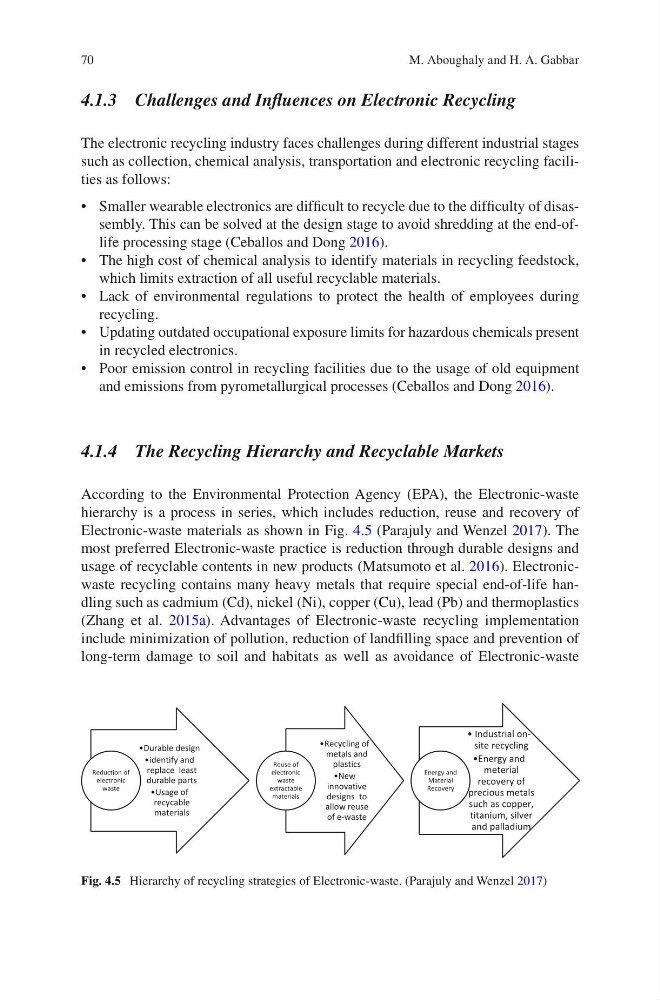
According to the Environmental Protection Agency (EPA), the Electronic-waste
hierarchy is a process in series, which includes reduction, reuse and recovery of
Electronic-waste materials as shown in Fig. 4.5 (Parajuly and Wenzel 2017). The
most preferred Electronic-waste practice is reduction through durable designs and
usage of recyclable contents in new products (Matsumoto et al. 2016). Electronicwaste recycling contains many heavy metals that require special end-of-life handling such as cadmium (Cd), nickel (Ni), copper (Cu), lead (Pb) and thermoplastics
(Zhang et al. 2015a). Advantages of Electronic-waste recycling implementation
include minimization of pollution, reduction of landfilling space and prevention of
long-term damage to soil and habitats as well as avoidance of Electronic-waste
•Durable design
•identify and
replace least
durable parts
•Usage of
recycable
materials
Reduction of
electronic
waste
•Recycling of
metals and
plastics
•New
innovative
designs to
allow reuse
of e-waste
Reuse of
electronic
waste
extractable
materials
• Industrial onsite recycling
•Energy and
meterial
recovery of
precious metals
such as copper,
titanium, silver
and palladium
Energy and
Material
Recovery
Fig. 4.5 Hierarchy of recycling strategies of Electronic-waste. (Parajuly and Wenzel 2017)
M. Aboughaly and H. A. Gabbar
4.1.3 Challenges and Influences on Electronic Recycling
The electronic recycling industry faces challenges during different industrial stages
such as collection, chemical analysis, transportation and electronic recycling facilities as follows:
• Smaller wearable electronics are difficult to recycle due to the difficulty of disassembly. This can be solved at the design stage to avoid shredding at the end-oflife processing stage (Ceballos and Dong 2016).
• The high cost of chemical analysis to identify materials in recycling feedstock,
which limits extraction of all useful recyclable materials.
• Lack of environmental regulations to protect the health of employees during
recycling.
• Updating outdated occupational exposure limits for hazardous chemicals present
in recycled electronics.
• Poor emission control in recycling facilities due to the usage of old equipment
and emissions from pyrometallurgical processes (Ceballos and Dong 2016).
4.1.4 The Recycling Hierarchy and Recyclable Markets
According to the Environmental Protection Agency (EPA), the Electronic-waste
hierarchy is a process in series, which includes reduction, reuse and recovery of
Electronic-waste materials as shown in Fig. 4.5 (Parajuly and Wenzel 2017). The
most preferred Electronic-waste practice is reduction through durable designs and
usage of recyclable contents in new products (Matsumoto et al. 2016). Electronicwaste recycling contains many heavy metals that require special end-of-life handling such as cadmium (Cd), nickel (Ni), copper (Cu), lead (Pb) and thermoplastics
(Zhang et al. 2015a). Advantages of Electronic-waste recycling implementation
include minimization of pollution, reduction of landfilling space and prevention of
long-term damage to soil and habitats as well as avoidance of Electronic-waste
•Durable design
•identify and
replace least
durable parts
•Usage of
recycable
materials
Reduction of
electronic
waste
•Recycling of
metals and
plastics
•New
innovative
designs to
allow reuse
of e-waste
Reuse of
electronic
waste
extractable
materials
• Industrial onsite recycling
•Energy and
meterial
recovery of
precious metals
such as copper,
titanium, silver
and palladium
Energy and
Material
Recovery
Fig. 4.5 Hierarchy of recycling strategies of Electronic-waste. (Parajuly and Wenzel 2017)
M. Aboughaly and H. A. Gabbar