

69
China, India and Pakistan. These illegal recycling practices are motivated by capturing of valuable substances such as copper, iron, silicon, nickel and gold recycling
(Zhang et al. 2012). Currently, approximately 70% of the world’s global Electronicwaste is available in China at approximately 28 million tonnes of Electronic-waste
per annum (Perkins et al. 2014). Below are recommendations for effective industrial
E-waste recycling strategies:
• Effective analysis of Electronic-waste generation including economic and population data to establish a correlation between various factors such as population
density with waste generation and waste recycling per capita (Kumar et al. 2017).
• Analysis of future trend of Electronic-waste systems by the electronic and electrical equipment sales trends and estimated life of electrical and electronic
products.
• Increase the awareness and understanding of recycling including analysis of
Electronic-waste and the importance of recycled materials present in Electronicwaste as well as preserving the environment from hazardous metallic and nonmetallic content.
• Implementation of streamline software and usage of material tracking in production chains for identification of bottleneck in the production chains.
• High-level waste collection recovery implementation in provinces and the prevention of waste exportation to developing countries (Kumar et al. 2017).
• Obtaining accurate waste generation and recycling data considering hidden business information by exporters and importers (Tran and Salhofer 2018).
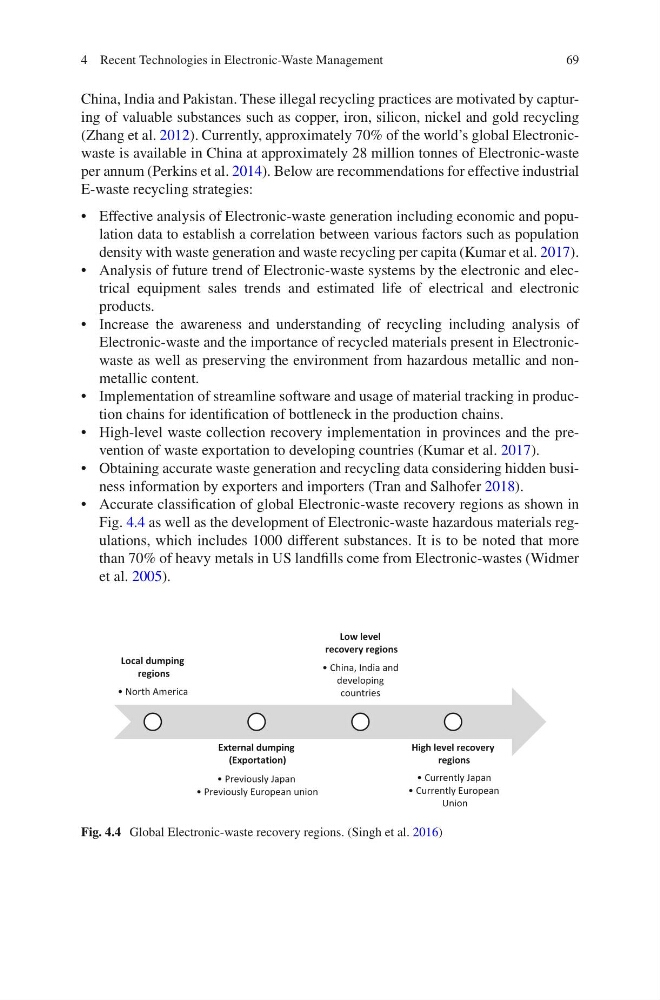
• Accurate classification of global Electronic-waste recovery regions as shown in
Fig. 4.4 as well as the development of Electronic-waste hazardous materials regulations, which includes 1000 different substances. It is to be noted that more
than 70% of heavy metals in US landfills come from Electronic-wastes (Widmer
et al. 2005).
Local dumping
regions
• North America
External dumping
(Exportation)
• Previously Japan
• Previously European union
Low level
recovery regions
• China, India and
developing
countries
High level recovery
regions
• Currently Japan
• Currently European
Union
Fig. 4.4 Global Electronic-waste recovery regions. (Singh et al. 2016)
4 Recent Technologies in Electronic-Waste Management
China, India and Pakistan. These illegal recycling practices are motivated by capturing of valuable substances such as copper, iron, silicon, nickel and gold recycling
(Zhang et al. 2012). Currently, approximately 70% of the world’s global Electronicwaste is available in China at approximately 28 million tonnes of Electronic-waste
per annum (Perkins et al. 2014). Below are recommendations for effective industrial
E-waste recycling strategies:
• Effective analysis of Electronic-waste generation including economic and population data to establish a correlation between various factors such as population
density with waste generation and waste recycling per capita (Kumar et al. 2017).
• Analysis of future trend of Electronic-waste systems by the electronic and electrical equipment sales trends and estimated life of electrical and electronic
products.
• Increase the awareness and understanding of recycling including analysis of
Electronic-waste and the importance of recycled materials present in Electronicwaste as well as preserving the environment from hazardous metallic and nonmetallic content.
• Implementation of streamline software and usage of material tracking in production chains for identification of bottleneck in the production chains.
• High-level waste collection recovery implementation in provinces and the prevention of waste exportation to developing countries (Kumar et al. 2017).
• Obtaining accurate waste generation and recycling data considering hidden business information by exporters and importers (Tran and Salhofer 2018).
• Accurate classification of global Electronic-waste recovery regions as shown in
Fig. 4.4 as well as the development of Electronic-waste hazardous materials regulations, which includes 1000 different substances. It is to be noted that more
than 70% of heavy metals in US landfills come from Electronic-wastes (Widmer
et al. 2005).
Local dumping
regions
• North America
External dumping
(Exportation)
• Previously Japan
• Previously European union
Low level
recovery regions
• China, India and
developing
countries
High level recovery
regions
• Currently Japan
• Currently European
Union
Fig. 4.4 Global Electronic-waste recovery regions. (Singh et al. 2016)
4 Recent Technologies in Electronic-Waste Management