

6
potential environmental impacts on soil and groundwater resulting from leaching of
lead in the funnel glass during recycling of cathode-ray tube. Airborne lead and
particulate matter, leaded wash water and slag, and leaching of lead into the soil and
groundwater could possess a significant public health and contamination of the
stockyard during cathode-ray tube glass-to-glass recycling (Hsiang and Diaz 2011;
Johri et al. 2010). Workers involved with recycling as well as end users of cathoderay tube-recycled products are exposed to health threat from lead used in a cathoderay tube. Even a small amount of lead exposure can damage human’s central nervous
system, circulatory system, and the kidneys and causes learning disabilities in children (Xu et al. 2016). Therefore, some countries highly restrict storage of cathoderay tube waste in stockyards (Milovantseva and Saphores 2013). Besides not only
stockyards and recycling process of a cathode-ray tube but also during transportation of cathode-ray tube glass and transboundary shipment, airborne-related pollution takes place. Air pollution also takes place during secondary lead smelters to
extract lead by heating materials at high temperature. The emitted lead particles also
contaminate soil and surface water as well as hazardous waste resulting from slag
as a by-product.
1.4 Available Technologies for Recycling
of Cathode-Ray Tube
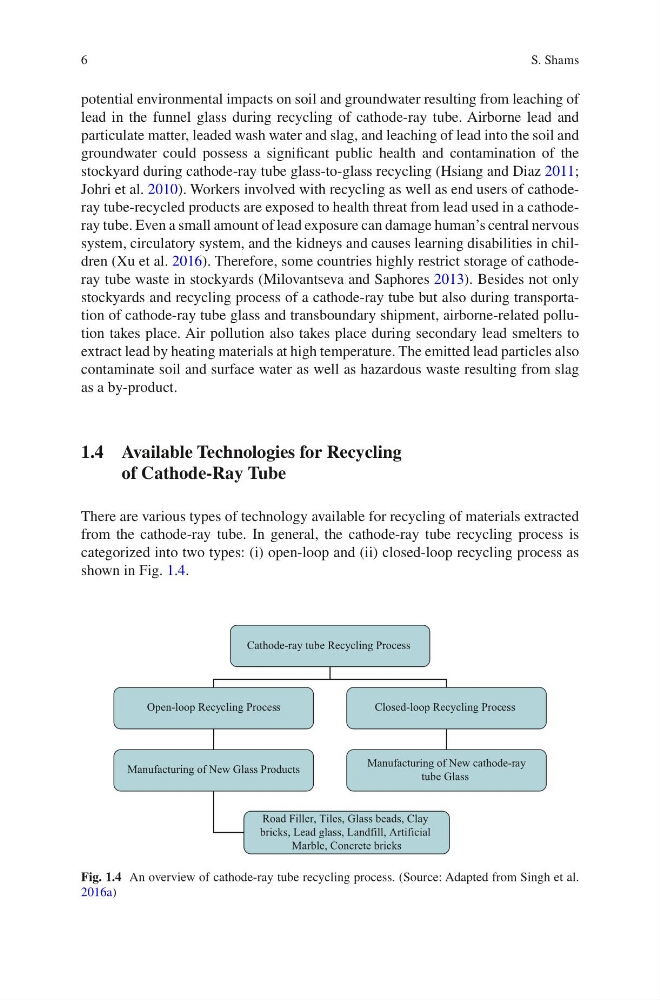
There are various types of technology available for recycling of materials extracted
from the cathode-ray tube. In general, the cathode-ray tube recycling process is
categorized into two types: (i) open-loop and (ii) closed-loop recycling process as
shown in Fig. 1.4.
Cathode-ray tube Recycling Process
Open-loop Recycling Process
Closed-loop Recycling Process
Manufacturing of New Glass Products
Manufacturing of New cathode-ray
tube Glass
Road Filler, Tiles, Glass beads, Clay
bricks, Lead glass, Landfill, Artificial
Marble, Concrete bricks
Fig. 1.4 An overview of cathode-ray tube recycling process. (Source: Adapted from Singh et al.
2016a)
S. Shams
potential environmental impacts on soil and groundwater resulting from leaching of
lead in the funnel glass during recycling of cathode-ray tube. Airborne lead and
particulate matter, leaded wash water and slag, and leaching of lead into the soil and
groundwater could possess a significant public health and contamination of the
stockyard during cathode-ray tube glass-to-glass recycling (Hsiang and Diaz 2011;
Johri et al. 2010). Workers involved with recycling as well as end users of cathoderay tube-recycled products are exposed to health threat from lead used in a cathoderay tube. Even a small amount of lead exposure can damage human’s central nervous
system, circulatory system, and the kidneys and causes learning disabilities in children (Xu et al. 2016). Therefore, some countries highly restrict storage of cathoderay tube waste in stockyards (Milovantseva and Saphores 2013). Besides not only
stockyards and recycling process of a cathode-ray tube but also during transportation of cathode-ray tube glass and transboundary shipment, airborne-related pollution takes place. Air pollution also takes place during secondary lead smelters to
extract lead by heating materials at high temperature. The emitted lead particles also
contaminate soil and surface water as well as hazardous waste resulting from slag
as a by-product.
1.4 Available Technologies for Recycling
of Cathode-Ray Tube
There are various types of technology available for recycling of materials extracted
from the cathode-ray tube. In general, the cathode-ray tube recycling process is
categorized into two types: (i) open-loop and (ii) closed-loop recycling process as
shown in Fig. 1.4.
Cathode-ray tube Recycling Process
Open-loop Recycling Process
Closed-loop Recycling Process
Manufacturing of New Glass Products
Manufacturing of New cathode-ray
tube Glass
Road Filler, Tiles, Glass beads, Clay
bricks, Lead glass, Landfill, Artificial
Marble, Concrete bricks
Fig. 1.4 An overview of cathode-ray tube recycling process. (Source: Adapted from Singh et al.
2016a)
S. Shams